• TalkBass has been independent since 1998. Add your voice.
    Create a free account to reply to discussions, view embedded media, and browse with fewer display ads.
    Join freeLog in
    Want zero display ads or expanded classifieds tools? Compare plans.

Squier Owners Club

Could be my lack of expertise on electronics. I may be under the impression (misguided?) that CTS were better. As for the cable...I do have a better one...but at the time of arrival...this one was on the table...so I grabbed it. I am trying to educate myself...that's why I hang out here.:)
 
There are a couple camps regarding switching out pots... In theory any 250k pot regardless of who made it should sound the same. Some feel different than others, some claim to be more "linear" (I think that's what we're calling it now) in terms of how the tone or volume changes as you turn the knob.
I personally subscribe to the notion that if your pots work and aren't noisy then don't touch them. All that being said, it's just my opinion... Which ain't worth much!
As far as the cord goes, we were just bustin' you a little... All in good fun man!
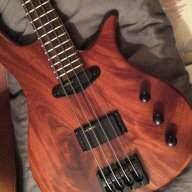
Beautiful bass btw! Love the P/J!
 
I have to say that on single pickup basses, like the P, the volume control probably (stress probably) isn't as critical. But on basses with more than one pickup, where the likelyhood of actually mixing the pickups in varying amounts is high, then volume pots that have a more linear curve are very helpful.

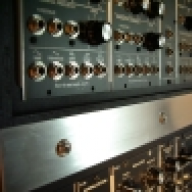
I modified my own VMJ to have independent outputs (one for each pickup). I began to use a modular synth signal mixer for mixing the pickups after I did the 2-channel mod to the bass. Using the synth mixer, I immediately noticed FAR better control over the pickup mix after I did the mod and used something other than the stock Squier volume pots for dealing with pickup mixing. I can only imagine that using better quality pots would have something close to the same results. I have no personal experience with the "CTS" pots, but if they are even a little better than what was installed on the bass from the factory it has to be an improvement.

I did, however, change the pots to Alpha 250k pots (some I had kicking around for amplifiers) and that seemed to be an improvement over the stock ~stuffs~. It's like the operational curve of the stock ones is far too logarithmic, meaning ~nothing~ seems to happen until the last 20% of the sweep is used, at which point there is a large change making the volume controls very touchy.

On a side note, I'm glad that I did the 2 channel mods for many reasons, but I never thought that getting a better pickup mix with greater ease would be one of them.
 
Jweber76, pots are of 2 varieties: linear and audio. Linear drops the resistance in a straight line over the rotation. Audio drops resistance in a curve.
Like this: I (
Actually there are more than two curves, for the most part three are used in most constructs. Log ~aka "audio"~ (which look like a "ski jump"), linear (which is pretty much a straight line from zero to max), and reverse log which climbs very quickly then has a mellow trail off.

Log ("audio") pots are usually called "A" curves.

Linear pots are usually called "B" curves.

Reverse Log are usually called "C" curves.

Hence, you see references to pots such as "A250k" or "B100K" and so on.

:)
 
So...is there anyway to figure out if mine are linear or audio??
The best way is to plot out the resistance, making a hand drawn graph of what the actual resistance is at even points along the sweep, using the standard "clock" positioning. For instance...

7: = 0 ohms.

8: = 10k.

9: = 20k.

10: = 50k.

And so on. If there is a large rise near the end of the sweep, like the last three or four "hours" then you have a LOG ("audio") pot. If the readings stay very constant all the way through the sweep, you have a LINEAR pot. Experienced techs/modders/DIYers can tell usually just by observing how the ohmmeter responds to turning the knob, but if this isn't your strongest suit, just plot it out, it doesn't take long (five minutes maybe?)

The human hearing ensemble (ears, brain, and psyche) will fool the heck out of you sometimes, so simply saying that if the sound gets loud really quickly at the end of the sweep promises that you have LOG ("audio") pots is not necessarily true. Depending on certain circuits, even a linear pot can be PERCEIVED as logarithmically curved. The only certain method is through measurement.

Or, you can spend $2.50 on a linear pot and do the "try and see if there is a difference" method.
 
brainfreeze.jpg
 
Sorry if this question has been posted here millions of times already. I would like to swap out the white pickguard on my affinity P bass but everyone I have contacted wants me to send a tracing and do a custom cut. Mine has 13 holes, so I was wondering if a standard p bass pickguard with 13 holes would fit? Anyone here had any experiences with replacing an affinity pickguard? Dumb question I know. I am trying to replace it without spending more for it than I did the bass itself.
 
Replacing a PG on an Affiniy without extra work to get it to fit can be hit or miss. If you're lucky, you may be able to get it to fit with maybe only having to re-drill one or two of the holes in the body. Then again, you may have to redrill most, if not all of the holes, and even may have to reshape the cutout of the neck pocket. You won't know for sure until you get a PG and try it out. The only way to be absolutely sure is to get a custom fit.
 
Replacing a PG on an Affiniy without extra work to get it to fit can be hit or miss. If you're lucky, you may be able to get it to fit with maybe only having to re-drill one or two of the holes in the body. Then again, you may have to redrill most, if not all of the holes, and even may have to reshape the cutout of the neck pocket. You won't know for sure until you get a PG and try it out. The only way to be absolutely sure is to get a custom fit.

Not wanting to pay more for the PG than I did the bass, perhaps I will try spray painting it or just living with the tuxedo look.
 
C. Linton is right on here. Totally hit or miss. I put a vintage fender repop pg on my 2000 affinity and had to toothpick or re drill everything as well as alter the pickup opening and around the neck! What a pain! I grabbed an allparts (I think) guard from gc for my other affinity, which is a couple years newer, and it matched right up!
It was down to the basses though as the two stock white pgs, while looking almost the same, were not interchangeable either.
IMAG1021-1.jpg
 
When I put my squier (2007 model from indonesia) and my MIM P bass next to each other the PGs look the same. Same number of screw holes and the neck pockets look to match up. One of these days I will get one and see if it fits.

While I can feel the difference in materials between my two P basses, I am amazed at how well the squier plays and sounds.
 
Hi there, here is a video I recently made, demoing the Devi Ever Hyperion Fuzz. I`m using my Squier P bass Matt Freeman Sig loaded with Dimarzio pups. I own another MF P Bass, the vintage white, that one is loaded with Basslines SPB-3

Excellent instruments, I gig them A LOT.

 
Hello....I just purchased a used Vintage Modified Jazz 70 but it didn't come with the Truss Rod adjustment tool. Can anyone help me out with the correct size tool i need to get for this. Love this bass(!!!!!) but i have a bit of a forward bow i would like to straighten out as the action is a tad high for me at present. Thanks!!