• TalkBass has been independent since 1998. Add your voice.
    Create a free account to reply to discussions, view embedded media, and browse with fewer display ads.
    Join freeLog in
    Want zero display ads or expanded classifieds tools? Compare plans.

Squier Owners Club

My experience with basswood is...

I picked up a cheapy p bass copy to refinish, it was basswood. The wood was so soft that just sanding it with a medium grit sandpaper started eating awy at the wood, I ended up throwing it away.

This got me to thinking that even a simple thing like a bridge change could strip out the holes because of the softness of the wood. I also used to have an Ibanez with a basswood body and the bridge started to lift of for the same reason (soft wood).

Sooo.... No More Basswood For Me

 
I wouldn't worry. I have a twenty year old basswood Squier 5 string where the bridge is actually bent up a bit at the tailpiece but the bending stops right at the screw line. You can insert a business card under the tail block and yet the screws hold. Of course other than that detail, the bridge works fine. It all comes down to how well they assembled it, if they over tightened the screws or not, chewing up the wood. Before you buy you can have the "tech" at the store check it out for you. After all it's your money.I'll add that QC on these new Squires seems pretty high and consistency of product as well.

As for sanding a finish off, I would never do that, I would use a chemical stripper and only prep sand the wood. Over zealous sanding of even ash or maple will still ruin an otherwise nearly perfectly flat wood surface.

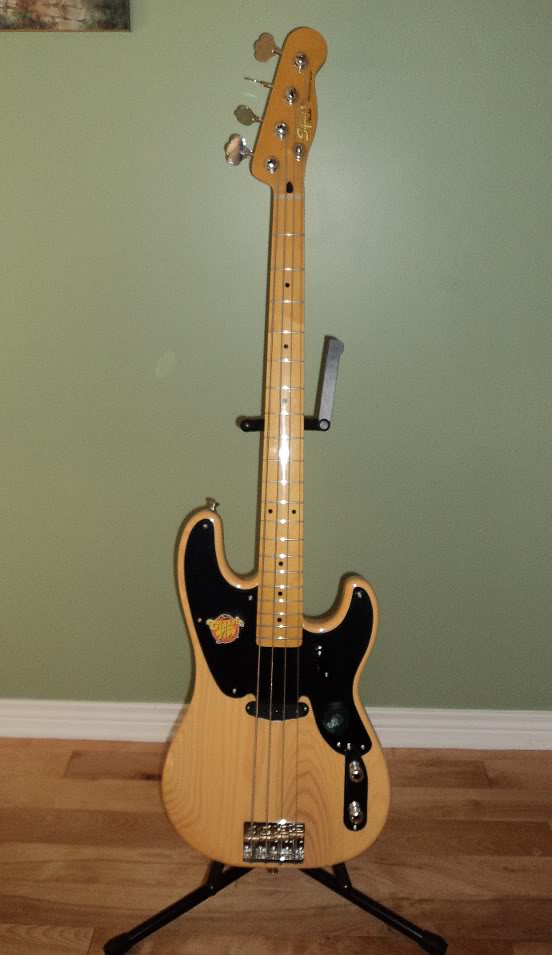
But do what you like, Oh and the CV 50's blonde P is pine, extremely soft wood. It'll ding easily but I'm not worried about the bridge, I checked it before buying. All you need to do is give it a twist with a screwdriver and make sure they are snug and don't spin in their holes. You can also harden the hole threads with ca glue if you ever take the bridge off.

EDIT: I've attached a pic to show how the bend stopped at the screw line. That's a piece of card shoved as far in as it will go. The tail block is about 1/2" thick and the bend is where the thin plate begins. The tension of the five strings has, over time, bent it up. The HM bridge is now low mass! Hey SurferJoe, you know, it sounds better now!;):D
 

Attachments

  • IMGP2231.jpg
    IMGP2231.jpg
    38.5 KB · Views: 62
Look - wood is important to the extent that it be sufficient to hold the neck (you wouldn't want it to fall off - right?) and then again the bridge mounting must be sufficient to stand the tension of the strings.

In all the situations that I've had in building a couple of basses with some very undesirable woods, I've not had any troubles at all.

One in particular was a body from Guitar Fetish that in my eyes ranked a couple of steps below balsa for hardness and (I also thought) it's ability to hold a screw - ANY screw.

Not only did it work well, it is a great player and although it requires some thoughts about using it as a weapon in a bar fight (I'd rather use something more substantial - Smith & Wesson comes to mind) - the wood has given me absolutely NO troubles, nor has the neck NOR the bridge fallen off yet.

And all this angst about wood and it's relative hardness and hardiness, kinda amazes me.

NOW - that said ---- if you sand any wood without a sanding block, then fer sure you're gonna notch the wood where the grain is softer and the scalloping will be obvious and quite frankly, I think if anyone does that, they don't have much insight into the nature of wood and the correct way to work with it.

Wood ain't aluminum, and it needs a little finesse and technique to get the surface and finish you want from it.

So don't let your bad experience with a soft wood befoul your attitude and forever poison the waters for you.

Somehow I feel that you really meant that you couldn't get the wood to a good surface and you therefor diss'd soft woods - right?

It was maybe just bad sanding technique, not necessarily bad wood.
 
People put WAYYYY too much emphasis on what kind of wood is used. I know people have their preferences, but I've played ply (laminated) wood instruments that were killer.

I'm not saying there aren't differences, but I've refinished tons of guitars and basses including pine and basswood bodies and never had a problem.

Heck, the earliest Telecaster guitars were made of pine and are some of the most valuable, highly sought after electric instruments in existence.
 
Fantastic! Your intonation looks kinda funny to me. I usually see it the other way around, as in the E is farthest away from the nut, and the rest sloping closer. Just curious, anyone else have observations on this subject?

Yeah, you are correct. That's how I got it from the store. But plays like butta and intonation is spot on. Actually I played the 3 had there and that one was the best one in terms of play-ability.
 
My experience with basswood is...

I picked up a cheapy p bass copy to refinish, it was basswood. The wood was so soft that just sanding it with a medium grit sandpaper started eating awy at the wood, I ended up throwing it away.

This got me to thinking that even a simple thing like a bridge change could strip out the holes because of the softness of the wood. I also used to have an Ibanez with a basswood body and the bridge started to lift of for the same reason (soft wood).

Sooo.... No More Basswood For Me

You may be selling it short. Basswood may be a little softer wood than the alder that Fender uses on the MIA models but it's a better tonewood for guitars and basses due to it's resonance and sustain. It's also more plentiful globally which would tend to make it less expensive.

I own a basswood body CV 60's Jazz and it's one of the best basses I've ever owned and certainly the best bargain.
 
My experience with basswood is...

I picked up a cheapy p bass copy to refinish, it was basswood. The wood was so soft that just sanding it with a medium grit sandpaper started eating awy at the wood, I ended up throwing it away.

No offense meant, but how do you know that body was basswood?

This got me to thinking that even a simple thing like a bridge change could strip out the holes because of the softness of the wood. I also used to have an Ibanez with a basswood body and the bridge started to lift of for the same reason (soft wood).

Sooo.... No More Basswood For Me

And again, how do you know the bridge problem was because of the wood, and not something else?

Not trying to flame, just curious.