• TalkBass has been independent since 1998. Add your voice.
    Create a free account to reply to discussions, view embedded media, and browse with fewer display ads.
    Join freeLog in
    Want zero display ads or expanded classifieds tools? Compare plans.

Stabilizing body crack - Fender Musicmaster

Why not "even" up the crack with a thin saw blade and then fit a piece of veneer into that space.

And do it in a contrasting color - sort of like kintsugi.

IMG_3589.jpg
 
Have you tried clamps to see if one would close the gap? It looks like the wing warped "down" away from the face of the bass, so a clamp and glue would de- warp it. What does a straight edge across the body tell you? A good pipe clamp and some blocks to keep the clamp from damaging the wood should do it. Just make sure the crack is clean and you use so super strong wood glue and you let it set. I have repaired a couple of stools that had separated and warped seats this way and they have held for 5 years so far.

At worst case, you could take everything off the body and steam the warp out, but it you have to go that far you probably should just go to epoxy wood filler.
 
Just to follow on my earlier question. If the wood is dry and stable as-is (that is, the crack is not actively growing, right now), you don't need to stabilize it. It's stable. Adding glue or anything into the crack will not really add anything to an already stable crack.

If the wood is not stable, and the pieces are continuing to change dimension, and the crack is continuing to grow over time, dripping glue into the crack won't change that.

Think of it this way. Go pick up a 1 7/8" thick board, and try to pull it apart. You can't. Wood is really strong, even in it's weakest dimension. The forces it exerts on itself in order to cause a crack like this are monumental. It's easy to underestimate that. A proper glue bond on STABLE wood can be very strong, but it's extremely difficult to fully stabilize a board that wants to crack. Which is why we let green wood dry before using it, and then work around the stable, dry shape. Let me repeat myself though: dripping glue into the crack is not going to stop a board that wants to split from splitting. Especially since this is a split on an already glued seam, so you're essentially fighting an uphill battle against the existing glue residue.

If I were in your shoes, I would leave it as-is. It looks good as part of a relic style instrument. And it helps tell the story of the bass's life. I know we often want perfect looking instruments, but sometimes the damage tells a story, and I think that's important as well.

If the wood continues to move, let it move until it stops. If it threatens the structural integrity of the instrument, we can walk you through a legitimate structural repair. If you decide you want to make the bass shiny and perfect again, we can walk you through an aesthetic repair. But don't try to fight wood if it's still moving.
 
Since you don't seem too particular about the repair job and your main concern is to stabilize the crack...............I personally would use some polyurethane glue. It expands and will bond both sides of the crack.

The challenge will be working the glue deeply and evenly into the crack.

Which I think can be done by using a very thin piece of sheet brass or the thinnest steel feeler gauge to spread the glue inside the crack.

It will then expand, fill in the crack and bond it together.

Tape off around the crack with masking tape and keep an eye on it constantly wiping it down as it will keep expanding out the crack until the glue starts to set up.

The instructions on the bottle will explain what you can wipe it with.

Should do the trick.

The Truth About Polyurethane Glue | Popular Woodworking Magazine

original_gorilla_glue_white_bg_v2.jpg
61tDfpsDqEL._AC_SS350_.jpg
 
Last edited:
Urethane glues like that Gorilla Glue will absolutely foam up and fill in the crack, but they have extremely poor strength in loose fitting joints like this. They also work poorly in wood that's contaminated (which we know is the case here since the body is splitting along a seam), and they need time to tack off before the joint is assembled in order to develop good strength - which you can't easily do when trying to fix a crack like this.
 
I do alot of woodworking (furniture, not instruments) and have dealt with more than my share of cracks. Lots of advice here, some good, others not so much. If it is truly stable (ie. the crack does not widen with moderate pressure to pry it apart) then I would use a 2-part epoxy to fill the crack. Wood glue and Cyanoacrylate (super glue) are effective at bonding two pieces of wood together, but not filling a void. If the crack shows movement, I would be looking at wood glue, super glue (gel) or a slow-set epoxy and clamps to pull the crack together. I would not do the wood wedge thing - that would just drive the crack open and expand it. To summarize, if its stable, fill it with epoxy (stuff is like iron when dry); if its not, use large bar clamps and glue to close it up. Let it dry for 24 hrs, then scrape off any glue that squeezes out. You do the same thing with epoxy, overfill the crack a bit, let it harden completely, then scrape/sand it flat.
 
Urethane glues like that Gorilla Glue will absolutely foam up and fill in the crack, but they have extremely poor strength in loose fitting joints like this. They also work poorly in wood that's contaminated (which we know is the case here since the body is splitting along a seam), and they need time to tack off before the joint is assembled in order to develop good strength - which you can't easily do when trying to fix a crack like this.

The web link in my post showed that the bond strength of urethane glue is very close to the same as Titebond.

The glue instructions for Gorilla Glue recommend some slight moisture on the 2 edges. That'll give adherence.

In our house, we had some terrible squeaking and creeking wooden stair steps down to the basement. Horrible noisy. Larger wood cracks in the steps than on that bass body.

Gorilla Urethane Glue fixed the stair steps and they have been solid as a rock for over 12 years. Noise gone.

This crack stopping on the bass body is not fixing a Stradivarius or something. It's a very heavily reliced and ugly bass body to say the least, of little value. All the guy wants to do is stabilize the crack. Urethane, epoxy or Titebond will do it. I'd even think that Titebond with some kind of paper sliver to fill in the gap will stop farther cracking.

It's not a collectable vintage bass body! With all due respect.
 
Last edited:
  • Like
Reactions: GroovyBaby
The web link in my post showed that the bond strength of urethane glue is very close to the same as Titebond.

Close to Titebond when applied correctly - a tight fitting clean uncontaminated seam that's been slightly moistened. There are all kinds of "which glue is best at X" studies on the web that confirm that urethane glue has horrible strength when used to fill gaps - you can find them if you don't believe me. Or just do a test yourself. Urethane glue is deceptive - it'll foam right up and fill a crack but the foam is incredibly weak. The good news is that there are plenty of other options for repairing this that WILL have good bond strength. And will be easier to hide visually if that's desirable. I'm not here to start an argument, just sharing information. I've gone through gallons of urethane glue on other projects and appreciate what it's good at, but I don't think this is an application it is good at. I don't really think it has any place in luthiery since there are other glues that are better suited to most instrument building and repair tasks (good PVA, epoxy, and CA mostly).

I agree with you that this bass is heavily reliced and not a Stradivarius!
 
Y'all really like your fenders around here, with that much damage I wouldn't make the effort of fixing it ....I would justView attachment 4128126Its a jazzmaster , really
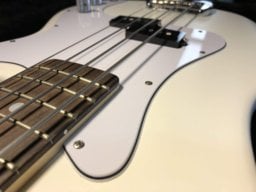
Well, this is probably the only vintage Fender I'll own (it was free) and fixing it up has been a great learning experience, especially the refret. The value is mostly in what I'm learning. If it plays and sounds nice in the end, which I hope, I'll be even happier!
 
  • Like
Reactions: dwizum