• TalkBass has been independent since 1998. Add your voice.
    Create a free account to reply to discussions, view embedded media, and browse with fewer display ads.
    Join freeLog in
    Want zero display ads or expanded classifieds tools? Compare plans.

Stabilizing body crack - Fender Musicmaster

GroovyBaby

He stole my mojo!
Supporting Member
Oct 19, 2007
1,877
2,636
Huntingdon, PA
This Fender Musicmaster I have come into sat but down in water at one point causing a separation in the wood pieces that are joined in the body. I'm keeping this bass rather roadworn looking, so I'm not looking to close the crack, just make sure it doesn't spread. I suspect it has not moved in a long time but am not sure. Based on suggestions I received in this thread...
197X Fender Musicmaster "restoration"
...my current plan is to simply drip super thin super glue down into the crack with the but up so that it seeps into the origin of the separation. After that, I'm thinking of doing the same with wood glue. I was advised in the thread above to seek advice in this forum. What say you, wise ones?
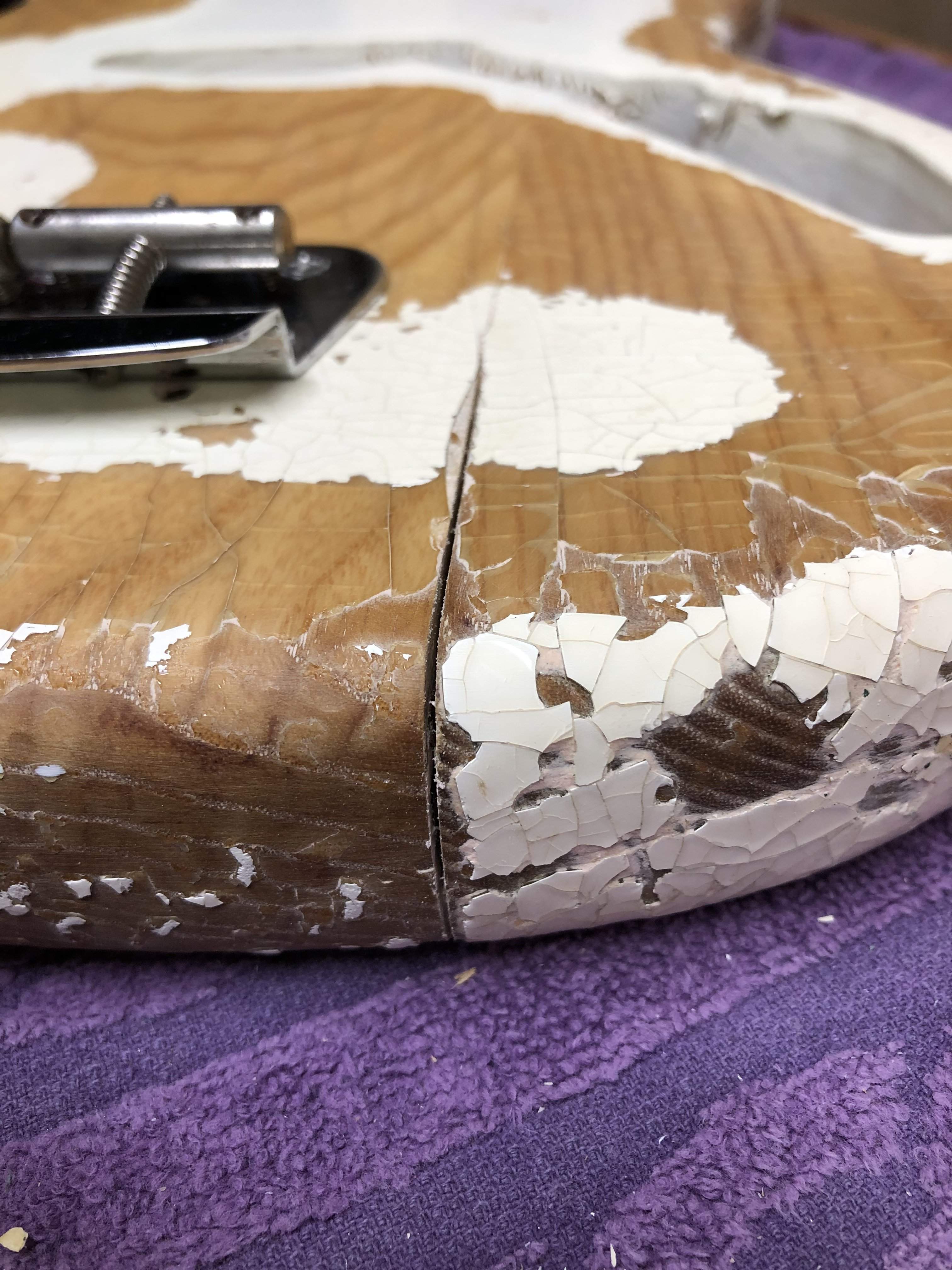
EF8E0E5D-E813-4B5C-9D51-C493A71738C8.jpeg


it is not very visible from the back...

KEpdXQMPSVudoEd+c4tRyg.jpg
 
Personally I would fix it properly (long explanation) but my second choice would be to leave it as is in case somewhere down the road someone wishes to have it fixed right (it's harder and more expensive to repair a repair).
Properly would mean what? Given that the wood absorbed water and warped, I believe properly would be opening up that seem all th way, planning both sides, and glueing them back together. Is that what you mean?
 
How long ago did the instrument get wet, and for how long was it in contact with water? If the instrument sat in water for any significant length of time, it can take a very long time (months or years) to come back to equilibrium. It's important to be aware of that because the crack likely won't be stable until the wood is at a normal moisture content all the way through.
 
How long ago did the instrument get wet, and for how long was it in contact with water? If the instrument sat in water for any significant length of time, it can take a very long time (months or years) to come back to equilibrium. It's important to be aware of that because the crack likely won't be stable until the wood is at a normal moisture content all the way through.
The history of the bass and crack is a little vague. It was moved around and sat in various basements for a couple of decades unplayed. I believe the damage is at least 5 years old, maybe more than 10 based on what I know of the history.
 
Opening it with a saw means you create a step down in the crack that will remain visible. If this is going to stay a relic, you just need to make it playable. :thumbsup:
True. I was thinking that it would mostly look like grain. At least on the top section. I would probably then apply a light coat of satin over the entire body. That would seal and protect/preserve it.
 
CA and wood glue both rely on having a very thin glue bond to have good strength - If you can clamp the thing and close up the crack, one of those might work. Epoxy would be a better choice if you can't close the crack up with clamps - it can have decent strength in a wider crack like that. Or just play it like it is.
 
CA and wood glue both rely on having a very thin glue bond to have good strength - If you can clamp the thing and close up the crack, one of those might work. Epoxy would be a better choice if you can't close the crack up with clamps - it can have decent strength in a wider crack like that. Or just play it like it is.

Yeah, since the OP said he didn't want to close the gap, shooting some epoxy down into the crack with a syringe and large bore needle would be my approach.
 
  • Like
Reactions: GroovyBaby
It's hard to say without seeing it in person. I'd be tempted to leave it as is a few more months to a year now that it's in your climate controlled, caring custody. If it isn't moving at all then go ahead. But sometimes seeing it in person you can tell it's dry and just ready to stabilize.
Once you're ready to go ahead:
If the body doesn't clamp back together, but you don't want to remove the weathered edges of the crack and inset a new piece of matching wood, another option is filling the gap with epoxy.
Some people will be offended to see epoxy used this way but it works well and won't shrink. Gluing another piece of wood in there may not actually look better, and in fact if someone were to wish they had that in the future they could simply route out the epoxy along with the weathered inside edges of that crack to insert the new piece of wood as before.

I could argue for and against the method but it's one I think could work well for you here. Clear epoxy in that crack could maybe even be done slightly shallow so the crack is still pretty visible along with the other wear.


If you go epoxy do not leave the painters tape on while the epoxy sets :roflmao:
 
  • Like
Reactions: GroovyBaby
My opinion would be to hand plane or block sand a piece of veneer (doesn't really matter what species but may as well be maple or birch) to a taper so that it fills as much of the space as possible and glue it in with wood glue. If you put super glue in their first, you'll never be able to use wood glue in there because it will seal the pores. Wood glue needs to be able to penetrate the pores to some degree. Pretty easy repair, and it will also prevent it from getting worse. If it's been out of the water for some time it is almost assuredly dry by now. The crack itself has aided the egress of moisture.
 
  • Like
Reactions: GroovyBaby

Latest posts