• TalkBass has been independent since 1998. Add your voice.
    Create a free account to reply to discussions, view embedded media, and browse with fewer display ads.
    Join freeLog in
    Want zero display ads or expanded classifieds tools? Compare plans.

Stacked pots for P/J pickup config

Apr 10, 2018
174
436
So I recently posted about buying an old Squier 5-string P-Bass, which I'm going to convert from J/J (I know, this confuses everyone) to P/J. But I also want to change out the controls.

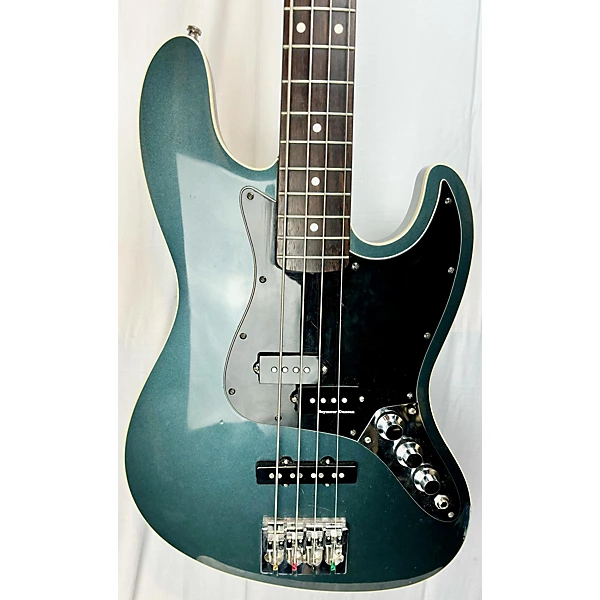
Currrently it has a master tone, a master volume, and a pickup blend knob. Ideally, I'd like to change this out for a stacked volume/tone pot for each pickup, as I have that config on my Squier Paranormal Jazz bass and I love the tonal flexibility it offers. They'd be passive pickups (either Nordstrand or Bartolini, probably, I haven't decided yet), and from the skim-reading online it sounds like pots for P pickups are usually 500K, and 250K for Js.

Is that correct, and if so, are there any recommendations on good stacked pots to buy?
 
I just replaced the stock Squier stacked pots on my CV Jag (J/J conversion) to the Fender CTS stacked pots. The Squier pots are 250K/250K and the CTS stacked are 250K/500K. I couldn't find any CTS 250K/250K pots, but I believe AllParts has Alpha (?) stacked that are 250K/250K.

There are some threads on TB about using a 500K resistor in parallel on the 500K pot to drop it to 250K. I thought about it, but I have no complaints about how things sound as-is.

I did do the 15K ohm resistor thing with the pots to make the tone controls more isolated from one another. That definitely works, although I would not be able to tell you, blind, which one was rolled off. However, I swapped out the usual .47uF cap on the bridge pickup tone control for a .22uF, which to my ear makes a little more distinct difference.

I know that rambled off your original question. Sorry for zigging and zagging.

Edited to add: The Squier stacked knobs are too large for the CTS shafts. I had to get AllParts knobs, which fit exactly.

:D
 
  • Like
Reactions: Bortron
If you like having more control over tone shaping you might want to consider a VVT. You already have the holes to do it and there are plenty of diagrams to follow.
If you have your heart set on the double double stack, you will need something to fill the extra hole. Perhaps a pilot light that is on when you are plugged in, or maybe a producer switch. Of the two, a producer switch would be the simplest most effective option. :smug:
 
Well I'll be needing a new pickguard in any case, to change from J to P at the neck, so the extra hole can disappear anyway. I figure if I'm needing a new pickguard, I might as well get the exact control configuration I want at the same time!

I did consider VVT, but I like the ability to have say full volume neck with tone up, with a touch of bridge with tone down. Having independent tone controls on my Paranormal Jazz '54 really allows for some crazy combos that work really nicely!
 
I just replaced the stock Squier stacked pots on my CV Jag (J/J conversion) to the Fender CTS stacked pots. The Squier pots are 250K/250K and the CTS stacked are 250K/500K. I couldn't find any CTS 250K/250K pots, but I believe AllParts has Alpha (?) stacked that are 250K/250K.

There are some threads on TB about using a 500K resistor in parallel on the 500K pot to drop it to 250K. I thought about it, but I have no complaints about how things sound as-is.

I did do the 15K ohm resistor thing with the pots to make the tone controls more isolated from one another. That definitely works, although I would not be able to tell you, blind, which one was rolled off. However, I swapped out the usual .47uF cap on the bridge pickup tone control for a .22uF, which to my ear makes a little more distinct difference.

I know that rambled off your original question. Sorry for zigging and zagging.

Edited to add: The Squier stacked knobs are too large for the CTS shafts. I had to get AllParts knobs, which fit exactly.

:D
Thanks for the input, sounds like 250/250 is good for the J pickup. To be honest, I'd ideally just look inside my Paranormal Jazz '54 and copy that, but I'm too scared to take any of it apart! I'll be getting someone competent to do the work for me, I just need to get the parts myself first.
 
  • Like
Reactions: srosenthal13
VVTT is what I use for my PJ stereo/dual out - this is not for spacial reproduction.
Each PU goes individually to a 2 channel amp/preamp and is EQed independently for bottom end and mids etc. Using 250k pots, customised with tone bleeds & rescaling.
I have a push/pull DPDT mono switch which switches controls to VVT with a redundant T.. It is amplified in mono, With extensive internal shielding I can dial a HiFi sound live.

It's a very versatile passive bass, from classic P to several modern composite sounds. The clarity often demonstrates the weakness in my playing, dammit.

Since you'll be routing for the P consider a reverse P orientation. I find it flattens my fundamentals over a much wider scale of the bass I think this helped me with pop rock and theatre gigs. I'm pleased with the recordings too. Lee Sklar is the example.
 
  • Like
Reactions: Bortron
Well I'll be needing a new pickguard in any case, to change from J to P at the neck, so the extra hole can disappear anyway. I figure if I'm needing a new pickguard, I might as well get the exact control configuration I want at the same time!
I've seen your posts about this Precision and there is something you, and anyone else who gets a Squier Standard as a modding platform, should know. One thing I've learned about the series is how much they drifted from the standardized interchangeable parts of other Fender/Squier basses. (Remember my post about the identical neck and bridge pickups?) Well, the pickguard is one of many of their deviations from the usual "blueprint". Even if you find an off-the-shelf, 5-string Precision pickguard, there's no telling if the screw-holes will match up.
 
  • Like
Reactions: Bortron
I've seen your posts about this Precision and there is something you, and anyone else who gets a Squier Standard as a modding platform, should know. One thing I've learned about the series is how much they drifted from the standardized interchangeable parts of other Fender/Squier basses. (Remember my post about the identical neck and bridge pickups?) Well, the pickguard is one of many of their deviations from the usual "blueprint". Even if you find an off-the-shelf, 5-string Precision pickguard, there's no telling if the screw-holes will match up.
Thanks for the heads up! I was already aware of the vagaries of Squier/Fender pickguard dimensions when trying to find a new one for an old Squier Tele, but as that was for a guitar that I'm only going to display (as I got the new pickguard signed by Francis Rossi of Status Quo), I got one that was vaguely close.

In this case, I'll likely use the existing pickguard as a template and have one custom made so the holes and neck width match, either by a company who'll do that for me, or my bandmate who is an amateur (but very skilled) luthier - I don't want to impose on him too much though!
 
  • Like
Reactions: Malak the Mad
VVTT is what I use for my PJ stereo/dual out - this is not for spacial reproduction.
Each PU goes individually to a 2 channel amp/preamp and is EQed independently for bottom end and mids etc. Using 250k pots, customised with tone bleeds & rescaling.
I have a push/pull DPDT mono switch which switches controls to VVT with a redundant T.. It is amplified in mono, With extensive internal shielding I can dial a HiFi sound live.

It's a very versatile passive bass, from classic P to several modern composite sounds. The clarity often demonstrates the weakness in my playing, dammit.

Since you'll be routing for the P consider a reverse P orientation. I find it flattens my fundamentals over a much wider scale of the bass I think this helped me with pop rock and theatre gigs. I'm pleased with the recordings too. Lee Sklar is the example.
I'll be honest, I understood little of that first paragraph! I'm such a noob when it comes to bass electronics.

I think I'll stick to the standard P orientation, as I have an Eastwood Hooky Viking Pro on order, which is a replica of Peter Hook's custom hollowbody basses, with reverse P pickup to match his favoured Yamaha BB1200S electronics (so it's also active with 3-band EQ). So that way I'll have standard and reverse P covered.
 
  • Like
Reactions: Derek Kay
Thanks for the heads up! I was already aware of the vagaries of Squier/Fender pickguard dimensions when trying to find a new one for an old Squier Tele, but as that was for a guitar that I'm only going to display (as I got the new pickguard signed by Francis Rossi of Status Quo), I got one that was vaguely close.

In this case, I'll likely use the existing pickguard as a template and have one custom made so the holes and neck width match, either by a company who'll do that for me, or my bandmate who is an amateur (but very skilled) luthier - I don't want to impose on him too much though!
Invalid Link Removed I'll likely be doing the same for another Projekt bass.

e.g.: I have a non-export Aerodyne that's been routed into a J/J configuration, but a number of the dimensions of my black/cream/black guard do not quite match up. Instead of cutting up the guard and the body of the bass further, I can make a tracing of the original guard, including the screw-holes, substitute the Jazz neck-pup slot for the original P-pup, then send it to them for fabrication.

G1Tlp8C.png
 
I'll be honest, I understood little of that first paragraph! I'm such a noob when it comes to bass electronics.

I think I'll stick to the standard P orientation, as I have an Eastwood Hooky Viking Pro on order, which is a replica of Peter Hook's custom hollowbody basses, with reverse P pickup to match his favoured Yamaha BB1200S electronics (so it's also active with 3-band EQ). So that way I'll have standard and reverse P covered.
Thanks for your honest reply

The point of stereo/dual out is to give better individual EQ to eack PU separately. Each PU leaves the bass on a single stereo cable, and each is fed into it's own preamp..

When 2 PUs are mixed onboard and fed to a preamp in mono (as usual), there is less opportunity to EQ so precisely. It is a bottle neck.

A neck PU produces the main fundamental low end. I prefer to EQ that PU specificly for that, and do the same seperately with the bridge PU for mids and tone. It's more accurate than a single onboard preamp processing both PUs at once.

My amplified output combines the two sounds in mono. Spacial stereo eg with 2 amps, or biamping is uninportant to me. The control of my sound has an early level of advantage. It is a copy of Rickenbacker's 4001 "Rick-o-sound", which few people bothered with.

I'm sure you'll appreciate the reverse P.config. I get a fatter bottom end with it.
Good luck.
 
Thanks for your honest reply

The point of stereo/dual out is to give better individual EQ to eack PU separately. Each PU leaves the bass on a single stereo cable, and each is fed into it's own preamp..

When 2 PUs are mixed onboard and fed to a preamp in mono (as usual), there is less opportunity to EQ so precisely. It is a bottle neck.

A neck PU produces the main fundamental low end. I prefer to EQ that PU specificly for that, and do the same seperately with the bridge PU for mids and tone. It's more accurate than a single onboard preamp processing both PUs at once.

My amplified output combines the two sounds in mono. Spacial stereo eg with 2 amps, or biamping is uninportant to me. The control of my sound has an early level of advantage. It is a copy of Rickenbacker's 4001 "Rick-o-sound", which few people bothered with.

I'm sure you'll appreciate the reverse P.config. I get a fatter bottom end with it.
Good luck.
Great setup!

I do the same thing onboard, by routing each pickup directly into its own tone stack, then combining at the master volume.
 
  • Like
Reactions: Derek Kay
If you don’t want to route a new cavity for P pups you could try split coil humbucking Jazz neck pup instead of single coil or stacked humbucker. Especially if the the Jazz splits are overwound.
It gets close to p bass pup sound. Lots of vids on YouTube that demo those.