
Hi All...Have read all the Stagg threads. Here's MY issue. Sound coming out of amp tends to crackle just before the tone dies away. Also, sometime I get sort of an echo or ping. The start of the tone or pitch is ok, but then there is this ping or echo. This does NOT occur via the earphone jack, I just get the common hiss through the earphone, LOL. It was a used grade B from a music store in Missouri. Half-price thank goodness. There was a half-hearted attempt to wrap some aluminum foil tape around all the wires but they were not shielded from each other. Removed that. I will do the tape shielding. I am a little nervous about the preamp mod but maybe I will need to to do that. BUT could this have something to do with the output jack? I saw a mod by Matey in which he attached a wire from the output jack back onto the circuit board. I may have to write him since I am not sure what this is doing...grounding the output jack better I assume? I only saw his mod photos on Flickr, I did not see any written explanation. Any Thoughts? MANY THANKS!

Enjoy the benefits of a premium membership!
Upgrade Account
-
TalkBass has been independent since 1998. Add your voice.
Create a free account to reply to discussions, view embedded media, and browse with fewer display ads.
Join free Log in
Want zero display ads or expanded classifieds tools? Compare plans.
You are using an out of date browser. It may not display this or other websites correctly.
You should upgrade or use an alternative browser.
You should upgrade or use an alternative browser.
Double Bass Stagg EUB megathread
- Thread starter derrenleepoole
- Start date
More options
Who Replied?Given all the headaches around the Stagg electronics, would a lot of the issues with the Stagg be solved by simply using a microphone setup next to the strings and running that to one's amp? Does the solid body produce enough sound to get a decent sound through the microphone? I only saw one reference to this idea so I am assuming it would not work well. But if it did, you could pick up a Stagg with non-functional electronics for a cheap price and then mic it.
Mine is dead quiet although no shielding is added to it anywhere. This tells me that all the hiss issues are caused by the poor quality onboard preamp (which is heavily modded in mine). I'd say you have two options: mod the pre (or have it done by somebody), or connect one of the two piezos (E side) to the output directly. If you choose the latter, make sure to use a short cable and a good external pre that works well with piezos (input impedance high enough).

Thanks for the answer. Maybe the designer included this as a strange solution to give the user a possibility to adjust string length - at least in two steps, set for all strings at once.Before I swapped strings, the bridge for intonation purposes leant towards the bridge with the stock strings, and I think the undersides of the feet were flat (I could be wrong on that, it was a few years back). Replacing the strings with Thomastiks meant I could have perfect intonation with the bridge upright. Not sure if this helps, but I stood mine in the position the intonation worked best.
...Mine is dead quiet although no shielding is added to it anywhere. This tells me that all the hiss issues are caused by the poor quality onboard preamp (which is heavily modded in mine).
Thanks M1234...I will print out your instructions and do my best. But why would the headphone signal be fine but the signal through the jack to the amp is messy?? Best not to question..."just do it..." I don't know enough to do the piezo mod you mentioned. That is confusing to me. I assume I would take one of the piezo wires, snap and strip, and solder it to the jack somehow...LOL...I think I would make a mess of it...
Thanks M1234...I will print out your instructions and do my best. But why would the headphone signal be fine but the signal through the jack to the amp is messy?? Best not to question..."just do it..." I don't know enough to do the piezo mod you mentioned. That is confusing to me. I assume I would take one of the piezo wires, snap and strip, and solder it to the jack somehow...LOL...I think I would make a mess of it...
The stock preamp has multiple stages, it is quite possible that different outputs have different amounts of noise. The parts for each stage are different and grounding layout (star etc) on the panel can also be different.
The headphone signal was the noisiest on mine
If you want to try it with only one piezo connected that's easy: they are connected to the preamp board by two small jacks. Just disconnect the other one.
If you want to route one piezo signal directly to the output that would take some soldering. You could also buy a socket for that small jack and make an internal connect cable from that to the output jack, that way you don't have to cut the piezo cable. This would be better for testing, you could easily return to how it was before in case you don't like the mod.
The headphone signal was the noisiest on mine
If you want to try it with only one piezo connected that's easy: they are connected to the preamp board by two small jacks. Just disconnect the other one.
If you want to route one piezo signal directly to the output that would take some soldering. You could also buy a socket for that small jack and make an internal connect cable from that to the output jack, that way you don't have to cut the piezo cable. This would be better for testing, you could easily return to how it was before in case you don't like the mod.
...The stock preamp has multiple stages, it is quite possible that different outputs have different amounts of noise. The parts for each stage are different and grounding layout (star etc) on the panel can also be different.
Lord, thanks again... really helpful and educational. You are a very bright person...If your playing matches your knowledge, I'd like to hear that!
Lord, thanks again... really helpful and educational. You are a very bright person...If your playing matches your knowledge, I'd like to hear that!
Thank you. I think I could get gigs by showing your response Anyway, my background is nothing special, before college I was an electronics technician.
Well, you're smart no matter...I'm at that age when, like, 10 year olds start looking brilliant..."How the heck did he know THAT?!? Damn computers!!" ONE MORE DUMB QUESTION: Just so I understand...if I complete the preamp surgery, I'll be able to run my cable from my output jack to my basic, small Roland bass amp right? Make my adjustments on the amp? I have read people saying that you need to "have your own preamp" after the preamp mod....meaning "amp" right?? THANKS ONCE MORE....
Anyway, my background is nothing special, before college I was an electronics technician.Well, you're smart no matter...I'm at that age when, like, 10 year olds start looking brilliant..."How the heck did he know THAT?!? Damn computers!!" ONE MORE DUMB QUESTION: Just so I understand...if I complete the preamp surgery, I'll be able to run my cable from my output jack to my basic, small Roland bass amp right? Make my adjustments on the amp? I have read people saying that you need to "have your own preamp" after the preamp mod....meaning "amp" right?? THANKS ONCE MORE....
I don't see why you would need another pre after doing the mod. I mean not more than you would with the stock preamp.
What's left of the preamp after the mod is the JFET buffer. It does impedance matching, provides the piezo with a high impedance load and drives the cable. Therefore, cable capacitance will not load down the piezo and degrade the sound. The stock preamp does not do anything more in an acceptable (to me) quality.
Now, regardless of proper impedance matching, piezos do not sound too good. They often have a strong midrange hump. Mine has two at around 800 Hz and 1.3k. This is the freq analysis of my EUB, check out those mids:
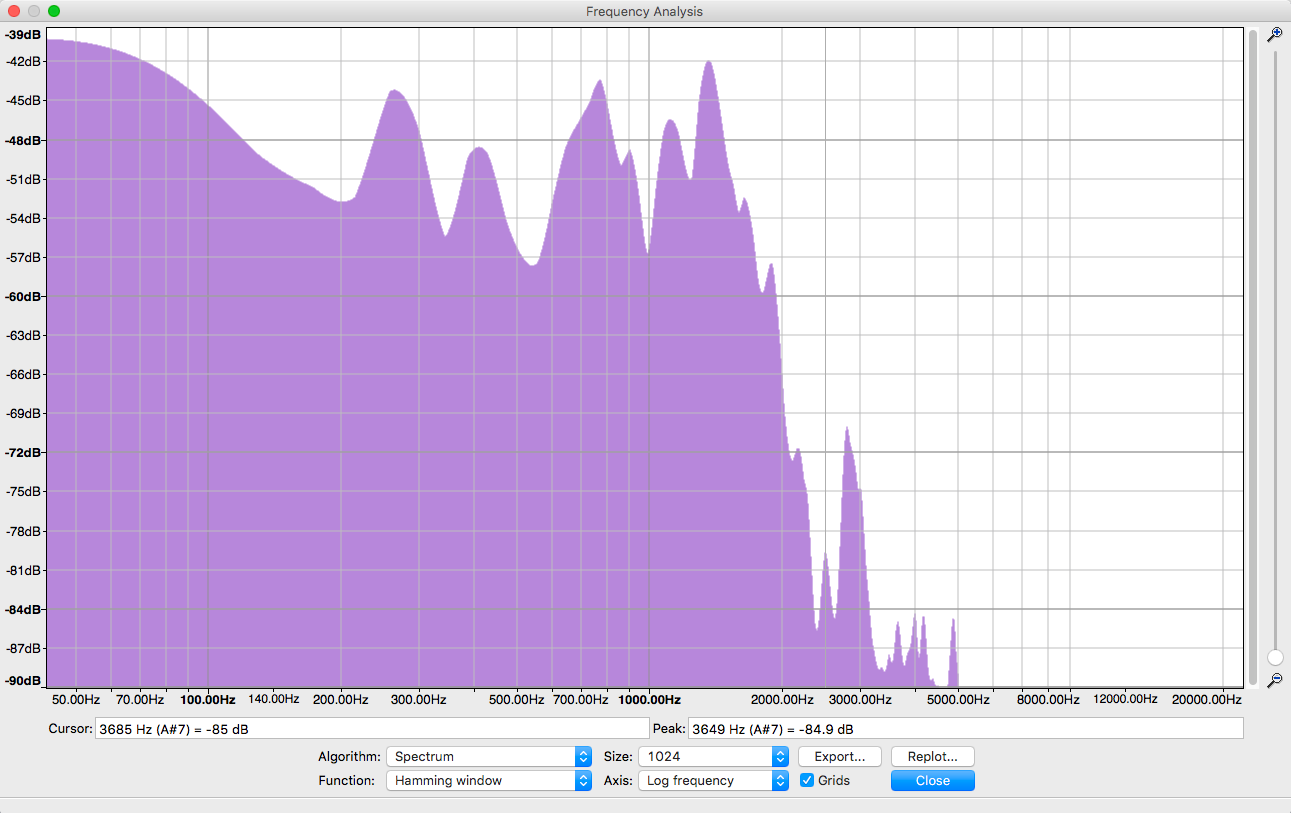
It sounds best when those nasty mids are cut, but if you cut too much or too wide it will sound like a BG and lose most of its character. So instead of using the low-mid and high-mid controls on my amp I use a 10 band EQ pedal. It's an always on pedal for me, it can handle problem room frequencies as well. Different rooms have different problem frequencies. The single mid control on my amp is not enough to handle these. I try not to boost anything with the 10-band EQ though, just cut problem areas.
If I connect the EUB directly to my amp (GK MB112-II) without the EQ, it sounds nasal.
What's left of the preamp after the mod is the JFET buffer. It does impedance matching, provides the piezo with a high impedance load and drives the cable. Therefore, cable capacitance will not load down the piezo and degrade the sound. The stock preamp does not do anything more in an acceptable (to me) quality.
Now, regardless of proper impedance matching, piezos do not sound too good. They often have a strong midrange hump. Mine has two at around 800 Hz and 1.3k. This is the freq analysis of my EUB, check out those mids:
It sounds best when those nasty mids are cut, but if you cut too much or too wide it will sound like a BG and lose most of its character. So instead of using the low-mid and high-mid controls on my amp I use a 10 band EQ pedal. It's an always on pedal for me, it can handle problem room frequencies as well. Different rooms have different problem frequencies. The single mid control on my amp is not enough to handle these. I try not to boost anything with the 10-band EQ though, just cut problem areas.
If I connect the EUB directly to my amp (GK MB112-II) without the EQ, it sounds nasal.

Llew Williams
Guest
- Jul 20, 2014
- 5
- 1
- 86
- Disclosures
- Ear player, self-taught; still don't read after 58 years playing . . . me bad! Happily married!
When I started getting occasional drops from my Stagg to the amp, I thought I would have to replace the 1/4 output jack. Instead, I use a cord from the headphone output to my Fender Rumble 100 and it not only cleared up the drops, but my big-band members indicated they liked the output more. Go figure . . .The stock preamp has multiple stages, it is quite possible that different outputs have different amounts of noise. The parts for each stage are different and grounding layout (star etc) on the panel can also be different.
The headphone signal was the noisiest on mine
If you want to try it with only one piezo connected that's easy: they are connected to the preamp board by two small jacks. Just disconnect the other one.
If you want to route one piezo signal directly to the output that would take some soldering. You could also buy a socket for that small jack and make an internal connect cable from that to the output jack, that way you don't have to cut the piezo cable. This would be better for testing, you could easily return to how it was before in case you don't like the mod.

First post (IIRC) to this side of the forum!
I bought a used Stagg EUB yesterday and it rules. I've been wanting to try an upright bass for a long time and this is a big step to that direction. A couple of notes:
- Even though it's not a "real" acoustic upright, these things are a different beast compared to an electric bass. I know the basics of setting up the height with the pin, and keeping a somewhat correct posture and still my left arm and shoulder was beat after trying to keep the elbow up all evening . Right hand was ok. 1-2-4 fingering needs plenty of practice, though.
- The fretboard side dots help a newbie like me a lot, navigating the neck and keeping decent intonation is a lot easier. I would assume that it develops muscle memory as well so that when you play without them you will navigate towards the correct locations.
- The electronics are what they are, but the headphone output is a nice feature for late night playing. I might end up doing the bypass mod if it get's more actual (amp) playing time.
- It's as fun as I hoped it to be!
- The only con: This opens up all kinds of new GAS streams.
I bought a used Stagg EUB yesterday and it rules. I've been wanting to try an upright bass for a long time and this is a big step to that direction. A couple of notes:
- Even though it's not a "real" acoustic upright, these things are a different beast compared to an electric bass. I know the basics of setting up the height with the pin, and keeping a somewhat correct posture and still my left arm and shoulder was beat after trying to keep the elbow up all evening
. Right hand was ok. 1-2-4 fingering needs plenty of practice, though.- The fretboard side dots help a newbie like me a lot, navigating the neck and keeping decent intonation is a lot easier. I would assume that it develops muscle memory as well so that when you play without them you will navigate towards the correct locations.
- The electronics are what they are, but the headphone output is a nice feature for late night playing. I might end up doing the bypass mod if it get's more actual (amp) playing time.
- It's as fun as I hoped it to be!
- The only con: This opens up all kinds of new GAS streams.
It's certainly a slippery slope, I bought a Stagg EUB on a whim and now own 2 EUB plus a starter DB.The only con: This opens up all kinds of new GAS streams.

Did that too!It's certainly a slippery slope, I bought a Stagg EUB on a whim and now own 2 EUB plus a starter DB.

It's certainly a slippery slope, I bought a Stagg EUB on a whim and now own 2 EUB plus a starter DB.
Me too!

I have a friend selling one of these, and I'm gonna pick it up! Just wanted to share!
What strings are you using with your Stagg for less sustain? Or any good spot to put some foam mutes to? I'd like the sound to be a bit more "thumpier" so that I don't have to mute with the arm so much.
I was thinking some cheaper nylon/kevlar strings (weedwackers?) might do the trick - people seem to hate these for the dead sound on an actual UB, but with just the piezo it might do the trick..
I was thinking some cheaper nylon/kevlar strings (weedwackers?) might do the trick - people seem to hate these for the dead sound on an actual UB, but with just the piezo it might do the trick..

Put the action higher, at least 5mm below the G and (if possible) even more (up to 3mm higher than the G) for the E.
If the strings are too hard to press down then, use lower tension synthetic (core) strings. Kind of Weedwhackers (for G and D) and synthetic wound synthetic core strings for A and E (maybe also for G and D). For the latter Innovation Silver Slaps might be good. With synthetic core strings you can or even need to put the action higher than mentioned before. Up to 10mm for the G.
If the strings are too hard to press down then, use lower tension synthetic (core) strings. Kind of Weedwhackers (for G and D) and synthetic wound synthetic core strings for A and E (maybe also for G and D). For the latter Innovation Silver Slaps might be good. With synthetic core strings you can or even need to put the action higher than mentioned before. Up to 10mm for the G.
I have a dumb question...I got a stand with mine. Are you supposed to play it in the stand, or is the stand for when you're not playing? The reason I ask is someone suggested I get a stand to keep the bass from moving around so much, but the stand I have blocks plugging the cable in! Sorry for asking such a silly question, but I feel the question you DON'T ask is the dumb one!


