DoubleMIDI, unless I'm misunderstanding you, Jazz version (I own it, so can confirm) has no adjustable sound post; in fact it's got no sound posts at all. You can only adjustable the bridge position just like on acoustic DB, and adjust action by tilting the fingerboard with a set screw. The resonating board rests on two points: the top near the pegbox and the bottom where he tail piece is, but it's permanently glued in place and cannot be adjusted in any way. There's nothing in the middle between it and the solid body (where a "sound post" would be if designer would choose to install it (under resonator board where the bridge sits.

Enjoy the benefits of a premium membership!
Upgrade Account
-
TalkBass has been independent since 1998. Add your voice.
Create a free account to reply to discussions, view embedded media, and browse with fewer display ads.
Join free Log in
Want zero display ads or expanded classifieds tools? Compare plans.
You are using an out of date browser. It may not display this or other websites correctly.
You should upgrade or use an alternative browser.
You should upgrade or use an alternative browser.
Double Bass Stagg EUB megathread
- Thread starter derrenleepoole
- Start date
More options
Who Replied?
I saw an instrument at the bass convention in Almere/Amsterdam about a decade (or a bit more) ago where they had a piece of wood between the small gap between top and body that could be moved up and down and acts similar to a soundpost.DoubleMIDI, unless I'm misunderstanding you, Jazz version (I own it, so can confirm) has no adjustable sound post; in fact it's got no sound posts at all. You can only adjustable the bridge position just like on acoustic DB, and adjust action by tilting the fingerboard with a set screw. The resonating board rests on two points: the top near the pegbox and the bottom where he tail piece is, but it's permanently glued in place and cannot be adjusted in any way. There's nothing in the middle between it and the solid body (where a "sound post" would be if designer would choose to install it (under resonator board where the bridge sits.
That might have been a prototype but the only model that is build that way is the Jazz model. Maybe they dropped that later or optimized so that they don’t need it now.
Yes, probably design has changed as present Jazz models don't have it for quite a few years now. You'd think that any object between resonating board and the solid body would dampen the board, preventing it from vibrating as easily as it does without anything touching/stopping it. I just took a photo of my instrument laying on the side (attached), so that the space along entire length of the resonating board is well visible.
Attachments

If you put something between top and body it would change the resonating frequencies up higher. But it depends on the width and even more on the pressure and position of that part.
When I saw the instrument at the bass convention, the piece of wood they used was about as wide as the bridge foot is thick, as thick as the room between top and body (with a thicker part outside as a handle) and as long to reach the bridge foot, I think.
You might ask them if I remembered it correctly and why they dropped that “soundpost”.
When I saw the instrument at the bass convention, the piece of wood they used was about as wide as the bridge foot is thick, as thick as the room between top and body (with a thicker part outside as a handle) and as long to reach the bridge foot, I think.
You might ask them if I remembered it correctly and why they dropped that “soundpost”.
While looking for something else, I've stumbled across this video where this guy tested exactly what we've discussed above. His instrument is not MK but something called Alter Ego, however from the video it appears like it uses the same design as the MK jazz model as far as floating resonator board. He inserts the spacer (appears to be just a wine cork) between the board and the bass body and you can hear the difference it makes. Oddly, I do like the sound with spacer more - it is brighter, more wood-like, while without spacer it is more like with magnetic pickup - no high harmonics so no authentic finger noise and string noise as if all frequencies above about 2kHz are cut off with an LPF. Interesting to watch.Should I try this on my MK Jazz? There must be a good reason Mirko abandoned this idea as you observed he evidently tried before. I might ask him out of curiosity...
Hey All!
I've read through a lot of this thread but not all yet, so please tell me if this was already discussed somewhere.
I'm looking to buy a Stagg EDB, I've noticed that some photos show two types of fingerboard, both black, with different thickness and mounting/support. I know about the RDL version from a couple years ago, but this is different yet. I've seen it also mentioned in some video on youtube (I've lost the link though). See here:
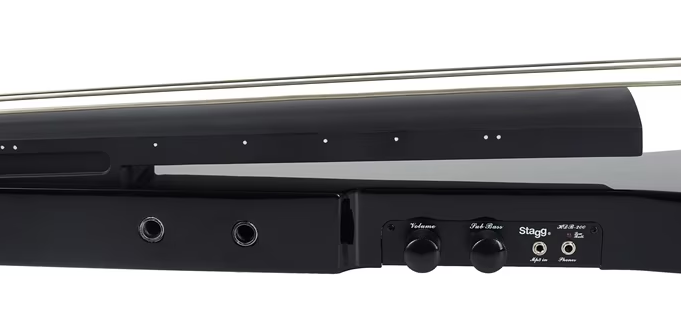
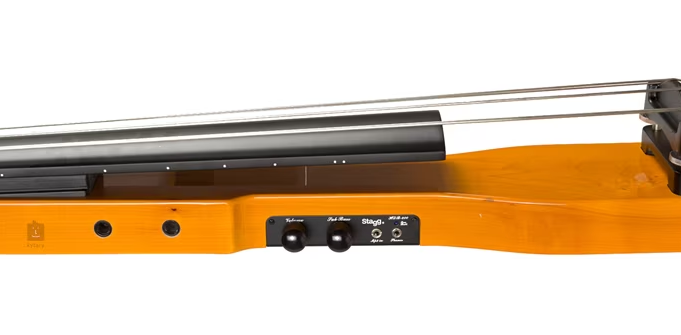
The thickness is different, the support is different. Both are screenshots from the same shop, that claims that they both have "standard fingerboard", though I can't get them to reply which one they actually sell. The question is, if there is a choice, which one would be better? And is it an actual difference between two models? Versions? One is older (both have the new head, thicker side planks)? Which one? I'd appreciate any info you can share. Links to the shop below.
https://kytary.pl/stagg-edb-3-4-bk/HN103903/
https://kytary.pl/stagg-edb-3-4-h/HN096294/
Regards,
T.
I've read through a lot of this thread but not all yet, so please tell me if this was already discussed somewhere.
I'm looking to buy a Stagg EDB, I've noticed that some photos show two types of fingerboard, both black, with different thickness and mounting/support. I know about the RDL version from a couple years ago, but this is different yet. I've seen it also mentioned in some video on youtube (I've lost the link though). See here:
The thickness is different, the support is different. Both are screenshots from the same shop, that claims that they both have "standard fingerboard", though I can't get them to reply which one they actually sell. The question is, if there is a choice, which one would be better? And is it an actual difference between two models? Versions? One is older (both have the new head, thicker side planks)? Which one?
I'd appreciate any info you can share. Links to the shop below.https://kytary.pl/stagg-edb-3-4-bk/HN103903/
https://kytary.pl/stagg-edb-3-4-h/HN096294/
Regards,
T.
The one with the honey body and the thinner fingerboard is the older one.
It also has the older support mounting with the glued-in rubber tube (which I personally prefer a bit over the later threaded one).
A thicker fingerboard would be a bit better if you play up high on the strings.
But both fingerboards are just part of the neck (all is one piece of wood) that is coated with a black epoxy laquer.
You cannot change the fingerboard, only the whole neck, if needed. The RDL version has a real separate fingerboard. It is covered with an almost uncoloured laquer that can be removed to plan the fingerboard. It could be finished with boiled linseed oil after planing like a real DB fingerboard.
The trussrod doesn’t do much if at all with such a thick neck, so planing might be needed (I know what I talk about, I have three of them).
The bridge is also bad (made for equal string height which is wrong on a DB) and too heavy because of the thick metal threads. I planned to replace it for years, but I’m too lazy because I hardly use my Staggs now since I have a used Clevinger EUB.
But I got my Staggs cheap because they were slightly damaged or with parts removed and paid less (about ten years ago) than the actual price of one standard Stagg now.
I think the price of a Stagg bis too high for what you get now. With the low price I paid and a bit of work they are OK practicing a bit when traveling through the holidays, have a second instrument when teaching at a students place or as a backup instrument or for jam sessions, but not as the only upright. An acoustic DB would be better and better quality if you want a serious instrument to learn.
I strongly recommend taking a bit more money out of the pocket and buy either buy a used Yamaha or the MK Studio from) an Italian manufacturer (thread Italian EUB on Talkbass).
BTW, there is a bass luthier around or from Cracow who builds EUBs, but as far as I can remember they are a lot more expensive. I think I once got the address here from a Talkbass post, but that was more than a decade ago and cannot remember name, address or where and if I saved the data somewhere.
It also has the older support mounting with the glued-in rubber tube (which I personally prefer a bit over the later threaded one).
A thicker fingerboard would be a bit better if you play up high on the strings.
But both fingerboards are just part of the neck (all is one piece of wood) that is coated with a black epoxy laquer.
You cannot change the fingerboard, only the whole neck, if needed. The RDL version has a real separate fingerboard. It is covered with an almost uncoloured laquer that can be removed to plan the fingerboard. It could be finished with boiled linseed oil after planing like a real DB fingerboard.
The trussrod doesn’t do much if at all with such a thick neck, so planing might be needed (I know what I talk about, I have three of them).
The bridge is also bad (made for equal string height which is wrong on a DB) and too heavy because of the thick metal threads. I planned to replace it for years, but I’m too lazy because I hardly use my Staggs now since I have a used Clevinger EUB.
But I got my Staggs cheap because they were slightly damaged or with parts removed and paid less (about ten years ago) than the actual price of one standard Stagg now.
I think the price of a Stagg bis too high for what you get now. With the low price I paid and a bit of work they are OK practicing a bit when traveling through the holidays, have a second instrument when teaching at a students place or as a backup instrument or for jam sessions, but not as the only upright. An acoustic DB would be better and better quality if you want a serious instrument to learn.
I strongly recommend taking a bit more money out of the pocket and buy either buy a used Yamaha or the MK Studio from) an Italian manufacturer (thread Italian EUB on Talkbass).
BTW, there is a bass luthier around or from Cracow who builds EUBs, but as far as I can remember they are a lot more expensive. I think I once got the address here from a Talkbass post, but that was more than a decade ago and cannot remember name, address or where and if I saved the data somewhere.
Last edited:
My intended use is to be able to start learning on something that is virtually silent, that's why I'm not looking into AUBs just yet. I know about the neck problems and I've looked for RDL but haven't found one. The Yamaha is still much more expensive than the Stagg, of course. So for me currently it's the choice between getting a Stagg or not starting to learn towards a double bass at all... and it's a touch choice to make.
Might be a problem to find used EUBs in Poland. You need some experience with an AUB to know how to set up an EUB and the feeling is still different then.
It is possible to silence an AUB by stuffing the f-holes (removable if you use closed-cell foam). But most of the energy goes to the floor on both, AUB and EUB.
If you start with DB, find a teacher first and discuss with him what might be the best solution. If you try to learn by yourself you might seriously hurt yourself.
It is possible to silence an AUB by stuffing the f-holes (removable if you use closed-cell foam). But most of the energy goes to the floor on both, AUB and EUB.
If you start with DB, find a teacher first and discuss with him what might be the best solution. If you try to learn by yourself you might seriously hurt yourself.
Thank you, I do have a teacher, he also suggested AUB as the best choice but that's not something I can do right now, so EUB seems to be second best. And now the only thing is to find something that I can start on.

FYI... Anyone looking for replacement parts for a Stagg EUB, EMD Music in Nashville is a great source. I just ordered a complete pre amp and bridge assembly. Quick response and shippping.

Is anyone aware where if anywhere I can get a rosewood neck for the Stagg? A good while back they offered them for sale separately, but I missed the window... Still contemplating cutting the existing fingerboard off somehow and replacing with ebony... But that's a big move...gulp...
The black fingerboard is one part with the neck. Not easy to remove to glue a new one on. Better get a complete neck with the rosewood fingerboard.Is anyone aware where if anywhere I can get a rosewood neck for the Stagg? A good while back they offered them for sale separately, but I missed the window... Still contemplating cutting the existing fingerboard off somehow and replacing with ebony... But that's a big move...gulp...

Hey EUB owners. I just bought a used one of these from Reverb. I notice that the headphone jack needs to be plugged in for the 1/4” output to work. Is this normal?
So, if there are no headphones plugged in, and I plug in a 1/4” cable, the blue light blinks once, but stays off and no sound is send through the 1/4”. Then when I plug in a headphone cable, the blue light stays on and the 1/4” sends sound to my amp..
Thanks for any input.
So, if there are no headphones plugged in, and I plug in a 1/4” cable, the blue light blinks once, but stays off and no sound is send through the 1/4”. Then when I plug in a headphone cable, the blue light stays on and the 1/4” sends sound to my amp..
Thanks for any input.
Remove and inspect your output jack. If you look at the schematic of the preamp, contacts of 1/4" oupur jack and contacts of 3mm headphones jack that connect battery to the circuit when either one is plugged in are both in parallel, so electrically there is no difference - either jack must keep the blue light on when plugged into. If 1/4" one does not do it (provided, battery is fresh), either the jack is defective, or battery-to-ground connection wire broke off.Hey EUB owners. I just bought a used one of these from Reverb. I notice that the headphone jack needs to be plugged in for the 1/4” output to work. Is this normal?
So, if there are no headphones plugged in, and I plug in a 1/4” cable, the blue light blinks once, but stays off and no sound is send through the 1/4”. Then when I plug in a headphone cable, the blue light stays on and the 1/4” sends sound to my amp..
Thanks for any input.
Remove and inspect your output jack. If you look at the schematic of the preamp, contacts of 1/4" oupur jack and contacts of 3mm headphones jack that connect battery to the circuit when either one is plugged in are both in parallel, so electrically there is no difference - either jack must keep the blue light on when plugged into. If 1/4" one does not do it (provided, battery is fresh), either the jack is defective, or battery-to-ground connection wire broke off.
Perfect - thank you!
Hiya, I have a question that I haven't seen covered so far. Hope that this is the right place to post it? I'm a bit new to the whole forum thing.
So recently I've bought a Stagg EUB (the newer, I think, version that has a wooden bridge), second-hand. The one issue it has is that the D string is significantly quieter than the other strings. The markings under the bridge also say A2 under the D string and D3 under the A string, like it was strung the wrong way around. (The support holes are in the right place though, so I doubt it's a leftie), The difference is not as noticeable with arco playing, but with pizz the D string is barely useable except for ghost notes. From what I can tell from recordings, it seems to mostly be low-end that's missing.
Hope there's someone here who has some clue about what this issue is caused by and how to fix it!
So recently I've bought a Stagg EUB (the newer, I think, version that has a wooden bridge), second-hand. The one issue it has is that the D string is significantly quieter than the other strings. The markings under the bridge also say A2 under the D string and D3 under the A string, like it was strung the wrong way around. (The support holes are in the right place though, so I doubt it's a leftie), The difference is not as noticeable with arco playing, but with pizz the D string is barely useable except for ghost notes. From what I can tell from recordings, it seems to mostly be low-end that's missing.
Hope there's someone here who has some clue about what this issue is caused by and how to fix it!
I had something similar with my Stagg - turned out just a bad D string. The main problem was it was buzzing when stopped at some locations on a fingerboard rather than being quiet(er) plucked empty than, say, A or G, but uneven volume was an issue too, and both were fixed by replacing the strings. I bought mine new, so when I complained to Stagg about it asking for D string replacement (turned out it was slightly kinked in the middle - probably was sharply bent at the factory before installation), they just sent me the whole set of 4 new strings for free. In your case the instrument is second hand, so Stagg is not going to replace your string(s), but certainly can sell you a new set, although you can just buy them anywhere else. If I were you, I'd just grab a new D string in Guitar Center and see if this takes care of the issue - if it doesn't - you can always return the string. If you don't want to bother with such exchange, take your Stagg to the nearest GC and the service tech can try a new string on the spot right there for you.
If all other strings resting on the same bridge sound more-less evenly, it is unlikely the problem is with electronics or pick-up piezo wires under the bridge or anything else common to all the strings. The D string itself would be my first suspect.
If all other strings resting on the same bridge sound more-less evenly, it is unlikely the problem is with electronics or pick-up piezo wires under the bridge or anything else common to all the strings. The D string itself would be my first suspect.
You can just swap G and D and check if it is the string or the position of the string that causes the problem.


