• TalkBass has been independent since 1998. Add your voice.
    Create a free account to reply to discussions, view embedded media, and browse with fewer display ads.
    Join freeLog in
    Want zero display ads or expanded classifieds tools? Compare plans.

Staggered 2x12 dispersion

The staggered, 2-driver alignment would have the broadest spread in the uppermids on an angle, like upper left and lower right or vice versa...also subject to floor bounce....and with the combing changing tone as your ears move through the different areas of the pattern.

Pile up 4 of them and things get more mixed up. In that case you can view it as one, big, rectangle speaker....sort of...with caveats. :)


Another solution is just crank it up and see what it sounds like.

"Combfiltering" and narrowing dispersion happen everytime there is more than one driver playing the sound. The various alignments let you decide where to put it.

A good default is to opt for widest horizontal with narrow vertical, as there are no ears on the ceiling. Sometimes ears can end up on the floor but by that time whatever you're doing will sound good anyway. :)

Audiences may be very wide, but the difference in ear level between a tall person standing and a short person sitting is still only 3 or 4 feet.

Prosound systems are mostly about filling sound on the horizontal axis for coverage with narrow vertical directivity.......that is before you get to filling a bowl with sound, and power shading, j-arrays, centerfills, time delayed far fills, etc., etc., etc............

If you're playing smaller places where the audience is being played to by your rig alone, that stuff can really matter. If you're hooked up to a huge PA, it doesn't matter so much.
 
Vertical has the best, side by side the least and staggered in between. :)

You could make a little stand that would support the staggered cabinet on a corner. Like a diamond. Might be a bit difficult to put your amp on top mind you!! :D

Think of the questions you might face. :)

Precisely my solution to the problem. I'm still working out the design details. No problem keeping the amp on top of the cab. I just use copious amounts of glue. Yes, this method does raise numerous questions. Like...how do I keep the amp and everything else from sliding off of the floor? Again, copious amounts of glue. And how to keep the house from sliding down the hill? Yep, copious amounts of glue. YMMV.
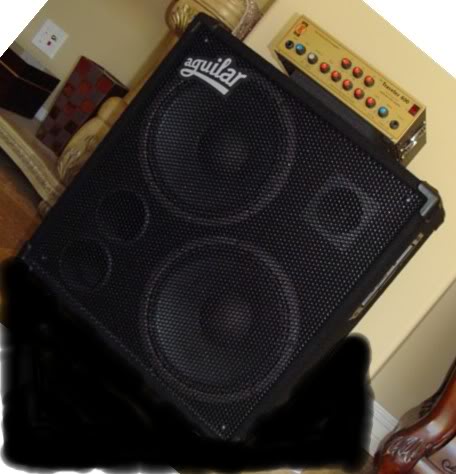
verticalarrayampstand.jpg


M. M. :)
 
A lot of them are made that way so the company can use the same box for its 212, 410, and 115 models while the only extra cuts (read extra cost) come in the baffle panel only.

Doesn't seem to matter if they're viewed as "budget" or "boutique" brands either.
 
Precisely my solution to the problem. I'm still working out the design details. No problem keeping the amp on top of the cab. I just use copious amounts of glue. Yes, this method does raise numerous questions. Like...how do I keep the amp and everything else from sliding off of the floor? Again, copious amounts of glue. And how to keep the house from sliding down the hill? Yep, copious amounts of glue. YMMV.

verticalarrayampstand.jpg


M. M. :)

A lot of them are made that way so the company can use the same box for its 212, 410, and 115 models while the only extra cuts (read extra cost) come in the baffle panel only.

Doesn't seem to matter if they're viewed as "budget" or "boutique" brands either.
Yes, cost savings is king with that layout, certainly nothing to do with sound choices :smug:.
 
The cabs the OP mentioned minimize dispersion by locating the two drivers as closely together as possible. Two stacked 1x12s will have more dispersion than the Avatar pictured, albeit all in the vertical plane.

Has anyone noticed (not measured) combing from a 4x10 at any reasonable distance? If not, no problem here for sure.
 
Has anyone noticed (not measured) combing from a 4x10 at any reasonable distance? If not, no problem here for sure.
What would you consider "reasonable distance"?

I was in a band that had an bass amp for me to use at their practice space, a Randall head of some sort and a Fender/Sunn 4-10 cabinet. I found the tone of my bass to change drastically as I moved around with some big notches/holes/uneven response at certain frequencies. It, frankly, sounded terrible compared to any of the LDS cabs I have/had, a 2-8, 2-12, and (2) 1-10s, all with 6 1/5" mid drivers.
 
Reasonable distance would be within a typical club, say, 150 ft.

The problem with extrapolating from a small room is that all the close reflections are interacting, so while you heard interference, it wouldn't simply translate to an open area, where there are essentially no reflections coming back at you.
 
Last edited:
There definitely were no reflections back, it was a really dead sounding room. I have not used that cabinet outside of that space so I can not comment further on that. I agree, an open space makes a huge difference along with just having room to get physically away from the rig some. Most rigs I have used in large spaces actually sounded pretty good, it was always down to the room, or boomy hollow stages, that were the real culprits in bad sound.
 
I'm no scientist and excluding brand/cost I'd say that my 2x12 that is vertical sounds much better than my staggered 2x12. Both cabs though still sound good when I play. My smooth Jazz/R&B outfit however gets nervous any time I show up with anything bigger than a 2x10 LOL!!!! They are ready to tell me to turn down even before I plug up. It's hilarious. The psychology of showing up to gigs with a bigger cab really has an affect/effect on my fellow Band Members. I also run my 2x10 cabs vertical as well.
 
I have two GK Neo 112's I stack vertically.
Because it gets the sound higher and closer to my ears: better personal monitor.
I have two GK Neo 212's; of the "staggered sort."

I've never, ever, ever, never had anyone at a music venue notice any difference, comment on one or the other, or, one versus the other.
Ever.

Never.

So: I suppose there is a difference. But: I don't think it matters terribly much.
 
I'm no scientist and excluding brand/cost I'd say that my 2x12 that is vertical sounds much better than my staggered 2x12. Both cabs though still sound good when I play. My smooth Jazz/R&B outfit however gets nervous any time I show up with anything bigger than a 2x10 LOL!!!! They are ready to tell me to turn down even before I plug up. It's hilarious. The psychology of showing up to gigs with a bigger cab really has an affect/effect on my fellow Band Members. I also run my 2x10 cabs vertical as well.

This is one of the reasons I went with grill cloth on my new cab. No one knows what is in there. The cab isnt big, and I get left alone when I roll it in.
 
  • Like
Reactions: phillybass101
I have two GK Neo 112's I stack vertically.
Because it gets the sound higher and closer to my ears: better personal monitor.
I have two GK Neo 212's; of the "staggered sort."

I've never, ever, ever, never had anyone at a music venue notice any difference, comment on one or the other, or, one versus the other.
Ever.

Never.

So: I suppose there is a difference. But: I don't think it matters terribly much.

That is kind of what I was thinking. Really it comes down to form factor for me. I have a tube head so I want a cab that will hold the head as safely as possible. I have put the head on the floor before but this is a pain if I need to make adjustments during the show. If I were only playing on big stages then perhaps the head overhanging the edges of the cab wouldn't be a problem but I play a lot of DIY shows where the audience is right on top of us. I don't want to have to be super paranoid that my head is about to get knocked over and damaged at any moment.
 
The GK 112's would be "narrow for a tube head" when stacked vertically.
You could also use on GK212, and one GK 112 on top, horizontally.
I do this sometimes. This came to me from Tom Bowlus, via Robert Gallien.
For me, the 2 x 212's is usually too much; and the 312 rig is good from "bigger than small, smaller than big" venues.
You have to be mindful that you could overpower the 112; that's really the only downside.
 
You have to be mindful that you could overpower the 112; that's really the only downside.

I was wondering about that. As a system, that combination of cabinets should handle 900W, but it's hooked up as one 600W cab and one 300W cab (8 ohms each). I understand that the amp sees a total 4 ohm load, but I was wondering if "the extra juice" somehow knew to flow to the 600W cab instead of overpowering the 300W cab. As you can tell, my knowledge of electronics is poor.
 
I've never really noticed any difference between staggered or stacked cabs of the same speaker size being run at the same power levels by the same amp. I suspect in a mix it matters about as much as alder vs ash body wood on a bass.
 

Latest posts