Sorry to interrupt your Joey666 YT time:
From Wikipedia
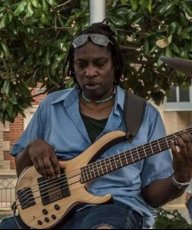
"When playing electric bass, Clarke places his right hand so that his fingers approach the strings much as they would on an upright bass, but rotated through 90 degrees. To achieve this, his forearm lies above and nearly parallel to the strings, while his wrist is hooked downward at nearly a right angle. For lead and solo playing, his fingers partially hook underneath the strings so that when released, the strings snap against the frets, producing a biting percussive attack. In addition to an economical variation on the funky Larry Graham-style slap-n'-pop technique, Clarke also uses downward thrusts of the entire right hand, striking two or more strings from above with his fingernails (examples of this technique include "School Days", "Rock and Roll Jelly", "Wild Dog", and "Danger Street").[citation needed]"
From Bass Player:
What do you think your legacy is on electric bass?
That’s not something I stop and consider, but I’d say I’m one of quite a few bassists who have contributed to the instrument’s development. There were the session guys I mentioned who really established how to play the instrument and make a record sound better. When I came along, I was rebellious in a way. I brought a jazz psychology and attitude to the electric. I never really prepared anything on it, like the guys who came after me—say Jaco through Victor Wooten. Those cats had a clear idea of what they wanted to present, and that’s what I love about them. The pieces on their records seemed much more prepared and worked out, with brilliant results. I was a jazzer; whatever came out that day, that was it. You didn’t think to fix a note or overdub. I didn’t prepare much, other than compositionally. For “School Days” we started the take, the engineer stopped us for a buzz, we started again, and that was the record. I didn’t make any fixes; we overdubbed my vocals and a bell.
My jazz sense applied to slapping, too. Larry Graham innovated the style using mostly open-string keys, but I needed to develop a way to slap in other keys, without using open strings, and to move through changes. When I look back now, I don’t see what I did as overly special; it was just different. I was one of the guys who pushed the instrument along, and later players pushed it in their ways, and it continues on.
“Gotham City” is an evocative track, made all the more intriguing by you playing notes below open E in your bass line.
I know. I always say I’m one of the last of the 4-stringers, but I actually use an Alembic 5-string; it just has to be a very controlled setting, like it is here [laughs]. It took it onstage once with Stewart and I just lost it—I kept thinking the low B was an E. I’m determined to get comfortable on it; I’m touring a lot in 2015, and I’m going to bring it out and really learn it. “Gotham City” is a wild piece, and difficult to play [see music]. I have a soft spot for superhero movies; they’re a fun form of escape. If I were writing the score to a Batman movie, this is what it might sound like.
From PopMatters
It was during this period that he developed his signature style for playing the electric bass, with his right hand bent sharply downward over the strings, in an L-shaped hook that places the fingers roughly where they would be on an acoustic bass. (Though the acoustic bass would be upright, where the electric is horizontal.) "I come from a time period when there really was no education there yet about playing the electric bass. There was maybe one book. Whereas with the stand-up bass, or acoustic bass, there was all kinds of literature," he says. "My approach to the electric bass comes from being an acoustic bass player. " Nowadays, he says, young bass players can study technique at any music school, so you see less variation in playing styles. But in the 1970s, bass players had, to some extent, to find their own way.
Back to basics
Stanley Clarke: "I built a new bass that looks like a Stratocaster; Fender is going to release it" | MusicRadar
Stanley Clarkes's technique?
From Wikipedia
"When playing electric bass, Clarke places his right hand so that his fingers approach the strings much as they would on an upright bass, but rotated through 90 degrees. To achieve this, his forearm lies above and nearly parallel to the strings, while his wrist is hooked downward at nearly a right angle. For lead and solo playing, his fingers partially hook underneath the strings so that when released, the strings snap against the frets, producing a biting percussive attack. In addition to an economical variation on the funky Larry Graham-style slap-n'-pop technique, Clarke also uses downward thrusts of the entire right hand, striking two or more strings from above with his fingernails (examples of this technique include "School Days", "Rock and Roll Jelly", "Wild Dog", and "Danger Street").[citation needed]"
From Bass Player:
What do you think your legacy is on electric bass?
That’s not something I stop and consider, but I’d say I’m one of quite a few bassists who have contributed to the instrument’s development. There were the session guys I mentioned who really established how to play the instrument and make a record sound better. When I came along, I was rebellious in a way. I brought a jazz psychology and attitude to the electric. I never really prepared anything on it, like the guys who came after me—say Jaco through Victor Wooten. Those cats had a clear idea of what they wanted to present, and that’s what I love about them. The pieces on their records seemed much more prepared and worked out, with brilliant results. I was a jazzer; whatever came out that day, that was it. You didn’t think to fix a note or overdub. I didn’t prepare much, other than compositionally. For “School Days” we started the take, the engineer stopped us for a buzz, we started again, and that was the record. I didn’t make any fixes; we overdubbed my vocals and a bell.
My jazz sense applied to slapping, too. Larry Graham innovated the style using mostly open-string keys, but I needed to develop a way to slap in other keys, without using open strings, and to move through changes. When I look back now, I don’t see what I did as overly special; it was just different. I was one of the guys who pushed the instrument along, and later players pushed it in their ways, and it continues on.
“Gotham City” is an evocative track, made all the more intriguing by you playing notes below open E in your bass line.
I know. I always say I’m one of the last of the 4-stringers, but I actually use an Alembic 5-string; it just has to be a very controlled setting, like it is here [laughs]. It took it onstage once with Stewart and I just lost it—I kept thinking the low B was an E. I’m determined to get comfortable on it; I’m touring a lot in 2015, and I’m going to bring it out and really learn it. “Gotham City” is a wild piece, and difficult to play [see music]. I have a soft spot for superhero movies; they’re a fun form of escape. If I were writing the score to a Batman movie, this is what it might sound like.
From PopMatters
It was during this period that he developed his signature style for playing the electric bass, with his right hand bent sharply downward over the strings, in an L-shaped hook that places the fingers roughly where they would be on an acoustic bass. (Though the acoustic bass would be upright, where the electric is horizontal.) "I come from a time period when there really was no education there yet about playing the electric bass. There was maybe one book. Whereas with the stand-up bass, or acoustic bass, there was all kinds of literature," he says. "My approach to the electric bass comes from being an acoustic bass player. " Nowadays, he says, young bass players can study technique at any music school, so you see less variation in playing styles. But in the 1970s, bass players had, to some extent, to find their own way.
Back to basics
Stanley Clarke: "I built a new bass that looks like a Stratocaster; Fender is going to release it" | MusicRadar
Stanley Clarkes's technique?