• TalkBass has been independent since 1998. Add your voice.
    Create a free account to reply to discussions, view embedded media, and browse with fewer display ads.
    Join freeLog in
    Want zero display ads or expanded classifieds tools? Compare plans.

Stingray classic pre Swap

Hey everyone
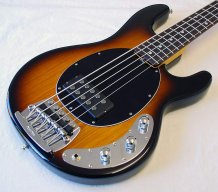
I have a stingray classic 5 and I’m looking to swap the pre

Thinking obp2
Darkglass
Or nord or even Seymour

But I’m looking to change the pre because I don’t like the fact the 2 band is Dente less


I love the bass itself as it has the gloss neck and mute kit bridge

I’d keep the stock pickup
 
I, too, like detents or a "flat" position (as in no boost on the tone pots) which is why I like the 3-band preamp.

Since most everyone claims that the 2-band sounds sooo much better than the 3-band, I wanted to try it and see for myself. But I'm not at all unhappy with the tone of the 3-bands in my SR5s and no center detent was a deal-breaker, at least for the time being. I could not find an aftermarket 2-band MM pre with center detents. So I quit looking. No one believes in "if it aint broke, don't fix it" more than I do (well, most of the time, anyway).

Good luck with your search.
 
the 2 band Stingray preamp doesn't have centre detents, is because there is no "flat" setting per se : it's boost only.
Common misconception. The original (I’m assuming classic as well) Stingray pre was in fact “flat” (ish) at the halfway setting. Fully counterclockwise is not flat on that pre.
 
Common misconception. The original (I’m assuming classic as well) Stingray pre was in fact “flat” (ish) at the halfway setting. Fully counterclockwise is not flat on that pre.

Common misconception - it is boost only, and certainly not "flat" in the middle.

What is confusing is that the final few % throw of the treble pot introduces a low pass filter (apparently to kill interference), and apparently a similar, though less steep high pass filter is introduced to the bass pot, near the end of its throw.
 
With my last Stingray, I traded the stock 2-band preamp for the 3-band preamp from another TB member. I posted a For-Trade ad in the TB classifieds and had a hit within a few hours of posting. Something to consider if you want to keep everything "Ernie Ball".
 
You should (assuming they are standard 25 or 50k pots) be able to just replace those pots with ones that have detents. Much less expensive option.

They are 50k pots, and it is totally possible to swap the pots for ones with a detent.

However...

The 2-band ‘Ray is not necessary flat in the center position. You’ll have a slight boost in the treble and a good boost in the bass. The pre is boost/cut, but has way more boost than cut on tap, and the ratios of boost/cut are different in the bass and treble controls. The detent will give you a reference point if that’s what you’re after though.
 
  • Like
Reactions: mcnach
Common misconception - it is boost only, and certainly not "flat" in the middle.

It is not “boost only”, but you’re right it’s not truly flat in the center, just flat for the Stingray. Fully counterclockwise on a Stingray is not its “flat” setting.

From John East:

“The actual circuit of the MM bass is boost only, but there is a twist. The way the circuit is configured has been done in such a way that there is bass cut when the bass is fully backed off.”

The original hangtag manual that came with the bass in 1976 also said that the EQ controls were boost and cut and for a “neutral” sound to leave them at the center position.
 
Last edited:
Hey everyone
I have a stingray classic 5 and I’m looking to swap the pre

Thinking obp2
Darkglass
Or nord or even Seymour

But I’m looking to change the pre because I don’t like the fact the 2 band is Dente less


I love the bass itself as it has the gloss neck and mute kit bridge

I’d keep the stock pickup

I'd go for the John East MMSR preamp.
It has a 2-band section modelled closely on a '76 Stingray, and a semiparametric mids module (stacked controls: one for the centre frequency and another for cut/boost). Centre detents all round. When the mids module is set flat (detent), it has no effect and it sounds like a classic 2EQ.

I have that on my 2002 2EQ (see my avatar). I asked John to include a bypass switch, as I like to have that option if possible. I can't remember how much it added to the cost, but very little.
 
  • Like
Reactions: blindrabbit
They are 50k pots, ...

No, they're...

They are not 25or 50k. They are 100k log and 1M rev log.

But +1 for the East MMSR 3-band. Drops right into the 2-band with no modification beyond clipping the battery connector...
20190125_084639.jpg

20190125_111410.jpg
 
At the risk of stating the obvious ; don't forget you'll have to drill a hole in the instrument, for an output jack.

That will no doubt effect resale value.

Not for the 3-knob 3-band, as beautifully illustrated by @SteveCS above! :thumbsup:
 
It is not “boost only”

Yes it is :

From John East:

“The actual circuit of the MM bass is boost only, but there is a twist. The way the circuit is configured has been done in such a way that there is bass cut when the bass is fully backed off.”

It's a Baxandall, boost only, design : the "cut" only effects the lowest, and highest frequencies by introducing high, and low pass filtering when the knobs are fully backed off.

There is no "flat" setting, because you're always incurring some degree of boost from the EQ, or some degree of roll-off from the high/low pass filters.

The 3 band has a true (ie relative) flat position.


The original hangtag manual that came with the bass in 1976 also said that the EQ controls were boost and cut and for a “neutral” sound to leave them at the center position.

None that I've ever seen.

The prototype was cut only.

Tom Walker redesigned it as boost only, and his nephew - Sterling Ball - created the 3 band, with the expressed intention of offering the ability to cut the EQ, and to allow control over the mid range.

The 2 band, and the 3 band are designed to correlate identically in one specific setting - that is :

2 Band
Volume = 100%
Treble = 100%
Bass = 100%

is the same as

3 Band
Volume = 100%
Treble = 100%
Mid = Centre Detent
Bass = 100%


You can see that if the 2 band had offered cut, the mid range would be excessively pronounced, or the EQ would have had to have different corner frequencies / a different degree of boost, and/or a different slope.


Sterling has frequently reiterated that the 2 band has always been boost only. You could always ask him again, or just look up some of his explanations on the EBMM forums.
 
  • Like
Reactions: waynobass
At the risk of stating the obvious ; don't forget you'll have to drill a hole in the instrument, for an output jack.

That will no doubt effect resale value.
You're assuming he wants to sell it someday. Sometimes people aren't worried about this so-called "re sale value".
 
Yes it is...just look up some of his explanations on the EBMM forums.
My understanding, based on playing them for years, research, and also doing exactly what you just suggested is that
1) the BASS control is (almost) boost only, with some cut happening at the extreme end of travel
2) the TREBLE control is boost/cut albeit without detent

At the end of the day, I have no dog in this fight. I love Stingrays but stopped playing them 20 years ago because my tastes have changed, so whatevs...it is what it is.