• TalkBass has been independent since 1998. Add your voice.
    Create a free account to reply to discussions, view embedded media, and browse with fewer display ads.
    Join freeLog in
    Want zero display ads or expanded classifieds tools? Compare plans.

Strange volume loss P/J - pickups.

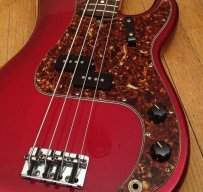
I recently had a Nordstrand NJ4SE J pickup installed in my American P/J (to replace the noisy factory pickup) and I love the sound of the Nordstrand by itself and the factory P's, also by themselves.

Now - when both pickups are at full volume (they have individual pots) there is a noticeable loss of volume.

This didn't happen before :rollno: .

It's sounds a bit like a notch filter. When you wind one of the pots up and the other is already on full, volume drops away!! - weird. I like having both pickups at full and tone at full. I always do it like that and I don't want to mess around with pots at different positions - I just want it all on 11 and leave it. The luthier reckons I will need to change one of the volume pots so I'm going to try that next week but until then.........................

anyone got any ideas?
:help:
 
The luthier reckons I will need to change one of the volume pots...
fire that "luthier", he's an idiot.

reverse the hot and ground leads on one pickup and you'll be fine (it probably says that in the instructions). you've got one pickup out of polarity with the other, so that they each sound fine by themselves but are creating opposite signal from each other.
 
  • Like
Reactions: Michael Moore
fire that "luthier", he's an idiot.

reverse the hot and ground leads on one pickup and you'll be fine (it probably says that in the instructions). you've got one pickup out of polarity with the other, so that they each sound fine by themselves but are creating opposite signal from each other.

+1.
What's this volume pot business about? Sounds like he was scrambling to think of something to say.

It is normal for the volume to drop a bit when the pickups go parallel with the volumes up, due to insertion loss, but it should not be a big deal. If the tone is thin and nasal, it's likely a phase inversion issue, which can be remedied as per Walter's instructions.
 
Hmmm, thanks.

It doesn't sound out of phase though. The signal is strong and full as the pot is wound up. It just has a marked volume drop when the pot is almost on full and then that continues as the pot reaches its fullest point.

I'll ask the guy who fitted it about a possible "out-of-phase" but he's a pro - he actually pointed out the problem and is also doing his homework to find a solution.

Appreciate your input. Thanks again.
 
Hmmm, thanks.

It doesn't sound out of phase though. The signal is strong and full as the pot is wound up. It just has a marked volume drop when the pot is almost on full and then that continues as the pot reaches its fullest point.

You are contradicting yourself.

You said:

when both pickups are at full volume (they have individual pots) there is a noticeable loss of volume.

If the pickups are out of phase, when they are both mixed equally, or as you said; "when both pickups are at full volume", you will hear a loss of volume and the tone will get thin, like a notch filter.

If you turn one pickup down, the other one will sound normal again. One pickup can't be out of phase with itself, so this is when they are both on.

Reverse the leads on one pickup.
 
Same thing happened to me, doing a similar thing (mixing brands & types in a P/J).

"Phase Cancellation" is the phrase I'm familiar with. (Basic wave theory - the troughs of one wave negate the peaks of a similar but mis-aligned wave.)

Switching leads cured the problem for me. Now in similar situations, when possible I try to do a quick check for this before soldering.
 
Thanks for all those replies - the guy is a luthier - he is a genius with wood and works for a highly respected guitar maker. He might be a dud on the electronics though. I am getting a second opinion as we speak!!

Cheers
 
OK, let's be fair here.

both pickups full-up will indeed be a little thinner than the P by itself, even when they're in polarity.

when they're out, both full-up will be really thin and weird sounding.

either way, it should be obvious what's going on to anybody who knows what they're doing as soon as they play it.
 
Just replaced the P pickup on my Aria PJ with a pickup from Guitar Fetish. I left the J pickup stock. Soldered everything up according to the wire colors, only to find the sound getting "thin" when both pickups were turned up. Alone, each sounded fine, and the tone control worked properly with both. A quick search brought me to this thread, and voila, 20 minutes and a bit of soldering later and she sounds great! Thanks, guys!

Clearly, manufacturers don't necessarily follow a standard with wiring pickups. Is there a way to tell/test polarity before installing the pickups?
 
Yes - there is not a standard. Some makers use the White as + and some use the Black as +.

If you have a good analog voltmeter, it is easy to check this. You put it on the most sensitive scale and clip to your guitar cord tip and sleeve. Then , you place a steel tool - screwdriver etc. - nearly touching a pole on the pickup and pull it away quickly. The meter needle will momentarily go + or - and return to zero. Then you do the same with your other pup. They should be the same.
 
a digital meter works just as well, but yep; i'll just slap the tool down onto the pickup, observing whether the meter reads + or - DC voltage, then yank it off, at which point the meter will read the opposite.

if the next pickup shows positive or negative in the same order, they're in polarity with each other.
 
I am an idiot and dud too. Just helped a friend to install his new EMG PJ HZ, followed all installation guides, solderless system, and still experienced the same as OP. The precision pup has a small but noticeable drop in volume when the jazz pup has its volume on full. Took everything apart and swapped volume pots too. Same result. Will go over it again now.
 
I am an idiot and dud too. Just helped a friend to install his new EMG PJ HZ, followed all installation guides, solderless system, and still experienced the same as OP. The precision pup has a small but noticeable drop in volume when the jazz pup has its volume on full. Took everything apart and swapped volume pots too. Same result. Will go over it again now.

This is normal. In general, J pickups have a lower output impedance than P pickups. At full volume, the J pickup's impedance reaches its lowest, and at that point, the load on the P pickup is greatest, and hence, the volume drop.

You might consider placing a low value trimmer pot in series with the J pickup, to increase its impedance. This might be a bit difficult with a solderless system, but if you do it, you will have the option to fine tune the resistance to give the smallest volume drop.
 
OK, let's be fair here.

both pickups full-up will indeed be a little thinner than the P by itself, even when they're in polarity.

when they're out, both full-up will be really thin and weird sounding.

either way, it should be obvious what's going on to anybody who knows what they're doing as soon as they play it.

Yes, when both pickup are run full together, it will be thinner than when the pickups are run separately.

I'm sure your problem and answer have already been covered by the posts.

When 2 pickup are run together in parallel, the ohms drop significantly. Example. J pickups are about 7 K ohms each but when run together in parallel, the ohms drop to 3.5 K ohms. With the drop in ohms so goes the drop in output.

Whether if the polarity is reversed on your new pickup/pickups, I do not know. Try reversing and hear how it sounds.
 
If indeed the pickups are in phase, then there's a few things you can try.

1: use two linear volume pots, and consider 9 as full volume. This leaves 10% of the pots resistance inline with the signal and serves to isolate the pickups from each other.

2: wire the P pickup in parallel. You can try this, but it will change the tone of the P pickup, but if easier blending is what you want, and the P is much higher imedance/resistance then this may help.

3: run two resistors to sum the output signals of the vol pots. You'll have to experiment, and you may even find that the resistors aren't the same value, or that you just need one, but this will also work to isolate the two pickups. It may slightly decrease your output on each pickup solo, but if chosen carefully, will give you that fuller tone with both pickups. Every one says this will suck because of the original Jazz bass wiring. But it had a couple of 220K resistors. I would suggest starting with a tenth of that - 22k.

4: shift to a vol & blend setup, but use a log/antilog blend. Unfortunately, the only ones I know of that you can buy are from Warwick/MEC are are very expensive. 60 euros or there-abouts. Last time I mentioned these blend pots I was taken to task, but I promise you that they work very well in your situation because they have a little (10%) of their resistance left when set in the middle. This also isolates the pickups from one another, as you move to one side or the other towards either pickup solo, this resistance disappears of course. Next time you are in a shop with a lot of warwicks, check out how well the blend pots work, even on the basses with very different pairs of pickups.

5: and of course, make sure your pickup heights are carefully adjusted so the outputs of each when solo are as close as possible.
 
4: shift to a vol & blend setup, but use a log/antilog blend. Unfortunately, the only ones I know of that you can buy are from Warwick/MEC are are very expensive. 60 euros or there-abouts. Last time I mentioned these blend pots I was taken to task, but I promise you that they work very well in your situation because they have a little (10%) of their resistance left when set in the middle. This also isolates the pickups from one another, as you move to one side or the other towards either pickup solo, this resistance disappears of course. Next time you are in a shop with a lot of warwicks, check out how well the blend pots work, even on the basses with very different pairs of pickups.

This is an excellent option, if you can get our hands on one of those pots. In my current PJ, I'm using a 500k Audio for the Alnico Fender P 10.5k , and a stacked 250k Audio/Linear with an old Schaller Humbucking J wired in parallel 7.5k. Works beautifully, and much in the manner you describe.