
Enjoy the benefits of a premium membership!
Upgrade Account
-
TalkBass has been independent since 1998. Add your voice.
Create a free account to reply to discussions, view embedded media, and browse with fewer display ads.
Join free Log in
Want zero display ads or expanded classifieds tools? Compare plans.
You are using an out of date browser. It may not display this or other websites correctly.
You should upgrade or use an alternative browser.
You should upgrade or use an alternative browser.
Strengthening Pinky Finger- Resources, Practice Techniques?
- Thread starter spector_boogie
- Start date
More options
Who Replied?


Trills involving the little finger, esp fingers 3 and 4.
String crossing with the pinkie being the first finger used on each string change.
Slides up to high notes with the pinkie leading the way.
String crossing with the pinkie being the first finger used on each string change.
Slides up to high notes with the pinkie leading the way.

It’s the “everything I had” part that creates a big variable, especially for a new/re-emerging player.
Doesn’t need to be much! If you can start with a major and minor scale, that’s plenty.


I found learning as many barre chords on regular guitar as I could , helped me quite a lot, both in terms of strength & dexterity around the fingerboard.
These days I play chords &/or sliding octaves on the bass using my pinky in preference to my ring finger due to it being easier for me.
These days I play chords &/or sliding octaves on the bass using my pinky in preference to my ring finger due to it being easier for me.

Still high after the 'Horns' 10 pt run over 'Bama Saturday I see.
I used an exercise that another bassist taught me, and it worked for me. It's 4 finger fretting diagonally up and down the neck. Starting on the E string on a 4 string do F F# G G# then move 1 fret up on the A string do B B# C C# and so on up the D and G string. Then reverse it and come back down to the F on the E string. I kept doing it and got faster and faster. You can do the same type of pattern on a 5 or 6 string. Now my pinky is as strong as my other fingers.
As with most things bass related, the answer is what we all already know, deep down. More practice.
Just make yourself use your pinky. Practice scales, songs, whatever keeps your interest. Just keep using it, and it will get where you want.
It is tempting to look at someone like Rocco Prestia and say that "he didn't use his pinky much, so I don't have to". Maybe that is the case, but if it were, you probably wouldn't be asking on here. Most of us mere mortals need to do things the "right" way, at least until we (hopefully) get good enough to find our own way that works better.
Just make yourself use your pinky. Practice scales, songs, whatever keeps your interest. Just keep using it, and it will get where you want.
It is tempting to look at someone like Rocco Prestia and say that "he didn't use his pinky much, so I don't have to". Maybe that is the case, but if it were, you probably wouldn't be asking on here. Most of us mere mortals need to do things the "right" way, at least until we (hopefully) get good enough to find our own way that works better.


With due respect, I disagree totally with all the above. The pinky has relatively fragile tendons, ligaments, and muscles. But to smoothly play all sorts of intervals, motifs, etc., it is absolutely necessary. You can injure your pinky irreparably overdoing it or exercising it wrong. The proper way to strengthen the pinky is to take lessons from a qualified double bass teacher using the Simandl method of bass playing. The Simandl method uses the 1st, 2nd, and 4th (pinky) fingers in positions up and down the neck on all strings. The teacher will help you with proper left-hand position and curvature of the fingers to improve fretting technique and strengthen the fingers including the pinky without risk of injury. I repeat: get a good, qualified double bass teacher of the Simandl method.
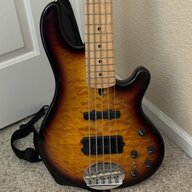

and being tuned to drop C, my hand is usually perpendicular to the fretboard, as opposed to the traditional position, where octaves have a little further reach.
I've no real suggestion other than the painfully obvious "any exercise will do provided it exercises the parts that need the exercise."
That said, I think it would help if you could clarify what you mean by 'Drop C'. As I understand it, Drop C is C, A, D, G, so the octave 'pattern' between the lower 2 strings is a 3-fret reach, and playing any type of scale over those two strings is impossible without at least couple of shifts. As such, you will need to adapt pretty much all of the advice given thus far - you may well be somewhat on your own as far as devising specific exercises goes.

Spider exercises and lots of them. Focus on the 3rd and 4th fingers a little more to really build them up. I can't think of anything that helps more than that.

Anytime I read where someone is trying to strengthen one of their fingers, I'm reminded of the classical composer Robert Schumann. He devised some sort of string and pulley contraption to strengthen his ring fingers. He ended up permanently injuring himself in the process. Be careful not to end up like Mr. Schumann.

Steve Bailey's Hazard Drill is probably the best thing I got out of the short time I took bass lessons. It helps build finger strength and independence, I can't recommend it enough.

Smooth_bass88
vaxx!
- Oct 31, 2006
- 12,122
- 16,793
- Disclosures
- have been on nationally released albums, charting on the Billboard 200
or just play chromatic scales all over the neck.Play the major scale using all 4 fingers.

It’s almost certainly a matter of technique and not strength. Electric bass shouldn’t require a lot of effort to play, even with heavy strings.
While I think incorporating the 4th finger more regularly with the others is a good thing, I would advise against any “strengthening” exercises.
While I think incorporating the 4th finger more regularly with the others is a good thing, I would advise against any “strengthening” exercises.
Steve Bailey's Hazard Drill is probably the best thing I got out of the short time I took bass lessons. It helps build finger strength and independence, I can't recommend it enough.
I know it’s SB here, and I’m just some dude from the internet, but I find this exercise to be potentially dangerous, and also not super musical. You can gain all the technique you’d ever need from practicing your repertoire and scales, arpeggios, and more musically useful sequences.

...
I find this exercise to be potentially dangerous
...
Totally agree, and SB almost admits as much at 05:24: "... it gets more painful ..." The most significant risks for me lie in those retained 1st and 2nd finger stops. IME there is nothing to be gained from keeping fingers stretched out stopping notes that are not being played - all they do is complicate the right hand by creating additional and avoidable muting challenges!


