• TalkBass has been independent since 1998. Add your voice.
    Create a free account to reply to discussions, view embedded media, and browse with fewer display ads.
    Join freeLog in
    Want zero display ads or expanded classifieds tools? Compare plans.

Stretch or no?

Going at this backwards. Please bear with me.

IME, strings lose intonation and ultimately break at the bridge bend. That is the only point at which the hardened steel core is significantly permanently deformed during installation, other than the 90 deg bend in the peg hole bend.

Over the years and through a bunch of basses, I have found that strings mounted with the largest break angle at the bridge saddle have the shortest life span. Caveat: setups minimizing the bridge break can prolong string life. But, there are string response trade-offs to consider.

So, the witness point at the bridge saddle is the primary string life factor. There are fundamental metallurgical reasons for this to be the case. Hardened steel is strong; but, the basic defect structure in the crystal, which causes the strength, becomes damaged by deformation. The point is that you want to damage the steel core as little as possible.

In fact, you do not want to “stretch” the steel core at all. BUT, there is unresolved slack in the string tension behind the witness points at each end, and around the tuning gear posts. Experienced players learn to coax some of that unresolved tension out of the initial setup by GENTLY pulling on the string at setup. Or, you can also wait for the tension to release.

Those familiar with using the HipShot Detuner understand this issue.

For my setups, that unresolved tension is gone within a day; and I just need to install the strings the day before the gig. A studio player may need less time for working reasons; but, they can also afford a little more damage, and just more frequently change the strings out. I’m cheap, so I go with whatever gives me longer life. But, all of this will depend a bit on your particular bridge setup, and how you install the strings. For example, I try to wind my strings on the tuning post under whatever tension I can apply by hand to minimize slack; but, that is never perfect and will vary by player etc.

Hope that helps understand what is being called “stretching,” but, which is actually the release of unresolved areas of low string tension, mainly behind the witness points.

Carry on.
 
Last edited:
  • Like
Reactions: logdrum and timmus
I have always used a miniature pair of channel locks whenever I change strings on a guitar or bass to tighten the coils on the tuner. That is where most of the tuning problem is when you change strings. After you change the strings and tune it up, pluck the low E string while turning the coil on the tuner with the pliers. You will be able to hear the string lock into place. Never once have I damaged a string, and it stays in tune from the onset. It really works!!!
 
I kind of think strings will stretch to some degree, no matter what we do.

I know I put mine on, tune them to pitch, and have to tune them again, the next day. My best guess is: that means they stretched overnight.

I haven't stretched strings intentionally for many years, but I don't know that it a mistake to stretch them ... maybe a half step or so.
 
Going at this backwards. Please bear with me.

IME, strings lose intonation and ultimately break at the bridge bend. That is the only point at which the hardened steel core is significantly permanently deformed during installation, other than the 90 deg bend in the peg hole bend.

Over the years and through a bunch of basses, I have found that strings mounted with the largest break angle at the bridge saddle have the shortest life span. Caveat: setups minimizing the bridge break can prolong string life. But, there are string response trade-offs to consider.

So, the witness point at the bridge saddle is the primary string life factor. There are fundamental metallurgical reasons for this to be the case. Hardened steel is strong; but, the basic defect structure in the crystal, which causes the strength, becomes damaged by deformation. The point is that you want to damage the steel core as little as possible.

In fact, you do not want to “stretch” the steel core at all. BUT, there is unresolved slack in the string tension behind the witness points at each end, and around the tuning gear posts. Experienced players learn to coax some of that unresolved tension out of the initial setup by GENTLY pulling on the string at setup. Or, you can also wait for the tension to release.

Those familiar with using the HipShot Detuner understand this issue.

For my setups, that unresolved tension is gone within a day; and I just need to install the strings the day before the gig. A studio player may need less time for working reasons; but, they can also afford a little more damage, and just more frequently change the strings out. I’m cheap, so I go with whatever gives me longer life. But, all of this will depend a bit on your particular bridge setup, and how you install the strings. For example, I try to wind my strings on the tuning post under whatever tension I can apply by hand to minimize slack; but, that is never perfect and will vary by player etc.

Hope that helps understand what is being called “stretching,” but, which is actually the release of unresolved areas of low string tension, mainly behind the witness points.

Carry on.

I stretch some and I have mored basses with DR round core. No breakage.

Based on what you said, my Charlie Hunter type bass + guitar from Hybrid Guitars should be breaking faster. Sharp bend at the thru hole bridge which is not a gentle roller saddle, guitar sized tuning pegs where the E has at least 1/2 inch past the silk winding and I tune up a 3rd GCF ( well it's a short scale but the tension is higher than a regular 34). The headstock is angled. But the GHS flats I had there since 2020 May are still good. Since I am learning to play a hybrid, I play this bass+guitar a lot. I wish I had at least 3/8 tuning pegs but there is no real estate to do that. The GHS were the light gauges, but originally I had D'Addario tapes which are 105 and I just restrung a week ago with the same. No issues. I think my setup puts the most stress on strings. They should be breaking constantly. I do an initial pull stretch during string change though and it doesn't slip or detune that much. I would say my most tune stable string instrument. The guitar side is equally the same, I changed twice per bass change

On top of the tiny pegs , some silk on the E, sharp bend at the bridge and high tuning, I also follow Charlie's advise to use a lot of forearm , so I am not playing the strings gently as well. Everything that should break a string already is what the strings have to endure constantly.

Also upright guys, buy and sell used strings all the time and the bend is mot the same from bass to bass. I have put on strings on my 1/2 scale from larger basses and I put them on with a kink which eventually goes away and 2 - 3 turns past the silk as well. All no-no's according to TB

THere's just too much worry here on TB. But not surprising. In general, it is a risk averse population

upload_2023-9-12_7-22-23.png
 
Last edited:
  • Like
Reactions: bucephylus
Believe me if I tell you that ANY regular standard string would have to be able to stand a few (a lot actually) of stretches, strong, slapping the string hard against the fretboard with rage and anger. Any string broken in the process is a poopy string. Better to discover it BEFORE A GIG, thats why you have to do it. Rage and anger is the key here. No gentle touch, no pussy playing, death metal rules (for a while) and there you have: a string that passed your QR
 
  • Like
Reactions: Rabidhamster
I stretch some and I have mored basses with DR round core. No breakage.

Based on what you said, my Charlie Hunter type bass + guitar from Hybrid Guitars should be breaking faster. Sharp bend at the thru hole bridge which is not a gentle roller saddle, guitar sized tuning pegs where the E has at least 1/2 inch past the silk winding and I tune up a 3rd GCF ( well it's a short scale but the tension is higher than a regular 34). The headstock is angled. But the GHS flats I had there since 2020 May are still good. Since I am learning to play a hybrid, I play this bass+guitar a lot. I wish I had at least 3/8 tuning pegs but there is no real estate to do that. The GHS were the light gauges, but originally I had D'Addario tapes which are 105 and I just restrung a week ago with the same. No issues. I think my setup puts the most stress on strings. They should be breaking constantly. I do an initial pull stretch during string change though and it doesn't slip or detune that much. I would say my most tune stable string instrument. The guitar side is equally the same, I changed twice per bass change

On top of the tiny pegs , some silk on the E, sharp bend at the bridge and high tuning, I also follow Charlie's advise to use a lot of forearm , so I am not playing the strings gently as well. Everything that should break a string already is what the strings have to endure constantly.

Also upright guys, buy and sell used strings all the time and the bend is mot the same from bass to bass. I have put on strings on my 1/2 scale from larger basses and I put them on with a kink which eventually goes away and 2 - 3 turns past the silk as well. All no-no's according to TB

THere's just too much worry here on TB. But not surprising. In general, it is a risk averse population

View attachment 5187481
Right.

To be clear, the only string breakage I have had was many years ago, and completely due to a technique issue I had. Playing notes on the D and G, I was stopping the pluck too hard on the lower D and A strings. I broke a few D’s and perhaps an A before sorting out my issue. But, the breakage always occurred at the saddle; the weak point.

My other anecdotal experience was a G string that I simply left on a bass for too long. It didn’t break, but the intonation started changing. I tried moving the saddle to get correct intonation, and literally couldn’t. While trying that adjustment, the string finally snapped. I could see through the windings that the core had necked down at the saddle break, the way a test billet in an Instron tensile test machine does at failure.

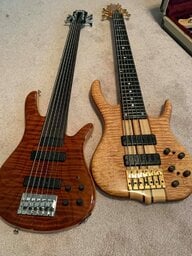
Looking at your pic, I’d be surprised if your B string doesn’t “go dead” before the higher strings. The B is particularly difficult to minimize saddle break.

Upright strings are a whole different animal with dramatically different core materials construction. FWIW
 
I set witness points by pressing down on the string in front of each saddle, and pressing down on each string behind the nut while holding the string down at the first fret. It does stretch the string to some degree, but maybe not how others stretch…
To me, this seems like a fair way to set the witness point at the nut, as I've always thought that pressing the string down too hard directly in front of the nut might wear down the front edge of the nut.
 
I apologize in advance if this is a topic that’s already been beaten to death.

I’ve always stretched new strings when I install them. Recently I saw a video, from DR I think, that said to never stretch your new strings, and that only poor quality strings need stretching to keep their pitch. They seemed to feel strongly enough about it to repeat the statement several times. So, of course, I’m now conflicted and seeking the wisdom for those who know. You folks. thanks!
Can you post a link to the video? I’m tempted to try the strings and complain when they won’t hold pitch instantly upon tuning up the first time lol.

But to answer your question I only stretch new strings if I want to be in tune.

I agree it’s likely just legal jargon, installing the string stretches it and they don’t warrant a stretched string, especially if you were misusing a string by stretching it out or removing it from its collectible keepsake safety packaging and you poke yourself in the eye
 
Last edited:
To me, this seems like a fair way to set the witness point at the nut, as I've always thought that pressing the string down too hard directly in front of the nut might wear down the front edge of the nut.
Yeah, I pressed pretty hard on a G string once and it broke the nut. The string was like a knife. The nut was some kind of plastic, not super cheap, but by no means a premium nut. Anyway, I've been more careful about this ever since.
 
  • Like
Reactions: zombywoof5050
I'm strongly opposed to stretching strings. All this does is prematurely "age" them. Even they're roundcore strings, it may actually "kill" them right after you put them on.

Put your new strings on and play them for a bit, an hour should do it. Re-tune as they stretch on their own. When they stretch on their own via playing and re-tuning, they stretch longitudinally. When you physically stretch them, they do so in a manner that can separate the wrap from the core.
 
I apologize in advance if this is a topic that’s already been beaten to death.

I’ve always stretched new strings when I install them. Recently I saw a video, from DR I think, that said to never stretch your new strings, and that only poor quality strings need stretching to keep their pitch. They seemed to feel strongly enough about it to repeat the statement several times. So, of course, I’m now conflicted and seeking the wisdom for those who know. You folks. thanks!
Their top-selling SKUs are roundcore which is why they don't advise stretching them.
 
  • Like
Reactions: Seth Miller
I'm strongly opposed to stretching strings. All this does is prematurely "age" them. Even they're roundcore strings, it may actually "kill" them right after you put them on.

Put your new strings on and play them for a bit, an hour should do it. Re-tune as they stretch on their own. When they stretch on their own via playing and re-tuning, they stretch longitudinally. When you physically stretch them, they do so in a manner that can separate the wrap from the core.
Spending an hour retuning every instrument during a string change would be impractical at best. Just learn to stretch the strings correctly and it will save you a lot of wasted time.
Here’s a secret - stretch the strings but just pretend you’re playing instead. Pop and slap and Bend at every fret, just do it quickly we don’t have an hour. The strings won’t realize they’re supposed to be ruined because they will think they just got played.:D
 
  • Like
Reactions: BlueTalon
Spending an hour retuning every instrument during a string change would be impractical at best. Just learn to stretch the strings correctly and it will save you a lot of wasted time.
Here’s a secret - stretch the strings but just pretend you’re playing instead. Pop and slap and Bend at every fret, just do it quickly we don’t have an hour. The strings won’t realize they’re supposed to be ruined because they will think they just got played.:D
My strings are settled in in ten to fifteen minutes. When I used to do studio work, I'd restring the night before and play ten to fifteen minutes.
 
Spending an hour retuning every instrument during a string change would be impractical at best. Just learn to stretch the strings correctly and it will save you a lot of wasted time.
Here’s a secret - stretch the strings but just pretend you’re playing instead. Pop and slap and Bend at every fret, just do it quickly we don’t have an hour. The strings won’t realize they’re supposed to be ruined because they will think they just got played.:D
Exactly! I've played many gigs on brand new sets of strings with about 5 minutes of breaking in, and the stretching I do isn't any harder on the strings than my normal playing style. I'll check the tuning on breaks, and I'll usually have to retune a bit with new strings, but the amount the tuning drops is usually imperceptible.
 
  • Like
Reactions: Rabidhamster
…..Put your new strings on and play them for a bit, an hour should do it. Re-tune as they stretch on their own. When they stretch on their own via playing and re-tuning, they stretch longitudinally. When you physically stretch them, they do so in a manner that can separate the wrap from the core.

+1.

I wind my new strings on, paying attention that I don’t allow the string to twist, then I tune them up to pitch. I play them for a bit, retune them as needed, and that’s it.

I’ve also never bothered with setting witness points. In fact, I’d never heard of setting witness points until a few years back.


BTW, That’s just my personal string mojo. And I’m not criticizing anyone from restringing their instruments differently as they see fit.
 
+1.

I wind my new strings on, paying attention that I don’t allow the string to twist, then I tune them up to pitch. I play them for a bit, retune them as needed, and that’s it.

I’ve also never bothered with setting witness points. In fact, I’d never heard of setting witness points until a few years back.


BTW, That’s just my personal string mojo. And I’m not criticizing anyone from restringing their instruments differently as they see fit.
I'm with you on the "witness point" thing. I've never done it either and I've designed or spec'd bass strings for quite a few well-recognized brands.
 
I’ve also never bothered with setting witness points. In fact, I’d never heard of setting witness points until a few years back.
I'm with you on the "witness point" thing. I've never done it either and I've designed or spec'd bass strings for quite a few well-recognized brands.
It always seemed a bit daft to me. So let's say I put a new set of strings on, and set the witness points. Then it turns out I need to adjust the intonation. Now what?
 
  • Like
Reactions: hasbeen