I use ernie ball hybrid slinky (45-105) on my musicman stingray bass. It seems like my A string is way to tight and high in tension. Is using a pack of strings with thinner gauges like regular super slinky (45-100) reduce the string tension? And is there any way to reduce the string tension in general?

Enjoy the benefits of a premium membership!
Upgrade Account
-
TalkBass has been independent since 1998. Add your voice.
Create a free account to reply to discussions, view embedded media, and browse with fewer display ads.
Join free Log in
Want zero display ads or expanded classifieds tools? Compare plans.
You are using an out of date browser. It may not display this or other websites correctly.
You should upgrade or use an alternative browser.
You should upgrade or use an alternative browser.
String gauges
- Thread starter Venturella
- Start date
-
- Tags
- strings
More options
Who Replied?
What you are experiencing is unbalanced tension. Some people dont care but you do as well as I.
45/60/80/105 would be a more balanced tension.
Maybe get two sets to make one or bassstringsonline.com and get singles.
More balanced is
45/60/80/105
50/65/85/110
40/55/75/100
45/60/80/105 would be a more balanced tension.
Maybe get two sets to make one or bassstringsonline.com and get singles.
More balanced is
45/60/80/105
50/65/85/110
40/55/75/100


I'm another one of those people who care about "balanced-tension".
I've always hated the traditional "medium-light" set, 45-65-80-100, because of the tight D and loose E, while "standard" sets like 40-60-80-100 and 45-65-85-105 usually have the middle two strings (D&A) tighter than the other two (G&E).
I like my set to be as close to "45-60-80-105" as possible, as suggested above by @shawshank72.
bassstringsonline.com does offer EB Slinky's in singles so you can put together a custom set to try out:
Invalid Link Removed
Invalid Link Removed
I've always hated the traditional "medium-light" set, 45-65-80-100, because of the tight D and loose E, while "standard" sets like 40-60-80-100 and 45-65-85-105 usually have the middle two strings (D&A) tighter than the other two (G&E).
I like my set to be as close to "45-60-80-105" as possible, as suggested above by @shawshank72.
bassstringsonline.com does offer EB Slinky's in singles so you can put together a custom set to try out:
Invalid Link Removed
Invalid Link Removed

Unfortunately, balancing the tension goes in a direction of unbalancing the tone and loudness of the strings. To balance the tension you typically need thinner D and thicker E. Look at D'Addario BT for instance. Such sets feel nice, but E usually sounds louder and somewhat boomier in a mix (unless some heavy compression is used), and the thinner strings sound just that-thinner. To get the tone and loudness even, you need thicker D and G strings Those 50-70-85-105 and 45-65-80-100 sets are not on the market for nothing. If you look at tension charts you'll see that they are heavily unbalanced in terms of tension. The reason of using them is because they sound better balanced, both in tone and loudness. Then you have the reasonable compromise, which is 45-65-85-105, or the so-called medium, standard... set. Still unbalanced, but not too bad.
To balance the tension you typically need thinner D and thicker E. Look at D'Addario BT for instance. Such sets feel nice, but E usually sounds louder and somewhat boomier in a mix (unless some heavy compression is used), and the thinner strings sound just that-thinner.
This is not the case in my experience. When I was using the Fender 9050L (45-60-80-100), the E always felt and SOUNDED somewhat weaker (or at least different in tone) than the rest. Now that I've been using the 9050CL (45-60-80-105) for the last three weeks, I find the E to be better balanced both in tension and TONE.
Having said that, though, I do agree with the notion that "balanced tension does not always translate to balanced tone". The string tension is only one of many factors involved in determining how your bass sounds as a whole.
Just to add to my post above...
Prior to discovering the Fender 9050L, I was using the D'A Chromes ECB84 (40-60-80-100) on my J bass. I never did like the way 40-G sounded (too bright compared to the rest) even after four years. The 9050L with the 45-G solved that problem.
Three of my favorite sets of strings for optimum balance both in tension and tone all have a smaller D and a bigger E.
Fender 9050CL, 45-60-80-105.
La Bella 760FL, 43-60-82-104.
GHS ML7200 (Pressurewound), 44-58-80-102.
Prior to discovering the Fender 9050L, I was using the D'A Chromes ECB84 (40-60-80-100) on my J bass. I never did like the way 40-G sounded (too bright compared to the rest) even after four years. The 9050L with the 45-G solved that problem.
Three of my favorite sets of strings for optimum balance both in tension and tone all have a smaller D and a bigger E.
Fender 9050CL, 45-60-80-105.
La Bella 760FL, 43-60-82-104.
GHS ML7200 (Pressurewound), 44-58-80-102.
Last edited:
In a system of a string and a magnetic pickup, the magnetic field strength (and the output) is proportional to the vibrating mass, which in turn, is proportional to the string thickness. Everything else equal, the thicker the string, the higher the output. You can easily verify this by recording your strings one at the time and comparing the amplitude of the resulting waveforms. This is one of the main reasons for using compressors.
Back to the OP...
If you've been using 45-65-85-105 and find the 85-A too tight, it's definitely an option for you to try 45-65-80-100. Only YOU can decide what works best for YOU.
Meanwhile, I would suggest you not get too hung up on this whole discussion about "balanced tension vs. balanced tone".
If you've been using 45-65-85-105 and find the 85-A too tight, it's definitely an option for you to try 45-65-80-100. Only YOU can decide what works best for YOU.
Meanwhile, I would suggest you not get too hung up on this whole discussion about "balanced tension vs. balanced tone".

You have to factor in tension and flexibility as well. With two strings, tuned to the same pitch since that's what we're talking about*, the one with larger gauge and mass has also more tension and less vibrating amplitude. Which one offsets the other? And to what extent? are there diminishing returns, and where? As Michael said, tension is but one factor, as are the magnetic properties of the string. A proper verification would entail putting gradually thicker strings tuned to the same pitch on the same instrument (something like, .050 .055 .060 .065 .070 of the same make and model, all on one five-string bass, all tuned to D), with as flat a radius as possible and a blade pickup. But then, without dissecting them and doing extensive analyses, you'd still know nothing about core-to-wrap ratios and other details. "All things being equal" comes with "which they never are".In a system of a string and a magnetic pickup, the magnetic field strength (and the output) is proportional to the vibrating mass, which in turn, is proportional to the string thickness. Everything else equal, the thicker the string, the higher the output. You can easily verify this by recording your strings one at the time and comparing the amplitude of the resulting waveforms. This is one of the main reasons for using compressors.

*OK, I'm aware the topic was balanced tension vs. tone, but the corollary is the selection of, say, a .060 vs. a .065 D.
It is getting a bit too much into physics here, but I'll try to explain. The vibrating amplitude does not factor into magnetic field strength, the energy input does. The fact that on a thinner string, the same energy input translates to a larger amplitude of vibration doesn't matter. This is the physics of things. It doesn't stop anyone of perceiving things differently however.
25-30 years ago, heavy top sets (like 50-105) were more common than they are today. Todays players are a lot more concerned about their own comfort than tone. We all see it. Everybody is moving to a lower tension and manufacturers respond accordingly. Think Dunlop Super Bright for example. Balanced tension is another thing. Everybody is complaining about how rough Rotosound SS are (back then, nobody was even thinking about that), etc...
To me, low tension is a trade off. Lower tension means higher action. Unless you have a very, very light touch IMO the benefits of lower tension bass strings are questionable and a matter of personal preference. I happen to prefer stiffer strings and low action without fret buzz, others may prefer vice versa.
25-30 years ago, heavy top sets (like 50-105) were more common than they are today. Todays players are a lot more concerned about their own comfort than tone. We all see it. Everybody is moving to a lower tension and manufacturers respond accordingly. Think Dunlop Super Bright for example. Balanced tension is another thing. Everybody is complaining about how rough Rotosound SS are (back then, nobody was even thinking about that), etc...
To me, low tension is a trade off. Lower tension means higher action. Unless you have a very, very light touch IMO the benefits of lower tension bass strings are questionable and a matter of personal preference. I happen to prefer stiffer strings and low action without fret buzz, others may prefer vice versa.
Uh, sorry, no, I don't get it. I'm interested though, so if you care going into deeper detail, please do.It is getting a bit too much into physics here, but I'll try to explain. The vibrating amplitude does not factor into magnetic field strength, the energy input does. The fact that on a thinner string, the same energy input translates to a larger amplitude of vibration doesn't matter. This is the physics of things.
EDIT: let's examine my thought experiment described above.
What you're saying is that, if we had a robot pluck or pick the strings with the same force, for every couple of adjacent strings the one of larger gauge would be invariably the louder (through the pickup of course). Am I interpreting you correctly?A proper verification would entail putting gradually thicker strings tuned to the same pitch on the same instrument (something like, .050 .055 .060 .065 .070 of the same make and model, all on one five-string bass, all tuned to D), with as flat a radius as possible and a blade pickup.
Last edited:
Yes they are, as long as you are using the same make and model of strings in different gauges on the same instrument. Talking about SS wraps, they don't matter much, since the type of SS used in strings is not magnetic. Nickel is magnetic , but if it is only a thin plating it wouldn't matter much either. Thus, you are left with the mass (and the diameter) of the carbon steel core, and this is the only thing that varies from gauge to gauge, i.e. say from 60 to 65 to 70 for a D-string.But then, without dissecting them and doing extensive analyses, you'd still know nothing about core-to-wrap ratios and other details. "All things being equal" comes with "which they never are".

I liked my Hybrid Ernie Balls when I was in standard tuning. Now I think they are too loose when tuned a full step down and drop C. I set my strings with really low action, too. I need to go bigger.


find a site that actually lists the string tensions .. !! either a sales site ( juststrings.com ) or try a manufacture's site ... there is more to a string's tension than just it's gauge . !

For what I know strings with a thicker section will require more force to achieve the same extension if compared to strings having a thinner section.
This not only makes strings harder to bite but also increase the bass neck bow as strings are pulled but they transfer their pill onto the neck as a compression force which acts eccentrically with respect to the center of gravity of the neck section, causing the neck to bow and increase the strings action.
I've got small hands and to play comfortably I've found very useful the particular Rotosound Funkmaster 66 a kind of very light gauge roundwound strings ending at 36 at the G string (if i am not mistaken).
These strings were developed by Rotosound and Mark King and are really nice to play.
This not only makes strings harder to bite but also increase the bass neck bow as strings are pulled but they transfer their pill onto the neck as a compression force which acts eccentrically with respect to the center of gravity of the neck section, causing the neck to bow and increase the strings action.
I've got small hands and to play comfortably I've found very useful the particular Rotosound Funkmaster 66 a kind of very light gauge roundwound strings ending at 36 at the G string (if i am not mistaken).
These strings were developed by Rotosound and Mark King and are really nice to play.
The 2nd and 3rd posts are correct.
> You have to factor in tension and flexibility as well. With two strings, tuned to the same pitch since that's what we're talking about*, the one with larger gauge and mass has also more tension and less vibrating amplitude.
Yes. String excursion also affects output, otherwise the output wouldn't rise the harder you play.
> balancing the tension goes in a direction of unbalancing the tone and loudness of the strings.
It can help too, the jump of gauge from D to G is smaller, so the tone progression improves there, helping make the tone of the G more consistent with the others, this is a common complaint.
To help with volume pickups can be tilted, however heavier AD strings may be due to neck radius and flat pickups, but then of course looser strings have more excursion which raises output and compensates, so might as well go with a more ergonomic and playable equal tensions.
> Those 50-70-85-105 and 45-65-80-100 sets are not on the market for nothing
At some point many decades ago traditional gauges were chosen, based on old technology, then a commercial vicious circle of demand and supply kept the tradition going. If every new bass has traditional gauges as stock that's what most players get used to right from the start (new players rarely question gauges), getting accustomed to the feel and tonal change across a set, then that's what they want to buy later, so that's what is provided by manufacturers with pre-packaging costs and shops with limited shelf space, so that's what players buy ... and the cycle goes on, it's hard to break but Kalium are doing it slowly.
> The reason of using them is because they sound better balanced, both in tone and loudness
Tonally that's subjective, it's just a different change of tone across a set, admittedly it can require some re-acclimatisation. Once you're used to it there's actually nothing worse about the tone of a balanced set, you realise it was a case of 'being used to the former'.
> Todays players are a lot more concerned about their own comfort than tone. We all see it. Everybody is moving to a lower tension
There's nothing worse about the tone of a looser string as long as it's above a certain practical limit (which rises for thicker strings, but is around 25-30 pounds), it's just different.
What's happeneing is good, players are realising that traditional 'acoustic contrabass' type tension is ridiculous, unhealthy, not very playable and completely unnecessary, bass guitar is moving towards actually being a bass *guitar* instead of an 'electric contrabass' which is the original concept of the P-bass.
I find so-called 'medium' sets unplayably tight, it's a significant effort to hold a string firmly against a fret, bass should not be only for the strong.
Having used balanced sets i've gone one step further, which is tension falling from low to high like some guitar sets, there are actually many good playability reasons for this but would be too shocking for most bassists. It is however the future and the next revolution after balanced sets.
It's a case of accepting the tonal change of higher, thinner and looser strings, instead of the futile attempt to avoid it.
> You have to factor in tension and flexibility as well. With two strings, tuned to the same pitch since that's what we're talking about*, the one with larger gauge and mass has also more tension and less vibrating amplitude.
Yes. String excursion also affects output, otherwise the output wouldn't rise the harder you play.
> balancing the tension goes in a direction of unbalancing the tone and loudness of the strings.
It can help too, the jump of gauge from D to G is smaller, so the tone progression improves there, helping make the tone of the G more consistent with the others, this is a common complaint.
To help with volume pickups can be tilted, however heavier AD strings may be due to neck radius and flat pickups, but then of course looser strings have more excursion which raises output and compensates, so might as well go with a more ergonomic and playable equal tensions.
> Those 50-70-85-105 and 45-65-80-100 sets are not on the market for nothing
At some point many decades ago traditional gauges were chosen, based on old technology, then a commercial vicious circle of demand and supply kept the tradition going. If every new bass has traditional gauges as stock that's what most players get used to right from the start (new players rarely question gauges), getting accustomed to the feel and tonal change across a set, then that's what they want to buy later, so that's what is provided by manufacturers with pre-packaging costs and shops with limited shelf space, so that's what players buy ... and the cycle goes on, it's hard to break but Kalium are doing it slowly.
> The reason of using them is because they sound better balanced, both in tone and loudness
Tonally that's subjective, it's just a different change of tone across a set, admittedly it can require some re-acclimatisation. Once you're used to it there's actually nothing worse about the tone of a balanced set, you realise it was a case of 'being used to the former'.
> Todays players are a lot more concerned about their own comfort than tone. We all see it. Everybody is moving to a lower tension
There's nothing worse about the tone of a looser string as long as it's above a certain practical limit (which rises for thicker strings, but is around 25-30 pounds), it's just different.
What's happeneing is good, players are realising that traditional 'acoustic contrabass' type tension is ridiculous, unhealthy, not very playable and completely unnecessary, bass guitar is moving towards actually being a bass *guitar* instead of an 'electric contrabass' which is the original concept of the P-bass.
I find so-called 'medium' sets unplayably tight, it's a significant effort to hold a string firmly against a fret, bass should not be only for the strong.
Having used balanced sets i've gone one step further, which is tension falling from low to high like some guitar sets, there are actually many good playability reasons for this but would be too shocking for most bassists. It is however the future and the next revolution after balanced sets.
It's a case of accepting the tonal change of higher, thinner and looser strings, instead of the futile attempt to avoid it.
Last edited:
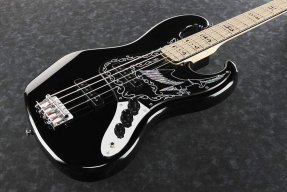
Put me down as someone who has ended up with unbalanced volume with balanced tension strings.
Traditionally pickups are flat but string action is radiused. The result is that th middle two strings are further from th pickup than the outer two. In the trial-and-error days a set with thicker A and D strings sounded better. To most players the sound is easier to notice, or was more important, than the feel.
My newer Ibanez with curved soapbars had no issue with balanced sets but when I moved to an older PJ Ibanez it was apparent on the J end of things.
Flatter fingerboards or curved pickups can mitigate the drawbacks of radiused stringbeds over olds school pickups.
All this is often forgotten in the numbers game of balancing tension based on string spec only.
Traditionally pickups are flat but string action is radiused. The result is that th middle two strings are further from th pickup than the outer two. In the trial-and-error days a set with thicker A and D strings sounded better. To most players the sound is easier to notice, or was more important, than the feel.
My newer Ibanez with curved soapbars had no issue with balanced sets but when I moved to an older PJ Ibanez it was apparent on the J end of things.
Flatter fingerboards or curved pickups can mitigate the drawbacks of radiused stringbeds over olds school pickups.
All this is often forgotten in the numbers game of balancing tension based on string spec only.
This is a new one for me. Have you got a source? Because, for what it's worth, I've found multiple references to the contrary.Talking about SS wraps, they don't matter much, since the type of SS used in strings is not magnetic. Nickel is magnetic , but if it is only a thin plating it wouldn't matter much either. Thus, you are left with the mass (and the diameter) of the carbon steel core, and this is the only thing that varies from gauge to gauge, i.e. say from 60 to 65 to 70 for a D-string.
According to a Rick Aiello, who (says) is a chemist and a maker of pickups and other stuff,
Stainless" Strings Alloy Questions. - The Steel Guitar ForumThe stainless steel windings are generally martensitic/400 series stainless steel ... which is ferromagnetic.
For the record, I'm not one to insist on "balanced tension" for its own sake, although I do have to admit I USED TO live and die by the numbers. Now that I've matured a bit, if I had to choose between "balanced tension" and "balanced tone", I would take the tone over the tension.
That said, it just so happens, at least in my case, I've been able to achieve balanced tone by balancing tensions in most cases. Or, let me put it this way - my attempt at balancing the tensions as much as possible for optimum playability has compromised very little in having a balanced tone.
That's all I have to say about that.
That said, it just so happens, at least in my case, I've been able to achieve balanced tone by balancing tensions in most cases. Or, let me put it this way - my attempt at balancing the tensions as much as possible for optimum playability has compromised very little in having a balanced tone.
That's all I have to say about that.
Last edited:


