• TalkBass has been independent since 1998. Add your voice.
    Create a free account to reply to discussions, view embedded media, and browse with fewer display ads.
    Join freeLog in
    Want zero display ads or expanded classifieds tools? Compare plans.

Double Bass String height creeping up on my Shen SB 80

Fat Steve

The poodle bites, the poodle chews it.
Hello all,

I've had my Shen SB80 for about 20 months. It's got an adjustable bridge. When I first got it, the adjusters would allow the bridge to go so low that the strings were within a 1/8"* of the fingerboard. As of the last couple months, the lowest I can get them are about 5/16"* above the fingerboard, which is a little high for my liking. The bridge doesn't appear to have moved forward or backward at all, nor does it appear that the the neck is becoming separated from the body. What other causes might there be for the action to steadily increase on a DB? Going to a luthier is out of the question financially at the moment, hence my attempt to better understand the issue first. Thanks in advance for any insight.

*Measurements are approximations from memory. I'm away from the bass at the moment.
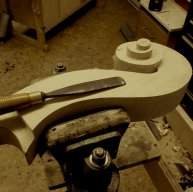
 
Put a straight edge up against the line where the fingerboard is glued to the neck, you should be able to see if the neck is bending forward. A little deflection is to be expected with a couple of hundred pounds of string tension. But if it is greater than lets say 3/32nds or so...
 
I don't know of any way to "prove" this, but one phenomenon that happens with age, on violin-family instruments, is that the belly arching gets higher. This seems counterintuitive, but remember that all that string tension is compressing the front, end to end. That much pressure on an already curved plate will tend to curve it more, not less. The back plate, of course, is under tension, and, in carved-back (round-back, like a violin) instruments, will tend toward flattening. So, in spite of the constant downward pressure of the bridge feet, the heaviest load on the top plate is longitudinal and compressive. The arch gets higher and higher. (This is especially noticeable in older violins and violas with very thin tops.)

If that is what is happening, then it would explain your string clearances increasing, even if the neck stays dead straight. It would tend to make the soundpost looser, too, I think, but not as fast, since the bridge keeps trying to force the center down, and the back (on round-back instruments) tends to come up. Kind of complex, but demonstrably true...I may be missing some small points...someone with deeper understanding may step in and clear things up, I hope.
 
No, it's not normal. No, that much bend of the neck is not normal. On DBs, tops often sink. As I understand it, the substantial downward pressure on the top from the bridge feet counters any theoretical swelling of the belly resulting from longitudinal forces. Luthiers? In any case, tge magnitude of the change described by the OP on a young bass is not normal and not likely the result of such effects.
 
Last edited:
Hello all,

I've had my Shen SB80 for about 20 months. It's got an adjustable bridge. When I first got it, the adjusters would allow the bridge to go so low that the strings were within a 1/8"* of the fingerboard. As of the last couple months, the lowest I can get them are about 5/16"* above the fingerboard, which is a little high for my liking. The bridge doesn't appear to have moved forward or backward at all, nor does it appear that the the neck is becoming separated from the body. What other causes might there be for the action to steadily increase on a DB? Going to a luthier is out of the question financially at the moment, hence my attempt to better understand the issue first. Thanks in advance for any insight.

*Measurements are approximations from memory. I'm away from the bass at the moment.

Hi Steve,
It would be easy enough for your luthier to let you know what's going on with a simple check over that shouldn't run you any cash.
Aaron Allen's point about the bridge is a good one.
 
...except that as the bridge departs from vertical, the string height would become progressively lower, not higher.