
Enjoy the benefits of a premium membership!
Upgrade Account
-
TalkBass has been independent since 1998. Add your voice.
Create a free account to reply to discussions, view embedded media, and browse with fewer display ads.
Join free Log in
Want zero display ads or expanded classifieds tools? Compare plans.
You are using an out of date browser. It may not display this or other websites correctly.
You should upgrade or use an alternative browser.
You should upgrade or use an alternative browser.
String Spacing Rant and Other Musings
- Thread starter Jack Deth
- Start date
More options
Who Replied?

Possibly hard to see in this image; but, Alembic S/N 001 had sliding pickups. that was the first I became aware of ca. 1973-ish.

Many bridges, such as the HipShots, offer a range of spacing adjustments. so, these things are out there.
As to why Fender has not embraced such features; I suspect they are selling the P’s and J’s with sufficient market share, such that they just don’t think too much about it.
Many bridges, such as the HipShots, offer a range of spacing adjustments. so, these things are out there.
As to why Fender has not embraced such features; I suspect they are selling the P’s and J’s with sufficient market share, such that they just don’t think too much about it.

My adjustable Warwick bridge is cool but having tried a bunch of different types, I prefer simplicity. (Had too many issues with elaborately engineered bridges seizing up and/or needing some obscure part.)

Furthermore, why isn’t it possible to create a pickup mounting system that allows the pickup(s) to slide forward and backward to adjust where you want it (them) to be between the bridge and neck? Seems like a trivial engineering puzzle to solve in today’s world of pocket supercomputers and terminator-like robots that have been built recently
It’s been done (Gibson Grabber bass) and it’s not a trivial engineering challenge. It’s difficult to maintain a reliable and quality electrical connection between two moving parts. After awhile parts begin to wear. And you also get contamination and oxidation since the contacts aren’t in a sealed environment. So you begin to get noise and signal dropouts.
I’m curious if there is a reason why bridges simply don’t have adjustable string spacing. I realize that could cause issues with the pickup poles, so why can’t they simply have a similar adjustment.
Some bridges do provide for a limited range lateral adjustment.
Pickups don’t need the capability. The “problem” of variable string spacing was simply and neatly solved by the introduction of “blade” type pickups that don’t use individual pole pieces.
Last edited:


All, thanks for the responses, I obviously have more in-depth research to do. I did search, just couldn’t find hardly anything on the obscure topics.
My stock Fender bridges allow for adjustment side to side. There are some Fender bridges that have multiple small grooves kind of like a screw thread. A little bit of adjustment goes a long way.
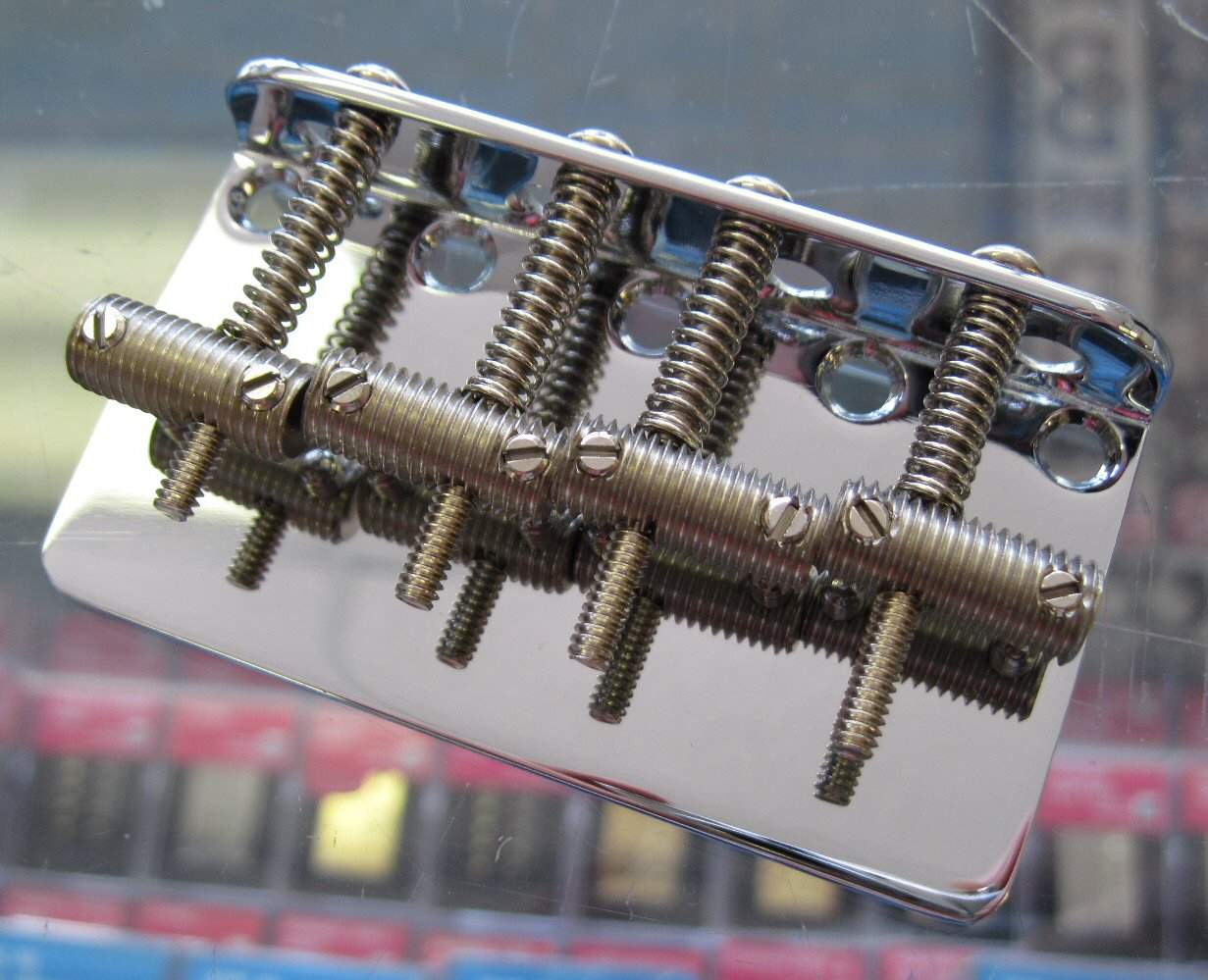

Wilkinson used to make a bridge back in the 90's called the 3D that had adjustable spacing. The string mounts and saddles were on a sort of rail at the back, and there was a small set screw that loosened them up so you could slide it back and forth to adjust the spacing. I have these on a couple of my basses. It really came in handy when I converted a bass from 6-string to 5-string, as all the other production bridges I checked out were either a little too narrow or a little too wide.

IIRC, I think these didn't catch on because they got a reputation for being not too stable. The first one I had did have problems with the big screws warping a bit, but my others have been working great for a couple of decades now.
-Y
IIRC, I think these didn't catch on because they got a reputation for being not too stable. The first one I had did have problems with the big screws warping a bit, but my others have been working great for a couple of decades now.
-Y


terminator-like robots that have been built recently.
Uhhhh....what?!
PS: my Hipshot bridges have a small amount of lateral adjustment


If I'm going to pay all that money for a bass, I expect the tone and blend settings to already be in the right place. I don't want to have to make that adjustment myself!If I'm going to pay all that money for a bass, I expect the strings and the pickups to already be in the right place. I don't want to have to make that adjustment myself!
My stock Fender bridges allow for adjustment side to side. There are some Fender bridges that have multiple small grooves kind of like a screw thread. A little bit of adjustment goes a long way. View attachment 3921072
You stole my thunder, because I was going to mention the 60's Fender bridge. It's definitely a poor man's adjustable string spacing but it does work for very minor tweaks. I have this bridge on my jaco pastorius and I do use the threaded barrels to fine-adjust the spacing. The problem is trying to go narrower, especially on the E and G strings. The string pull to the outside tends to force the saddles to splay outward, defeating the purpose and making your bridge saddles look all goofy. So it's not ideal.
Meanwhile, probably the reason you don't see adjustable spacing on bridges and variable PU positioning is kind of like electric seat adjustments in a car. Once you get the seat in the right place when you first get the car, you never adjust it ever again and the electrics rot and quit working years ago and you never noticed it, etc... Probably the same thing on a bass - it's not really cost effective to buy a bunch of complicated adjustment that you'll only ever use once and never again. That's probably why those features were thought of and offered but never caught on after the first time.
L

I used a Schaller roller bridge on my home build primarily for the adjustibility. After the install, I gave it a small tweak, and haven't touched the spacing in 25 years. No regrets....it's a great bridge, at a reasonable price. The strings are EXACTLY where I want them.
I think this may be the answer (or hinting at it). Most people tend to have a preference for a particular spacing, or not care at all. Adjustability is mostly beneficial when it allows for accommodating things that change over time (preferences, needs, wants). With largely stable or non-existent preferences like string spacing, adjustability offers little value. Particularly for mass-produced basses. Boutique basses often feature adjustable aftermarket bridges like Hipshot, in part to satisfy the buyer and their desire to fine tune the bass to their needs/wants, and I think they may be preferable for small-scale builders that make a variety of unique designs where they can use the same bridge model on different bass models.
Sliding pickups are a far more interesting idea, but really hard to execute well. It creates problems with functionality, reliability and aesthetics. Plus, most people seem to be happy with the options offered by pickup switching and EQ. IMO, IME, the most significant tonal impact comes from moving the bridge pickup when blended with a neck pickup (due to comb filtering). I think the most viable solution is what Wood & Tronics did - essentially moving a coil (or a couple) inside a large bridge pickup. Similar to what Fodera did for Pope, but they left the ugly large hole (which is aesthetically a no-no in my book).

I’m curious if there is a reason why bridges simply don’t have adjustable string spacing. I realize that could cause issues with the pickup poles, so why can’t they simply have a similar adjustment. Does anyone know of a reason that is not possible? Furthermore, why isn’t it possible to create a pickup mounting system that allows the pickup(s) to slide forward and backward to adjust where you want it (them) to be between the bridge and neck? Seems like a trivial engineering puzzle to solve in today’s world of pocket supercomputers and terminator-like robots that have been built recently.
Gibson made a bass with a sliding pickup back in the seventies ... the Grabber (IIRC). My guess is that it didn't sell very well as I've never seen one in a store or being played on stage live or in pictures. As far as bridges with adjustable string spacing ... there are a few that I know of: Hipshot Type A, some later models of Leo Quan Badass II and III bridges have threaded bridge saddles that give you some flexibility on string spacing. The Fender post - 1995 American Standard P and J threaded saddle bridges offer some string spacing flexibility. There's also the Schaller Roller Bridge mentioned earlier that does a good job of fine tuning the string spacing. I have a pretty good idea that there are plenty of other bridges out there that have string spacing adjustment capabilities.

Just because it's possible doesn't mean it's accepted *cough*GibsonRobot*cough*Seems like a trivial engineering puzzle to solve in today’s world of pocket supercomputers and terminator-like robots that have been built recently.

One of the reasons I bought a KickAss bridge was to experiment with different spacing - works very well!

1) Many bridges do have multiple grooves in the saddles, like the Fender Am. Std. bridge, or like my Ibby, have adjustable lateral adjustment per string.I’m curious if there is a reason why bridges simply don’t have adjustable string spacing. I realize that could cause issues with the pickup poles, so why can’t they simply have a similar adjustment. Does anyone know of a reason that is not possible? Furthermore, why isn’t it possible to create a pickup mounting system that allows the pickup(s) to slide forward and backward to adjust where you want it (them) to be between the bridge and neck? Seems like a trivial engineering puzzle to solve in today’s world of pocket supercomputers and terminator-like robots that have been built recently.
2) Gibson Grabber bass.

I love these simple bridges, I used to look down on them but threaded saddles work great and adjust on the fly evenMy stock Fender bridges allow for adjustment side to side. There are some Fender bridges that have multiple small grooves kind of like a screw thread. A little bit of adjustment goes a long way. View attachment 3921072
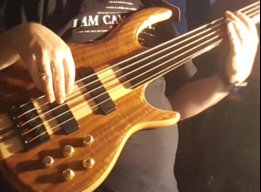
and Carvin/Kiesel - been using their adjustable spacing bridges for years. Excellent stuff. But it doesn't feel right on a neck to narrow it down... too much neck to the edges!Bridges with adjustable string spacing are available on production models, such as instruments made by Warwick and Ibanez. I am sure there's more that do it, they were just the first manufacturers I thought of.
I did this with a Carvin Bromberg 5 string with 19mm spacing... that was just too wide for a five, for me. But it looked funny and felt a little odd when I changed it to 17mm... lots of extra space on the B string side of the fingerboard's edge. I think that's the biggest reason why not to have adjustable string spacing... the neck width generally is chosen to match well with the string spacing.
Last edited:


