

Enjoy the benefits of a premium membership!
Upgrade Account
-
TalkBass has been independent since 1998. Add your voice.
Create a free account to reply to discussions, view embedded media, and browse with fewer display ads.
Join free Log in
Want zero display ads or expanded classifieds tools? Compare plans.
You are using an out of date browser. It may not display this or other websites correctly.
You should upgrade or use an alternative browser.
You should upgrade or use an alternative browser.
String Spacing Rant and Other Musings
- Thread starter Jack Deth
- Start date
More options
Who Replied?

I’m curious if there is a reason why bridges simply don’t have adjustable string spacing. I realize that could cause issues with the pickup poles, so why can’t they simply have a similar adjustment.
I've checked the magnetic field of dipole pickups such as the Fender style using EMG magnetic field viewing tape at the normal string to pickup distance and the field is a contiguous strip over and between the poles and not discrete pools around the poles so there is no practical reason to be concerned that moving the string within that contiguous area will effect the tone or volume. I've used bridges with adjustable spacing for years with no ill effect from moving the strings

Just to put things in perspective, Fender did adjustable bridge spacing, starting in 1957 with this very practical and effective approach. They still sell them.
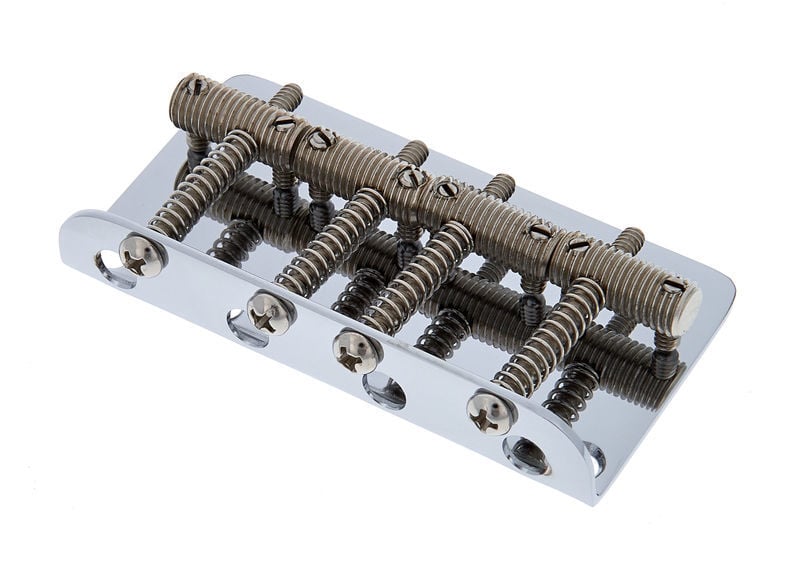
Fender apparently abandoned the sensible design for a while, but have re-introduced the same principle in the last few years, but in a modern and attractive package.
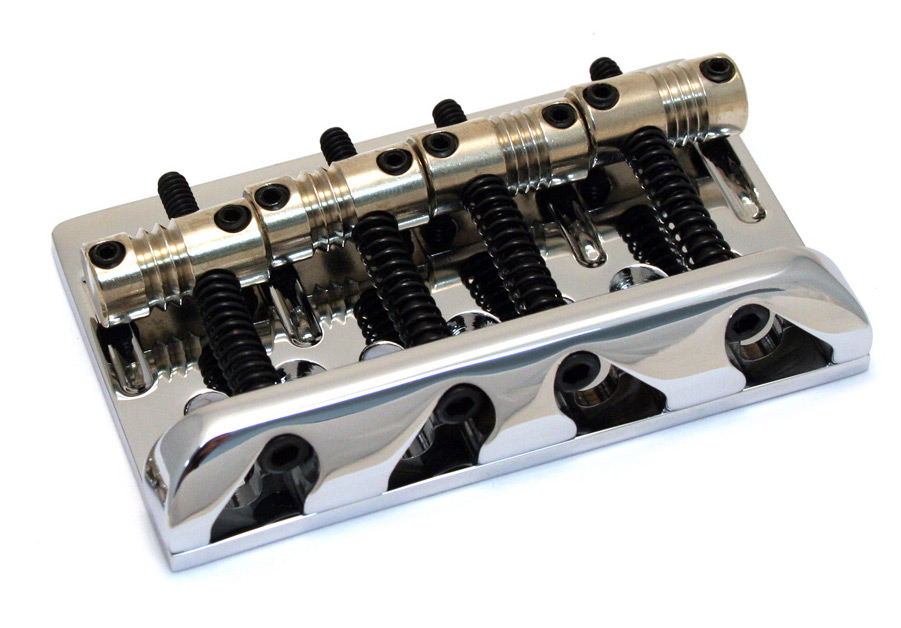
Fender apparently abandoned the sensible design for a while, but have re-introduced the same principle in the last few years, but in a modern and attractive package.

Since last year Cort makes this "Jack of all trades" model named GB74 GIG with an adjustable string space Omega bridge. The price of this bass is not exactly Cort'y though.
You know, when i got my Steinberger L2-5, the one with the extra narrow spacing ... well, it has taken me a week to get perfect comfy with; one's gotta think music, not string spacing.
I've swapped between several different string spacings ranging from Fender standard to Hofner and it took very little time to get used to it. Unfortunately, after a minor stroke 2 years ago that effected my right side, swapping to more narrow spacing was a problem since my fingers didn't work as well as they did and I would hit the wrong string or miss a string completely on the narrow spacing so I had to bench my Hofners while I did some healing. After about a year and a half I was able to work the Hofners back in and now it's no problem.

Couldn't care less whether the polepieces line up with the strings. That's all OCD stuff to me, and I don't have it. And there are plenty of bridges that have adjustable string spacing, starting with this one that first appeared in 1958, I believe:

Just to put things in perspective, Fender did adjustable bridge spacing, starting in 1957 with this very practical and effective approach. They still sell them.
View attachment 3921469
My all time favorite bridge. Elegant and genius in it's simplicity.
I played one of those BITD. Sounded awful no matter where the pickup was positioned.
My stock Fender bridges allow for adjustment side to side. There are some Fender bridges that have multiple small grooves kind of like a screw thread. A little bit of adjustment goes a long way. View attachment 3921072
Definitely with different string gauges. I used to be a fan of 130+ B strings until I tries the low B flat that Fender used to make. It would have been nice to be able to slide the big B string a little further away from the E string

I’m curious if there is a reason why bridges simply don’t have adjustable string spacing. I realize that could cause issues with the pickup poles, so why can’t they simply have a similar adjustment. Does anyone know of a reason that is not possible? Furthermore, why isn’t it possible to create a pickup mounting system that allows the pickup(s) to slide forward and backward to adjust where you want it (them) to be between the bridge and neck? Seems like a trivial engineering puzzle to solve in today’s world of pocket supercomputers and terminator-like robots that have been built recently.
My Fender Precision’s saddles have several grooves each spanning 3/8”. My Warwick, have saddles that can be moved side to side and locked in place with a set screw.
I’m going to venture a guess the saddles on my PJ could have been and aftermarket acquisition, but something like that is a quick fix.
My all time favorite bridge. Elegant and genius in it's simplicity.
Right? Dunno if Fender thought of it first (he may have), but when it debut'd in 1957 I can imagine other guitar builders thinking...."threaded saddles, why didn't we think of that!"
As much as I love the old Fender design, it is not pretty by today's standards, but it was never meant to be seen. I admit that the new one is a handsome piece of metalwork and should be just as functional. It also satisfies players who want a bridge with more mass.
Couldn't care less whether the polepieces line up with the strings. That's all OCD stuff to me, and I don't have it. And there are plenty of bridges that have adjustable string spacing, starting with this one that first appeared in 1958, I believe:
View attachment 3921494
I feel the same way about obsessing over "tight neck pockets". As if some tiny bit of lateral tightness is going to add one iota of clamping force to 4-6 torqued-down wood screws. It's not, and I could pose a question to the tight pocket believers that would be very hard to answer. And I'm not even an engineer!


That would be cool if it was real.
US Robotics. It’s real. Scary stuff they have for sure. They made a dog, and what looks like a pack mule too.

Right? Dunno if Fender thought of it first (he may have), but when it debut'd in 1957 I can imagine other guitar builders thinking...."threaded saddles, why didn't we think of that!"
As much as I love the old Fender design, it is not pretty by today's standards, but it was never meant to be seen. I admit that the new one is a handsome piece of metalwork and should be just as functional. It also satisfies players who want a bridge with more mass.
I really like these Fender HMV bridges. They're solid, their sound is true, they're rugged and all adjustments are very precise. I like how the ball ends of the strings can only mount to the back of the bridge one way which locks them in place and helps to avoid twisting the strings upon install. I also like the allen wrench adjustability of the bridge pieces forward/back screw ... it adds precision and prevents the screw from tightening/loosening on it's own. I have that HMV bridge on four of my basses and consider it to be about as good as anything, IMHO.
Last edited:
US Robotics. It’s real. Scary stuff they have for sure. They made a dog, and what looks like a pack mule too.
The robots in the video you posted are fake.
The robots in the video you posted are fake.
I guess nobody informed DARPA that they were fake:
Invalid Link Removed
Side note: I was wrong, just only about the company name. It’s actually Boston Dynamics, my apologies.
Home | Boston Dynamics
[EDIT: the contest for DARPA is what resulted in those robots. The one in my original post was not a winner back then because it is more recent, but that company had one that was really eerie.]
[EDIT 2: Atlas (robot) - Wikipedia]
Last edited:
I guess nobody informed DARPA that they were fake:
Invalid Link Removed
Side note: I was wrong, just only about the company name. It’s actually Boston Dynamics, my apologies.
Home | Boston Dynamics
[EDIT: the contest for DARPA is what resulted in those robots. The one in my original post was not a winner back then because it is more recent, but that company had one that was really eerie.]
[EDIT 2: Atlas (robot) - Wikipedia]
I realize robots are real, I'm just saying the ones in the first video you showed is clearly fake.
Did you look at the Atlas robot from that DARPA research? Let’s assume the first video is in fact CGI generated. The Boston Dynamics Atlas robot by itself is proof enough.
[EDIT: that first vid was in fact a spoof, you are correct. I still stand by my statement though that they are real.]
[EDIT: that first vid was in fact a spoof, you are correct. I still stand by my statement though that they are real.]


