Tonight my new Bass Player magazine came. Kind of makes me look forward to going to the bathroom. But that's another story...
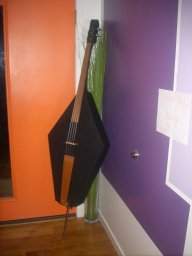
In this issue, Ed Friedland reviewed a new King-type plywood upright optimized in a bunch of ways for slap playing. He noted that the angle made by the strings going over the bridge was shallower (closer to flat, I guess) than is typically the case and he suggested that this resulted in lower tension in the strings.
Now call me a crotchety old physicist, but where I come from string tension is completely determined by frequency (pitch), mass/length of the string, and string length. The angle a string might make coming over the nut or bridge don't enter into it. (Although I do buy his other point that it might influence the likelihood of breaking a string while wailing away on it in a slapping frenzy.)
Have I missed something here?
In this issue, Ed Friedland reviewed a new King-type plywood upright optimized in a bunch of ways for slap playing. He noted that the angle made by the strings going over the bridge was shallower (closer to flat, I guess) than is typically the case and he suggested that this resulted in lower tension in the strings.
Now call me a crotchety old physicist, but where I come from string tension is completely determined by frequency (pitch), mass/length of the string, and string length. The angle a string might make coming over the nut or bridge don't enter into it. (Although I do buy his other point that it might influence the likelihood of breaking a string while wailing away on it in a slapping frenzy.)
Have I missed something here?