• TalkBass has been independent since 1998. Add your voice.
    Create a free account to reply to discussions, view embedded media, and browse with fewer display ads.
    Join freeLog in
    Want zero display ads or expanded classifieds tools? Compare plans.

String won't stay in nut slot

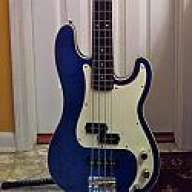
The A string was fine when I got it, but I put flats on it and that happened. I fixed that problem by winding the string down the tuning peg so it stays in now.
first I set the intonation, then did some truss rod adjustment. That was when I started this post. Now I've raised the bridge saddles to try and stop the buzzing, but I'm still getting a little and the saddles are maxed out :confused:


Here are a few things I keep in mind when setting up my basses

Try loosening the strings then turning the truss rod counter clockwise by ~1/4 - 1/2 turn. Then tighten up the strings and see if the buzzing goes away. If it does lower the saddles until the buzzing starts again and then raise them just enough to stop the buzzing. Then set the intonation. Repeat the above steps until you get the action low enough for you. Go little by little and play it a bit after every cycle of adjustments. You will need to tweak the truss rod less and less each time.

If the truss rod is too tight then you will get buzzing at the 1st few frets near the head stock caused by the neck being too flat. If it buzzes down towards the bridge then the saddles are too low. A lot of times on Fender basses the end of the fret board near the bridge ramps up a bit causing the highest fret to buzz. A luthier can fix this by dressing the frets near the end towards the bridge. You probably don't want to try this yet.

Take the neck off and see if someone put a shim in there. This can cause the problem you have with the saddles being maxed out and still getting buzz. Remove the shim and try setting it up again. I had this problem with a used Jazz bass that I bought here. Removing the shim made it much better. The guy I bought it from said that he brought it to a bad Luthier for a set up.

Good luck

 
Make sure the nut slot is at least half the depth of the string, but preferably more.

Past that make sure on the E and A strings (or any string without a string tree) are wound all the way down the tuning post. With an angled headstock it is not as essential as a flat headstock.

If your nut slot is cut too low it can cause buzzing in the first few frets. If it is buzzing from frets 5-12 only, then it is probably back bow.

Also get a precision straight edge and check for high frets.
 
GC and Sam Ash are just the only places I've ever been to. If anyone knows somewhere else in Atlanta or north of the Perimeter off 75 I'd appreciate any recommendations

No reputable instrument repair shops in the Atlanta area?

I think I'm just gonna take it to GC tomorrow

More often than not, not the best idea....this search took about 27 seconds: Invalid Link Removed
 
GC and Sam Ash are just the only places I've ever been to. If anyone knows somewhere else in Atlanta or north of the Perimeter off 75 I'd appreciate any recommendations

I agree with Immigrant about avoiding GC and/or Sam Ash but sometimes you can get lucky and find someone who knows what they are doing. When you go there, don't just drop off your bass. Ask to see the person who will be working on it. If that person knows what they're doing, they'll see the problem right away. If they give you the deer in the headlights look, take your bass somewhere else.

There's lots of good videos at YouTube that show you how to setup your bass. I've learned a lot of setup tips on YouTube. :bassist:
 
See JLS above, re: shops nearby.

I hate to be contrary, but, without actually holding the instrument in your hands, it's nearly impossible to tell from the pictures that there is any twist in the neck.

It sounds as though the truss rod is a bit tight. When turning it, turn it only about an 8th of a turn at a time and check the neck each time before making another change. The string wrap on the post is very important as a Fender type headstock is perfectly flat with respect to the neck. The string needs to be wrapped as many turns as will fit to create enough string pressure on the nut. It sounds as though you have already done this.
 
Make sure the nut slot is at least half the depth of the string, but preferably more.

If your nut slot is cut too low it can cause buzzing in the first few frets. If it is buzzing from frets 5-12 only, then it is probably back bow.

Also get a precision straight edge and check for high frets.

A bit of a correction -There is no advantage to having a not slot deeper than half the string thickness. Any part of the slot that is above the centreline of the string diameter is not holding the string at all.

And please note that a too low nut will not cause buzzing when fretting the first few frets.
 
I'm sure there are, I'm just not aware of them, that's why I asked for recommendations. I know the bass gallery is downtown, but I think I would feel silly taking my Squier into a shop that stocks Alembic
I am of the mindset that learning to set it up and repair it is the best answer. I also realize that its not for everyone. Check out some tutorials again and work slowly and methodically. U will get it right. And dont be embarrassed about what u play. We all start somewhere and that bass will play fine with a good setup. I setup a 100 dollar ibanez that played as nice as an expensive schecter.
 
I am of the mindset that learning to set it up and repair it is the best answer. I also realize that its not for everyone. Check out some tutorials again and work slowly and methodically. U will get it right. And dont be embarrassed about what u play. We all start somewhere and that bass will play fine with a good setup. I setup a 100 dollar ibanez that played as nice as an expensive schecter.

That was really a big reason why I got this bass, I want to learn how to do most of the work myself. And I'm not embarrassed at all about what I play, my point was that I don't want to spend $100 to get the bass playable when I only paid $300 for it in the first place
 
Update: so I took it into GC on a recommendation with a friend that the repair guy there does good work. As a test, I took it in and had him replace the input jack (it was loose) and did not say anything about the neck. When he finished, he asked if I knew that the neck had some problems. He told me that it was a little twisted, but still fixable. He said my best bet was to do a fret level and re-crown. So now I know what my next step is
 
He told me that it was a little twisted, but still fixable. He said my best bet was to do a fret level and re-crown. So now I know what my next step is
To get the neck heated and straightened, I would think. A re-crown might be a little tough on a twisted neck.

without actually holding the instrument in your hands, it's nearly impossible to tell from the pictures that there is any twist in the neck.
;)
 
To get the neck heated and straightened, I would think. A re-crown might be a little tough on a twisted neck.

;)

He said, and I believe him, that the twist isn't bad enough that a nice fret level wouldn't make it play beautifully. As I have it set up now, there is no fret buzz and it feels great to play, the slight twist is not noticeable at all.

There is no way I would pay to get this neck heated and straightened, it's just not worth it
 
He said, and I believe him, that the twist isn't bad enough that a nice fret level wouldn't make it play beautifully. As I have it set up now, there is no fret buzz and it feels great to play, the slight twist is not noticeable at all.

There is no way I would pay to get this neck heated and straightened, it's just not worth it

Cool that it worked out for you so far. If the neck continues to twist, I'd recommend against getting any fretwork done until you have the neck straightened or even replaced. You can get a replacement Mighty Mite neck for about $100 (I have), or there's a place called Warpedneck.com that guarantees results or you pay nothing. I believe their starting rate is $75. I don't think you can get a DECENT level/crowning/dressing for that.

Congrats!
 
Cool that it worked out for you so far. If the neck continues to twist, I'd recommend against getting any fretwork done until you have the neck straightened or even replaced. You can get a replacement Mighty Mite neck for about $100 (I have), or there's a place called Warpedneck.com that guarantees results or you pay nothing. I believe their starting rate is $75. I don't think you can get a DECENT level/crowning/dressing for that.

Congrats!

I'm actually planning on trying it myself. I got this bass as a project to teach myself this kind of stuff, so I think it'll be a good experience
 
That`s bizarre! :eek:

There's actually some good ergonomic engineering in it. But it's not without it's own set of problems. A twist in the neck will not present a problem on a properly configured instrument if the line on the fingerboard below each string is truly flat (or actually with the proper relief). Even if it is, there is a problem with a conventional trussrod in such a neck. The trussrod can do an adequate job in a single plane, but if that plane is rotating there's not much chance that it can be effective in all vectors. Fret levelling also becomes a big deal. It still can be done, but there's a whole other level of complexity involved.

I personally find that the ergonomics don't work for me and certainly aren't worth the aggravation. YMMV