I bought a 2008 1/2 size Shen that I am quite enjoying overall but the thing looks like an Engelhardt: Thick cherry red nitrocellulose lacquer thats so opaque one can barely make out any of the grain. I don't need any refinishing advice, but need to know if there will be any tonal/musical advantage to stripping this thick finish and applying a thin protective shellac /lac or oil? Better said, Is there a resonance benefit getting rid of a thick finish on a plywood bass? (Please, no lectures on it being a 1/2 size .thank you)

Enjoy the benefits of a premium membership!
Upgrade Account
-
TalkBass has been independent since 1998. Add your voice.
Create a free account to reply to discussions, view embedded media, and browse with fewer display ads.
Join free Log in
Want zero display ads or expanded classifieds tools? Compare plans.
You are using an out of date browser. It may not display this or other websites correctly.
You should upgrade or use an alternative browser.
You should upgrade or use an alternative browser.
Double Bass Stripping lacquer off a Shen
- Thread starter Dan Hannum
- Start date
More options
Who Replied?
Following and super interested in this. If you're already hip to strip and refinish it, why not just do it, post your process pictures/videos here and don't forget to record the instrument before you start, and afterwards.
Be advised, the instrument is (likely) assembled with hide glue which is heat sensitive and water soluble.
Good luck!
Be advised, the instrument is (likely) assembled with hide glue which is heat sensitive and water soluble.
Good luck!

RCWilliams
Commercial User
- Apr 23, 2007
- 299
- 82
- Disclosures
- owner RC Williams Co. LLC
Before going forward make sure it is not urushi lacquer, it is related to poisenivy. I don't know what they use per se, but before you mess with it, find out what it is soluble in and take precautions.
just about anything you do to a stringed instrument can have some effect on the sound. so expect changes.
just about anything you do to a stringed instrument can have some effect on the sound. so expect changes.
Doubt if its urushi. That stuff's hardness is close to pre cat and my test spot revealed this to be quite soft when tested with acetone . My hope is to open up the wood a little more for resonance even though its plywood. Hoping to (for lack of a better term) un clog the lumber. A cool little bass that responded nicely with a fresh set of Helicore hybrids. (Plywood Shen1/2 SB80,2008)

Jazzdogg
Less barking, more wagging!

I doubt that removing the finish on a plywood bass will do anything to the sound either way.

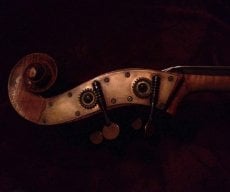
For maximum sound a double bass should have just enough structural integrity to avoid tearing itself apart, and a thick sprayed lacquer finish takes you in the wrong direction.
However, stripping and refinishing that bass will reduce its’ resale value to roughly $0.
However, stripping and refinishing that bass will reduce its’ resale value to roughly $0.
Salcott, this is the sort of input I wanted, Thank you. Kung Fu, agreed on your first point, but no playable bass is worth $0 refinished unless you run over it with a truck.

- Jan 12, 2004
- 1,493
- 1,270
- Disclosures
- Owner, Stand Up Guy Basses (Repair/Sell/Buy upright basses)
However, stripping and refinishing that bass will reduce its’ resale value to roughly $0.
Maybe not $0, but I think KFS's point is that it started out as the least expensive Shen bass that you can buy, plus it's a half size, plus it's going to look stripped and refinished (possibly in a very non-good way). Don't expect to find much grain under the finish if you do strip it, and don't expect noticeably improved sound.
The bass will definitely be worth more for resale if you leave the finish alone.
eh train: KFS post was thoughtless and condescending. If you had comprehensively read my previous posts, I know what I have, I asked NOT for a lecture on 1/2 size basses, you DONT know my skill levels as a finisher (45 year shop owner antique resto and furn ref) I dont intend on selling the bass, and oh yeah, I appreciate your one comment (as originally asked in the post) regarding the sound issue. All in all, I have decided to nix the idea, as two posters have stated there will most likely be no improvement in sound or resonance.
You say condescending, I say experienced.
You say thoughtless, I say experienced.
Some people…
You say thoughtless, I say experienced.
Some people…
I would just point out that, for basses and furniture, the really nice woods with really nice grains are usually reserved for pieces that'll get a high quality transparent finish. My experience has been that if a piece came painted or with a heavy opaque finish the wood probably isn't very attractive. A lot of people in the 70s and 80s spent a lot of time stripping the paint off old furniture only to find out it was painted for a reason: typically pieces that were made of a dog's breakfast mixture of ugly discolored but mechanically sound woods. (Then they'd try to stain those pieces, made from light softwoods, some kind of dark almost black finish, hoping to mimic aged walnut, and it just looked like a big ol' dark muddy mess; and then they'd brag about how they "brought this fine antique back to life by stripping it, sandblasting it, and staining it a color totally unsuited to the wood type").
So , OP, if you were to strip that orangey-red Simoniz finish off your bass, you'd probably find out the underlying veneer is more reminiscent of BC exterior ply than a 200 year old Italian bass.
So , OP, if you were to strip that orangey-red Simoniz finish off your bass, you'd probably find out the underlying veneer is more reminiscent of BC exterior ply than a 200 year old Italian bass.

OP, you don't like it's looks, but how does it sound to you? If you like the sound, and since you're an experienced refinisher, you could refinish the top to see if that improves it's looks. But, if you don't like the sound, you'd be better off getting another bass, IMO.

The real challenge is not adding a new finish, it is removing all of the old finish first and then preparing the surface for the new finish.
98% of the refinish attempts I see look like a$$.
There are many instances where I will refuse to work on a bass that has an amateur refinish. They are often too fragile and nearly impossible to do touch up work on with a perfect color, sheen, and material match.
When I do insurance estimates, I figure 1/3- 1/2 depreciation for a well done refinish. more for poorly done. That's half of the average used market value, not half of the new price, so on a half size plywood Shen, now you just spent 30+ hours of work on a $250 instrument.
Most skilled instrument builders will say that it takes 6-10 years to get good at building a specific instrument and then an entire lifetime to get great finish results. I've been doing it since 1980 and still find it the most challenging aspect of building.
All that said, this probably would have been a good project to take you mind off lockdown or the 521 days that my kids school was closed. If you have the time and the desire, give it a shot. The worst case scenario is a Shen bonfire.
98% of the refinish attempts I see look like a$$.
There are many instances where I will refuse to work on a bass that has an amateur refinish. They are often too fragile and nearly impossible to do touch up work on with a perfect color, sheen, and material match.
When I do insurance estimates, I figure 1/3- 1/2 depreciation for a well done refinish. more for poorly done. That's half of the average used market value, not half of the new price, so on a half size plywood Shen, now you just spent 30+ hours of work on a $250 instrument.
Most skilled instrument builders will say that it takes 6-10 years to get good at building a specific instrument and then an entire lifetime to get great finish results. I've been doing it since 1980 and still find it the most challenging aspect of building.
All that said, this probably would have been a good project to take you mind off lockdown or the 521 days that my kids school was closed. If you have the time and the desire, give it a shot. The worst case scenario is a Shen bonfire.
Last edited:
Decided against this project after all. Once again, this was about possibly improving the sound of the bass by getting rid of the thick closed pore lacquer finish and all the studying I have done tells me the laminate wont be affected...(probably not to my ears.) It sounds pretty good thru my Genzler acoustic array and I may upgrade pickups (Fishman BP 100) to ?? , and a set of Spiros.


Since you are savvy with wood/finishing you might consider getting spruce and carve yourself a new top.this was about possibly improving the sound of the bass
You could play what you have while working.
A small bass with a carved top can sound fantastic. I have one. It’s an old smaller 3/4, but has a bigger sounding high register than my 7/8ths. It even has a growl on the E.
Last edited:
Ha! Casey Vancouver.That was my moms name and she was married in Vancouver  ) The thought of turning that into a hybrid has me intrigued, but the carving skills are way over my head. I am looking for a 1/2 hybrid for sale close to southern Oregon. The Romanian hybrid 1/2 from Southwest strings is looking good but have been warned about green asian fingerboards falling off.
) The thought of turning that into a hybrid has me intrigued, but the carving skills are way over my head. I am looking for a 1/2 hybrid for sale close to southern Oregon. The Romanian hybrid 1/2 from Southwest strings is looking good but have been warned about green asian fingerboards falling off.
Oregon you say? 
Not relevant to this specific discussion but when I hear Oregon I think Seth Kimmel.
He does not do repairs. His basses are hand made boutique & bespoke beauties.
Pretty good value as a basic one can get out the door for under $20,000.
He makes a 5/8th model. You can be sure the fingerboard will not fall off.
Worth being aware of him, if you are not already.
Sorry for the derail. Please carry on.
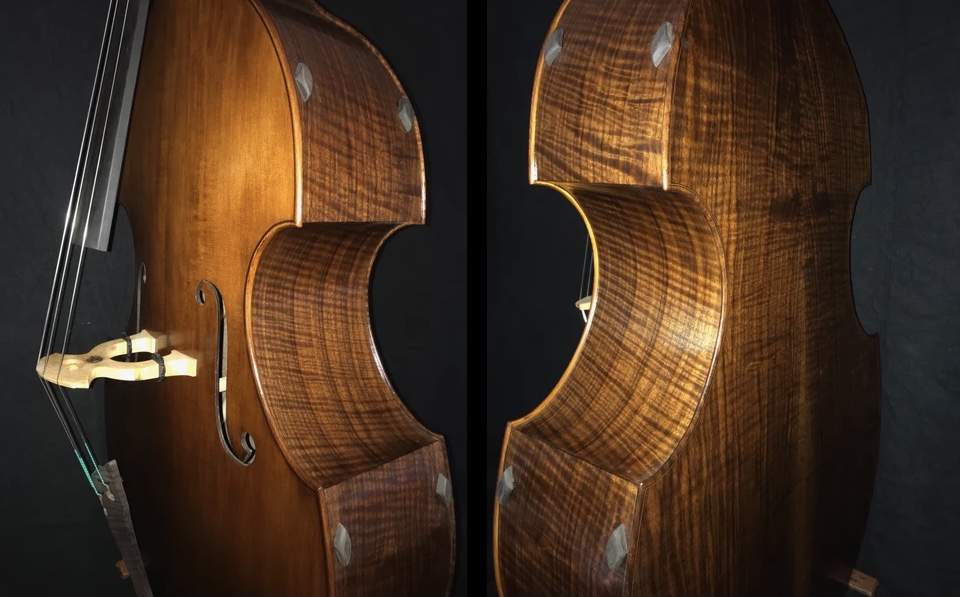
Not relevant to this specific discussion but when I hear Oregon I think Seth Kimmel.
He does not do repairs. His basses are hand made boutique & bespoke beauties.
Pretty good value as a basic one can get out the door for under $20,000.
He makes a 5/8th model. You can be sure the fingerboard will not fall off.
Worth being aware of him, if you are not already.
Sorry for the derail. Please carry on.


