
Enjoy the benefits of a premium membership!
Upgrade Account
-
TalkBass has been independent since 1998. Add your voice.
Create a free account to reply to discussions, view embedded media, and browse with fewer display ads.
Join free Log in
Want zero display ads or expanded classifieds tools? Compare plans.
You are using an out of date browser. It may not display this or other websites correctly.
You should upgrade or use an alternative browser.
You should upgrade or use an alternative browser.
Struggling to correct my technique
- Thread starter Rorybassman
- Start date
More options
Who Replied?

That picture is how you hold a rifle not play an instrument.Here is a photo of what I mean. Obviously quite an unhealthy technique which probably stems from me having very big hands, or playing piano since I was 7
Using your left hand give the middle finger gesture with the middle finger pointing straight up and elbow close to your body, now put the neck of your bass into your hand.

I'm not convinced that there is a 'one size fits all' position for all variations in hand anatomy. Personally, I can't get my thumb behind my index and middle finger unless I'm touching the tip or nail of my thumb to the back of the neck.
True on the variations but they should be small enough to allow for the general function of the average hand. For instance I'm having difficulty envisioning someone not being able to touch the pad/tips of the index and middle fingers to the pad of the thumb which is basically what we are talking about except with the bass neck between. That shouldn't change things that much unless I am really missing something. Quite possible where we are using the written word to describe physical actions here. I appreciate the OPs photo since a picture is worth a thousand words as they say.

JeezyMcNuggles
Inactive
- Feb 23, 2018
- 14,723
- 20,970
- Disclosures
- I suck, but nobody really notices
IMO, it is not good practice to play with the thumb behind the middle finger...at any point.
Yes it is. Thats natural finger placement.. Any angle you look at it, the thumb is always looking at the middle finger.


Here is a photo of what I mean. Obviously quite an unhealthy technique which probably stems from me having very big hands, or playing piano since I was 7
It could just be the camera angle, but it looks like your wrist is rotated back. I believe this is what the comment about gripping a rifle was about.
While you don't want you wrist bent over forward in a massive angle, I believe it should bend a little forward. The idea is to bring your arched fingers over the fret board, and to avoid excess tension in the wrist as much as possible.
Saying the thumb should always point a certain way is BS IMHO. The position of your thumb should be allowed to change depending upon where you are on the neck, the notes you just played, the you notes are playing, and the notes are about to play.
Also it has been mentioned that you may simply be suffering from an overuse syndrome. I was a working pro for a couple of decades. I sometimes rehearsed with two bands during the day and did a gig in the evening. It took quite awhile to develop the endurance to do this, and it still was extremely hard on my hands and body. My fingering hands would sometimes collapse from exhaustion, so I had to play like a chicken choker to get by.
If you are going to practice 6 hours a day, you need to work up to it, take plenty of breaks, and drink plenty of water. There was one guy I worked for who would sometimes make us do 2.5 hour sets. My elbow and finger tips would start to go numb. Even worse the more time I exposed my body to this sort of abuse, the quicker it started to transition into numbness. So I had the impression that playing such a long set was doing cumulative damage. I think it far more healthy to limit to sessions to about 45 minutes. After that give you body at least 15 minutes to recover. I rarely had any numbness playing all day as long as sessions were relatively short.

It's not from big hand dude .Here is a photo of what I mean. Obviously quite an unhealthy technique which probably stems from me having very big hands, or playing piano since I was 7
Your bass is low and grabbed like a guitar .
You should angle the neck to higher degree and then angle your hand same way .
You dont need do anything sepcial with thumb .
There is no fixed thumb so it can be different but what you wan it straight wrist with relax fingers .
What you have here is good for Persian instrument like tar or setar but not for bass .
You need to keep your hand in front on the bass and play with pad of your finger .
It's not guitar so do not try to copy it because hkh may get hurt.


Yes it is. Thats natural finger placement.. Any angle you look at it, the thumb is always looking at the middle finger.
When the thumb is behind the index or middle finger a groove ( or a "butcrack"..as Mushroo often refers to it
 ) is formed in the bass of the palm. It is through this groove that the tendons move. The groove is narrowed when the thumb is behind the middle finger and this causes the tendons to rub against the carpel tunnel. As with a piece of twine being constantly rubbed against a block of wood, the tendons start to fray over time, causing pain and irritation. All your photos contain this "butcrack". So IMO those photos are not typical of the neutral hand position. In a neutral position there is little or no groove at the bass of the palm. Check out this clip where Adam Neely talks about the neutral position.
When the thumb is behind the index or middle finger a groove ( or a "butcrack"..as Mushroo often refers to it
The advice to align the thumb with the index or ring finger comes from upright bass pedagogy. Not really applicable to bass guitar IMHO, but it's pretty natural for upright bass (see video below).
Some BG players use one finger per fret with a four finger box +/- one fret. With this concept you might use an approach where you pivot on the thumb to reach up or down the extra fret, and this can cause a temporary alignment between the thumb and the index finger. I would not consider this a neutral position.
Some BG players use one finger per fret with a four finger box +/- one fret. With this concept you might use an approach where you pivot on the thumb to reach up or down the extra fret, and this can cause a temporary alignment between the thumb and the index finger. I would not consider this a neutral position.
I agree. No one uses the exact same hand position 100% of the time when playing. The music and how high or low on the fretboard you are playing will dictate this. The idea is to use the neutral position as often as possible in order to minimise potential injury problems. Obviously the more often you use the neutral position the greater your chances are of avoiding RSI or CTS.
Granted...i did say .."at any point".. in my reply earlier to @JeezyMcNuggles. Hopefully my post above will correct this. I assumed it was a given that we dont play with the same hand position all the time.
Last edited:

Your left thumb should not be visible when playing.
Ideally the thumb is on the middle of the neck.
When this lockdown is over I highly recommend a teacher
to correct the issues you have. It will save you months & years of dubbing around.
Ideally the thumb is on the middle of the neck.
When this lockdown is over I highly recommend a teacher
to correct the issues you have. It will save you months & years of dubbing around.

When the thumb is behind the index or middle finger a groove ( or a "butcrack"..as Mushroo often refers to it
Haha thanks! I will never look at my hand the same way again. Always gonna be looking for that b-crack!
Great video too. Very comprehensive. Now a couple areas of muscle development and weakness make sense (thus far in a good way). Definitely worth 8min of anyone's time. Thanks!
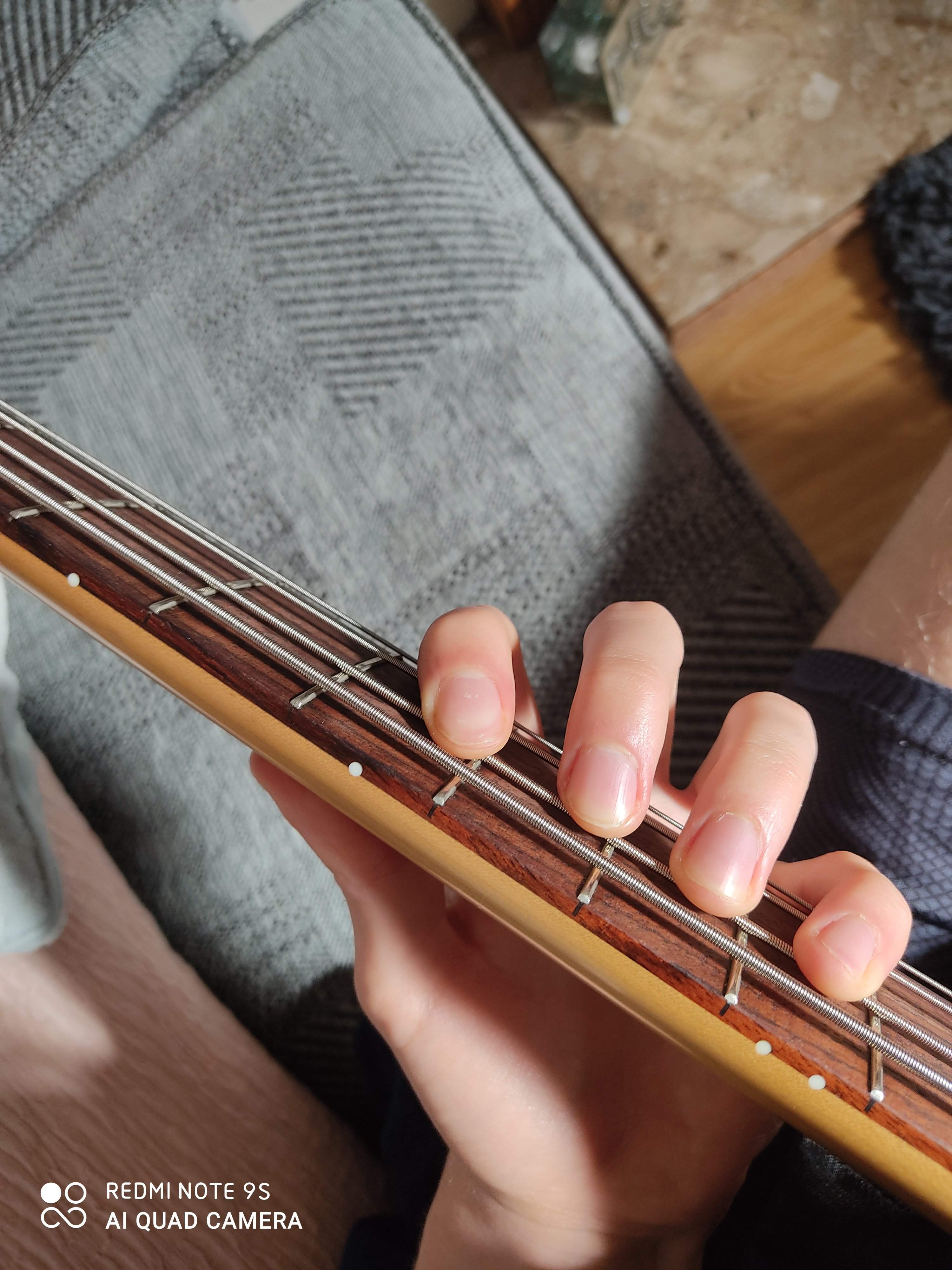
I wonder how you could possibly fret a low F (on E string) with this hand position.Here is a photo of what I mean. Obviously quite an unhealthy technique which probably stems from me having very big hands, or playing piano since I was 7

Hello again, this is how my left hand looks at the moment, should I be concerned about the flat-ish 4th finger?

Sorry for the influx of photos, but might also be worth pointing out a lot of the time my left hand defaults to resting the index finger joint on the neck, is this an issue at all?
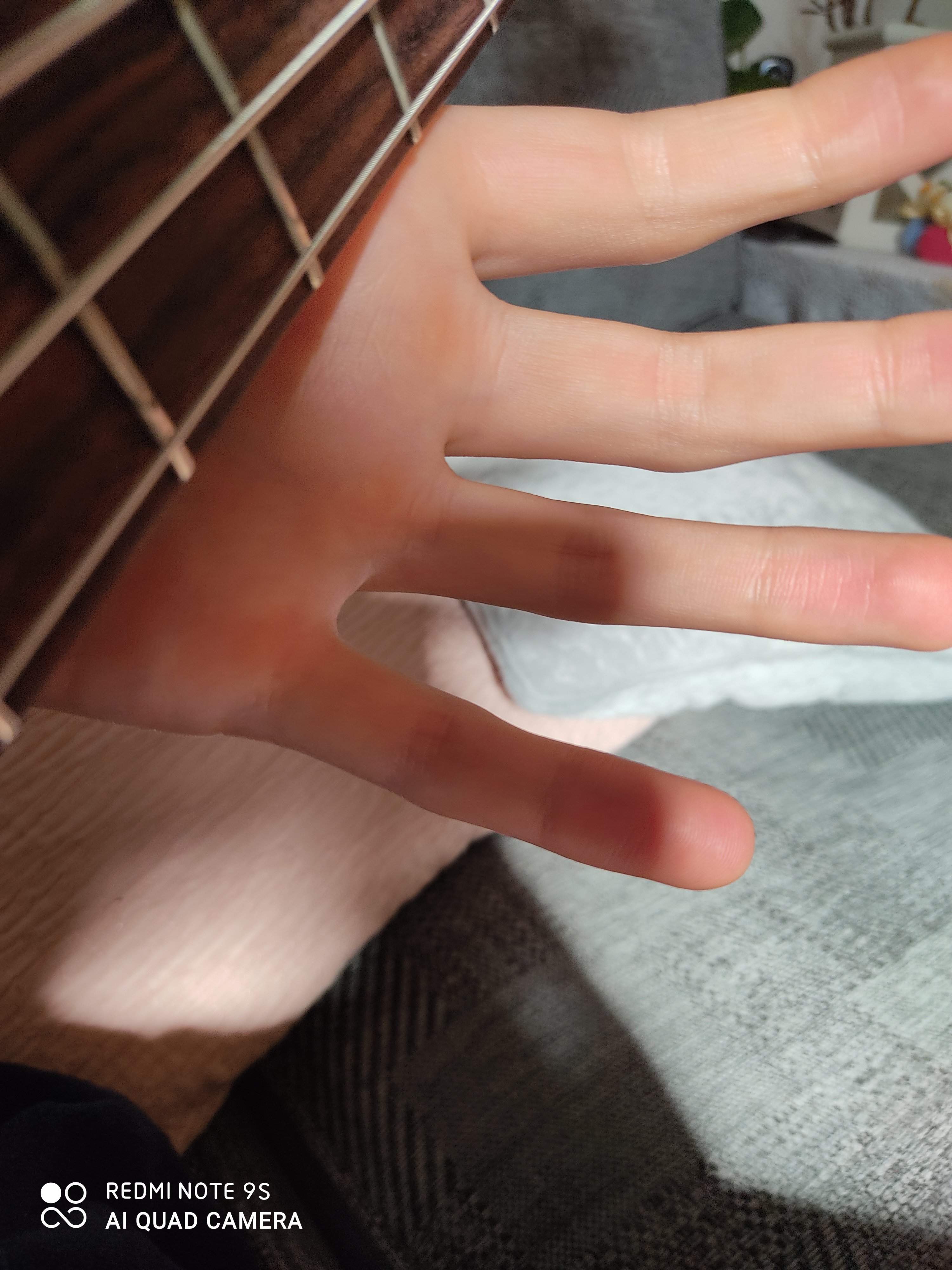
It appears from the pictures that the part of your palm next to the first nuckles is in contact with the bottom of the neck, and that your thumb is pointing towards the nut. Many people play with this kind of technique and opinions diverge on whether this is a good technique or not.
I personally believe that it impairs the mobility of your fingers in a given position, as well as with respect to shifting. You might try to change the poistion of your thumb and place it perpendicular to the neck, approximatey behind the middle finger, and touching the middle of the neck; also move your hand forward a bit to avoid contact between your palm and the bottom of the neck. Thus only contacts would be with the tip of your fingers on the the fretboard and your thumb on the back of the neck. That wont work overnight: you have to practice it for a while, then you can decide if this technique gives you a better tone and improved mobility as compared to the one you are currently using.
I personally believe that it impairs the mobility of your fingers in a given position, as well as with respect to shifting. You might try to change the poistion of your thumb and place it perpendicular to the neck, approximatey behind the middle finger, and touching the middle of the neck; also move your hand forward a bit to avoid contact between your palm and the bottom of the neck. Thus only contacts would be with the tip of your fingers on the the fretboard and your thumb on the back of the neck. That wont work overnight: you have to practice it for a while, then you can decide if this technique gives you a better tone and improved mobility as compared to the one you are currently using.
If you spend twenty minutes a day practicing the exercises from the clip in my post number 10, then I'd say you will see a marked improvement. See how different your hand position looks in comparison to the guy's in the clip. You need to bring the wrist forward more. Between that clip, and my other one in post number twenty eight, IMO you have all the information required (in the absence of a face to face lesson from a teacher) for safe and efficient left hand technique.
One other tip : It appears (correct me if I am wrong) from the photos that you may be sitting on a couch or soft chair without using a strap. I would advise using a hard chair ( kitchen type ) when practicing and to strap on the bass, having it roughly at the same height when both sitting and standing.
One other tip : It appears (correct me if I am wrong) from the photos that you may be sitting on a couch or soft chair without using a strap. I would advise using a hard chair ( kitchen type ) when practicing and to strap on the bass, having it roughly at the same height when both sitting and standing.
Last edited:
You might try to change the poistion of your thumb and place it perpendicular to the neck, approximatey behind the middle finger, and touching the middle of the neck;
This topic (thumb behind middle finger) was discussed earlier in the thread..starting with post number eleven.

That looks better than your previous position. However, there's no reason you need to be pressing all 4 fingers down. Also, you mentioned you play piano. I did too for many many years. My fretting hand for bass is a very similar shape to my hand when I play piano. Also, there's no rule that you can't shift and move your hand around depending on what you're playing.Hello again, this is how my left hand looks at the moment, should I be concerned about the flat-ish 4th finger?View attachment 3827082 View attachment 3827083
Your fingers look a lot better. I see in some of those pictures you are up near the twelfth fret. I know for me that necessitates bringing my elbow in which changes the angle of the hand significantly compared to first position. This question may have to be broken up into two different techniques.
It is a little confusing to have dueling experts (I mean Scott vs. Adam vs....). I see you are adopting the thumb pointing to the headstock (Adam Neely). Hard to argue with an accomplished and educated musician such as him. I am surprised at him though. I have found I'm more a Scott guy as it turns out watching his video.
As I was watching and pausing performances by known players, it's pretty obvious that "neutral and default" is almost academic once the performance starts. At any point in performance the thumb on the back in relation to the hand and arm position can and does shift and change. Lots of moving parts there. The biggest red flag for me is when you said you were feeling some pain. I hope by watching and trying it out for yourself you find a comfortable efficient way to play if not consulting with a teacher at this point.
It is a little confusing to have dueling experts (I mean Scott vs. Adam vs....). I see you are adopting the thumb pointing to the headstock (Adam Neely). Hard to argue with an accomplished and educated musician such as him. I am surprised at him though. I have found I'm more a Scott guy as it turns out watching his video.
As I was watching and pausing performances by known players, it's pretty obvious that "neutral and default" is almost academic once the performance starts. At any point in performance the thumb on the back in relation to the hand and arm position can and does shift and change. Lots of moving parts there. The biggest red flag for me is when you said you were feeling some pain. I hope by watching and trying it out for yourself you find a comfortable efficient way to play if not consulting with a teacher at this point.


