• TalkBass has been independent since 1998. Add your voice.
    Create a free account to reply to discussions, view embedded media, and browse with fewer display ads.
    Join freeLog in
    Want zero display ads or expanded classifieds tools? Compare plans.

Stupid hack n00b lacquer question

fretlessman71

Still beats havin' a job
Supporting Member
Aug 8, 2005
4,388
2,330
FoCo, NoCo
www.michaelolsononline.com
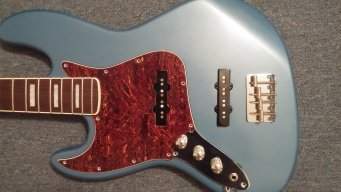
Converting an ATK305 to fretless.

Maple board.

Got an end nipper; frets come out easily enough and seem to leave minimal tang barb damage (sounds like an affliction caused by animals doin' the nasty, doesn't it?).

Lacquer left between the fret slots; gonna use standard lacquer thinner and a brush/terrycloth/masking tape to remove it (thanks for all your helpful tips; yeah, I'm talkin' to YOU, bub).

Now, one man's "minimal damage" might be another's "destroyed fingerboard", so are a few barb nicks really that big of a deal if I'm just going to coat the board with epoxy?

Also, I'm not using heat at all to help the frets out, as the first two came out pretty easy; would a soldering iron (or even a regular iron) help?

YES, I did a search. Couldn't wade through the answers I didn't want to find what I really needed. Sorry.

Thanks for your patience with me, as well as your responses!:hyper:
 
I removed the frets on a Yamaha BBN4 and I would consider the job to be on the scale of okay to reasonably well done. I did not have to remove lacquer but you aren't asking about that so it doesn't matter. Some of the of frets have reasonably sized cuts/dents from removing the frets. After 3 coats you do not even notice they are there. So IMO IME it does not matter that there are small cuts, because mine has them. Like you said to some people it might be the end of the world, but it should not be noticeable when playing or looking. Soldering iron might help, but I still had small cuts and I used one.
 
Make sure you fill the fret slots with something.

The removed material will make the neck more likely to Bow forward to the point where it's unfixable. In other words max out the truss rod.
I filled my fret slots with maple veneer and there was barely any front bow. So I would do it first and then see what happens. There was definitely not even close to a need to max out the truss rod.
 
I have seen fretless basses with steel insterts if that says anything

It does not.

It might be a good idea to verify that the kerfs were indeed filled with steel. It would be unusual to find one. Multiples?

Steel is pretty hard stuff. Depending on the mix, it's tough on files. Leveling the fingerboard would be extremely difficult.

The two materials most often recommended by pro techs are hard wood veneer or plastic. The plastic most often recommended is binding material. Both resist compression well and are soft enough to allow for a proper leveling and dressing of the fingerboard.
 
202dy said:
It does not.

It might be a good idea to verify that the kerfs were indeed filled with steel. It would be unusual to find one. Multiples?

Steel is pretty hard stuff. Depending on the mix, it's tough on files. Leveling the fingerboard would be extremely difficult.

The two materials most often recommended by pro techs are hard wood veneer or plastic. The plastic most often recommended is binding material. Both resist compression well and are soft enough to allow for a proper leveling and dressing of the fingerboard.

I saw it here on talkbass and I forgot where. I will try to find another.
 
I have seen fretless basses with steel insterts if that says anything

It does not.

It might be a good idea to verify that the kerfs were indeed filled with steel. It would be unusual to find one. Multiples?

Steel is pretty hard stuff. Depending on the mix, it's tough on files. Leveling the fingerboard would be extremely difficult.

The two materials most often recommended by pro techs are hard wood veneer or plastic. The plastic most often recommended is binding material. Both resist compression well and are soft enough to allow for a proper leveling and dressing of the fingerboard.

I saw it here on talkbass and I forgot where. I will try to find another.

Cool stuff - I would like to add that I think steel inserts, though probably possible, would require a lot of careful work, whereas a suitable hardwood or plastic would be a far better choice for a hobbyist or n00b (:) in title) If it has been done well it is pretty impressive! If one wishes to experiment with materials, please try the crafting, fitting, and finishing on a mock neck of similar material first, as a nice neck is a real shame to damage :crying:.

EDIT: It's an ATK 305!!!!!!!!!!! please treat it carefully (they are seriously cool basses (GAS GAS GAS GAS....)).

Cotton zarn it! (did I say it right?) I thought I'd found it: http://www.talkbass.com/forum/f57/lined-fretless-idea-450563/index2.html
It's a cool idea. File them flat, and refin the entire surface. Just take 1 belt sander and 5 minutes.
Hi I'm Johnny Knoxville and this is 5 minute defret!!! Ouch.
 
It does not.

It might be a good idea to verify that the kerfs were indeed filled with steel. It would be unusual to find one. Multiples?

Steel is pretty hard stuff. Depending on the mix, it's tough on files. Leveling the fingerboard would be extremely difficult.

The two materials most often recommended by pro techs are hard wood veneer or plastic. The plastic most often recommended is binding material. Both resist compression well and are soft enough to allow for a proper leveling and dressing of the fingerboard.

I saw it here on talkbass and I forgot where. I will try to find another.

The binding material I bought from Stew Mac was just ABS plastic strips - so there's no magic there.

Having the supposed 'professional' material and working with it in the past, I recognized the smell of it instantly and decided that buying plastic strips worth .0003/ft for astronomically H U G E prices from SM was just stupid to ever do again.

I began looking for any other way to buy the stuff and accidentally found it in the form of a sign I bought at Sharp's Hardware.

There are some really thin signs and others that are more substantial - so pick the right thickness as you see fit - or buy a variety of sizes so you can use them for custom binding and fret filling.

100_1093.jpg


They had white, blue and red and the salesman said they had just sold a dozen black signs, so I'd say the choices are pretty much bigger than the three colors from SM.

FWIW: if you pay $20/per sign, you're miles ahead of buying the same material from SM. One sign alone could conceivably yield a half-hundred strips at 1/4" width to stockpile your shop for the next two generation.

I'm so tired of these high pocket 'luthier-special tools & supplier' stores, as it's really e poke in the eye with a blunt object.

Once you add up the price of the material and then the shipping/handling fees, you're seriously in the red.
 

Latest posts