• TalkBass has been independent since 1998. Add your voice.
    Create a free account to reply to discussions, view embedded media, and browse with fewer display ads.
    Join freeLog in
    Want zero display ads or expanded classifieds tools? Compare plans.

switching between 4, 5, 6 strings

I have a 4, 5 and 6 string bass and I have never had a problem switching between them they all have very different spacing too and very different neck feels especially the P bass and the Ibanez.

What has been a problem is tone. I'm used being able to play something on one bass but it sound crappy on another.It takes a couple minutes to get used to the tone then I'm fine again. I guess thats the advantage of picking up 6 string bass so early.
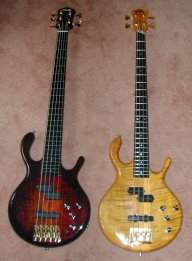
 
At first, I was just a fretted four player, But now I mainly use a fretted 4 and a fretless 5 and occasionally a fretted 5 and fretted 6. The one issue I have had is the starting note of a song - if I've always played it on a 4, I have found myself playing it down a 5th when I pick up a 5 or 6 string. I've made my own switching input derived from a Craig Anderton design which I mount to my mike stand and I can swap basses very quicky and I'll change back and forth within a set frequently.
 
that's funny...i have no issues switching to a bass with more strings...it is when i take away strings that makes my fingers get lost.

i also don't have problems switching between scales (with the exception of getting smooth artificial harmonics on scales shorter than 36" since I'm so used to it), but then again I don't play fretless. Someday I'll be doing what Brad Johnson does switching fretless scales on the fly...but for now, fretted it is!
 
One thing that I have done to make switching back and forth a bit easier is that I have gone to the floating thumb technique for my rright-hand. While I realize that most people associate problems with switching as primarily with the fretting hand, I have found that the floating thumb technique completely eliminates the right hand from the equation. It works the same no matter how many strings you are playing.

As for the fretting hand, I think you simply have to go back and forth while practicing, which makes the adjustment process that much faster. At some point, the brain just makes the adjustments regarding the extra string(s) and muscle memory required to play different basses. I also find it helps to play the same songs on all of your basses when practicing, just because it sort of highlights the adjustments to you while keeping what you are playing constant. That way, if you have to switch, or just want to, you are familar with playing those songs with all of your basses and the adjustment is fast.

That being said, if your practice time is limited, keep things as constant between basses as possible, as suggested by many above.