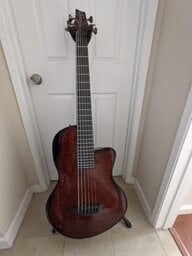
Thanks for all the feedback - i should have clarified that i was specifically talking about electric bass


TalkBass has been independent since 1998. Add your voice.
Create a free account to reply to discussions, view embedded media, and browse with fewer display ads.
Join free Log in
Want zero display ads or expanded classifieds tools? Compare plans.

Hi — small-handed bass player here. I’ve been playing for about three years using the one-finger-per-fret (OFPF) technique.
I recently had a lesson where my teacher recommended switching to 1-2-4, and it’s been going well so far. There’s definitely been a learning curve, but I feel like I can play faster in the lower frets without hand pain or having to over-stretch my pinky into awkward positions.
I do have a couple of questions, though. When playing three notes across four frets on the same string—say a triplet like G, A, Bb—should I play the G with my index finger, the A with my pinky, and then shift my pinky to the right to play the Bb again? That approach doesn’t sound as clean as when I’d play it using OFPF. In songs with a lot of these three-notes-over-four-frets patterns, it also feels like there’s a lot of movement happening between my index and pinky. How do players who use 1-2-4 typically handle this?
Also, I know many players use 1-2-4 in the lower register (roughly frets 1–7) and then switch to OFPF higher up the neck. Does that transition take a while to get used to? It seems tricky to switch between the two techniques, but I’m guessing it just takes time.
Thanks!

Does it really? In thumb position you don't really use the 4th finger. And you can start thumb position as early as E3 on the G string . I really understood that the role of the 3rd finger is to assist the 4th. If you cut or hurt you thirds finger this would be very obviousSimandl teaches that the 3rd finger is weaker than the 4th.

The greatest thing I learned witnessing Rocco live was that moving your left hand is allowed.And you can also do what Rocco Prestia does.

I generally avoid shifting up with the pinky.

Shifting approaches can become a VERY deep rabbit hole to fall down. My teacher plays guitar more than bass, so the starting point is a bit different, but he's developed a system where every single shift follows a set of rules to maximize efficiency and ensure all his shifts follow concise patterns, which makes it way easier to blaze up and down the fretboard because your shapes are consistent. We've had a lot of deep conversations on shifting theory!I hear more people say that. What’s the reason for that? Shifting with the pinky is not harder than shifting with any other finger.

For me it’s primarily that the pinky finger is not as strong or stable as the first and second fingers.I hear more people say that. What’s the reason for that? Shifting with the pinky is not harder than shifting with any other finger.
The easy answer is that you want to shift in order to access more of the fretboard. If you shift up with the pinky you have only extended your reach by a single fret, meaning you probably have to make another shift as soon as you want to access anything further up. Pretty much any other shifting choice is going to open up a greater amount of new fretboard real estate, and if you want each shift to be as efficient as possible, the more you can access with a single move, the better.
Then the question I'd ask is: am I really using the most efficient fingering possible if the line requires a single pinky shift?Sure. But I am using pinky shift mostly if the line ends with a pinky and doesn’t go any higher. Mostly half steps and whole steps. But I shift mostly with the first finger. But bassicaly any finger can be used shifting. Totally depends on the specific bassline. So no strict rules for me.
Only reason I can see to do it is you are running up the upper string on your bass via pinky slide and then coming down with the other fingers on the lower strings. Thinking about it, I've done that but it is an unusual move. I'd be more likely to just drop to an open, or a position on a lower string, which isn't really a shift? Any other ideas for this move?I hear more people say that. What’s the reason for that? Shifting with the pinky is not harder than shifting with any other finger.
I do a lot of shifting exercises, including the George Benson style single finger runs, where you'll run 4+ frets with your first finger, to move from one position to another. If you get into sweeping or doing arpeggios with techniques like open-hammer-pluck then having really efficient shifting strategies becomes more important, since both hands have to keep up with one another.
SBL teaches a 6 fret box. With OFPF the fingers sit over 4 frets and you pivot up or down one fret to get 5 and 6. A pinkie shift would be the best choice to reach out of the regular 4 fret box and come back.
That makes since if you are playing up chromatically, as this suggests to me. However since I primarily use OFPF on bass guitar, I would probably play 1,2,3,shift 1,2,3. Depending on what happens next, I might play 1,2,3,shift 2,3,4. But for me 2,3,4 is weaker than 1,2,3. 2 to 4 is weaker than 1 to 3 for me. That doesn't mean I never use 2 to 4.
I would probably play 1,2,3,shift 1,2,3
Yeah, I've seen Scott doing a lot of micro shifts. Works well on jazz and altered chords. Thank you for reminding me of that technique, I don't usually think about it, or use it, but it does work.I agree that the pinkie is not generally the best for shifting, especially when a line continues in the same direction. But I also agree that every finger can and should be used to shift (when appropriate).
SBL teaches a 6 fret box. With OFPF the fingers sit over 4 frets and you pivot up or down one fret to get 5 and 6. A pinkie shift would be the best choice to reach out of the regular 4 fret box and come back.
Pivoting up and down a half step is also a common technique for upright players who use 1,2,4. I don't believe Simandl mentions the pivot. However, I was taught primarily from Simandl and I was taught to pivot. I assume the pivot originated with Rabbath.
Another situation where I will shift on the pinkie is when I am sliding a finger across frets to create a greasy bass line. Basically slurring notes across frets.
I was practicing bebop and realized I micro shift all the time, for some reason I am not even aware I'm doing it. The big shifts are the ones that seem to take some thought?Yeah, I've seen Scott doing a lot of micro shifts. Works well on jazz and altered chords. Thank you for reminding me of that technique, I don't usually think about it, or use it, but it does work.