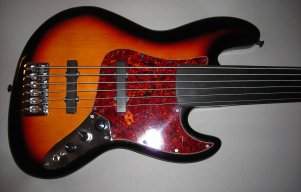
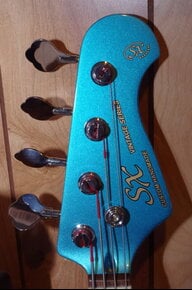
SO I took the not so much of a dive to buy a 6 string jazz, at 180 bucks + shipping I was a buyer of the sx ursa. Ordered it, got it. Not hassle. Now to the fun part. The item received. I got the bass as ordered. But I wasn't expecting so much too be wrong with it. Here's the list
-frets were un level in random places on all 6 strings
-truss rods were tightened up too much
-strings were already dead (not really an issue since they were factory strings)
-all along the fretboard they had sanded post finishing to round off the ends of the frets leaving unfinished wood all along the fretboard edge
-headstock had a nice ding in it that they tried buffing out with steel wool or 600 grit sandpaper, all that did is dull the mirror finish in that spot making it worse
-there was an unneeded shim under the neck making the bass sound dull and enhancing the fret buzz
From what my friend who has worked on them said, the frets are soft metal and wear fast so there's another con.
After putting in about an hour and a half of levelling, cleaning, polishing, and overal resetting up, the bass is good for the money. But I still think I paid too much for a bass with so much wrong with it. It sounds nice and the electronics seem decent though.
Ideas? Remarks? Comments? Questions? Open fire
Sure as owner of three (count 'em) SX 6ers and three 5er SX basses I have a bit of experience.
Actually the two things that tend to be "luck of the Draw" with SX basses are the levelness of the frets and the awesomeness of the wood. I'm guessing you did OK on the wood but not so OK on the frets.
1. Truss rods. Yes, truss rod mysteries are commonly the way the 6 string bass is shipped. There are no instructions for the dual truss rods and they often come with differing tensions (a no-no). Because they are dual acting, it's often hard to tell if they are pulling or pushing the neck! And with most of the 6ers the neck is quite straight which means that you are only going to need MINIMAL truss rod tension and may have trouble getting neck curvature. To get curvature you have to totally loosen the truss rods and let the bass sit for a while under string tension. In a week or so the neck will curve which you can stabilize with a small amount of truss rod tension. Note both rods tighten and loosen by turning in identical directions, and they ARE "double acting" if you absolutely need that to get curvature. I never have had to use "push" mode as 6 strings do put a decent tension on the neck.
2. Frets. They are luck of the draw. I've had some magnificent, some sanded level but had never been crowned, and some just like you describe. As for metal, traditional frets are German silver which is softer, unlike some "modern" stainless steel frets. However the softer frets have much less clanky tone, but wear faster (especially with roundwounds). A good leveling and crowning and polishing will make the bass positively booteek!
Personally I've never seen the fret rounding by sanding thing. Must have been somebody's cousin on the fret job got an "idea" for speeding up his work! Personally I took a Dremel tool with rubber abrasive wheels to round the fret ends. Not necessary but really makes the bass feel great.
3. Strings. Everybody knows that SX factory strings totally suck and the bass won't come alive until you buy some "real" strings for it. Why even mention it?
4. Neck joint. Well, you've found it! This is the standard "weak spot" on almost all SX basses. Neck joints are a mess. They are full of shavings and crap and shims and crooked screws and what have you. It's essential that at minimum you take the joint apart and clean the crap and bumps out of it. And if you want that great wood in the SX to turn into a "keeper" bass, I HIGHLY recommend installing threaded inserts to mount the neck. I use 8-32 flat head or button head socket head 1 1/2" stainless screws. You want to use the zinc threaded inserts not the fat brass ones. I use a tiny amount of epoxy or gorilla glue on them to lock them in place.
Amazon.com: 8-32 Int. Thd., .394 Lg., Flushed, E-Z Lok Hex Drive Knife Thread Inserts for Wood (1 Each): Industrial & Scientific
In worst case, you may have to plug crooked screw holes and redrill, but it's all WORTH the effort.
5. Headstock ding: Yeah stuff happens. but as for dull spot, they just didn't know that steel wool or 600 grit leaves you a satin finish. If you want to return to glossy you need to buff it out with polishing compound. Ordinarily a bass like yours, (unless wood was exceptionally choice making it worth fixing) would be a return to B stock, but pickings are slim these days in the SX 6er availability. so you have to deal with it.
6. Value. Come on. You want perfection in a Chinese $200 6 string bass? Hasn't TB taught you anything? The key here is that an SX bass comes with real wood. Not particle board or soft basswood or other cheap stuff. Some of them (if you are lucky) come with boutique grade matched grain. You think you can buy a bare 6 string body like that for this amount? Look around. And you get the rest of the bass parts FREE (if you choose to use them and most of us do). And then, start looking at the price of 6 string basses. No, not just any 6er, but Fender-style Jazz passive 6ers. No doubt a Steve Bailey or a Low End comes not needing any fretwork or neck joint repair, but now go look at what you paid for your SX clone, and compare.
Nuff said.
PS. And I always do a copper foil shield job and add a series/parallel switch to all my SX basses. Shielding makes the single coil hum less noticeable and I love the added range of tone from the series/parallel switch. And since my 6ers are in burst I sprung for new custom tort pickguards. Makes those basses look like a million!