• TalkBass has been independent since 1998. Add your voice.
    Create a free account to reply to discussions, view embedded media, and browse with fewer display ads.
    Join freeLog in
    Want zero display ads or expanded classifieds tools? Compare plans.

Table Saw Safety

I've never owned or used a radial arm saw. And if I ever come across an extra few $1000 to spend on a large rig, I'd go with a table saw, simply because I already have experience on them. If someone gave me a radial arm saw for free, I'm sure I'd find things to use it for.
Anyway, in the spirit of the thread, I think it would be fun to see the radial arm saw owners talk about what they've done to make their saw safer. Whether by safety contraptions, or technique.
 
The lock on the Sawstop fence is definitely the weak spot. Most of us learned on Biesemeyer fences. They have sort of a one stop push down and it locks. The Sawstop has sort of a two tiered lock- an initial that is very close to the feel of an old Biesemeyer and stops it from moving, but that does not fully engage the lock. You have to push it down more secure. I've had the fence slip like the above poster mentioned several times.
True statement!
I just got a SawStop.
The first test cut I made? The fence started drifting. :eek:
I thought it was locked down... given my muscle memory of all the other saws I've used. :rollno:
 
  • Like
Reactions: james condino
I've never owned or used a radial arm saw. And if I ever come across an extra few $1000 to spend on a large rig, I'd go with a table saw, simply because I already have experience on them. If someone gave me a radial arm saw for free, I'm sure I'd find things to use it for.
Anyway, in the spirit of the thread, I think it would be fun to see the radial arm saw owners talk about what they've done to make their saw safer. Whether by safety contraptions, or technique.
I added lots of high Kelvin LED lighting above it so there's no shadows.
Converted to 220VAC for better power ... and much less slow down in cuts.
I always draw the saw with my right hand as it is more powerful than the left ... for better control.
I allow it to hog-in and stall once in a while to retrain me of its capabilities.
Keep the front/entry area of the rotating guard very close to the work even though at that place the blade rotation is pushing the work tighter to the bench.
Always cut distorted wood cup-end-down.
Try to not cut distorted wood.
Never cut a diagonal unless the whole workpiece is supported along a fence.
If the cutoff drops into the unsupported acute angle of the fence, it can throw the cutoff piece a goodly distance or jam the blade ... the same as a table saw.
If it throws cutoffs, they go to the right, so keep that trajectory in mind.
It WILL stall if it hogs-in, so I know its limits.

The only time I felt really ill-at-ease was ripping green, wet, 10 foot long planks by myself... even using the one way finger guides ... and I just took those cuts to my table saw .......... where I was still concerned about getting speared..
 
  • Like
Reactions: RichterScale
I like a RAS to crosscut large material, including angles. This was mentioned earlier and is worthy of mentioning again - use a negative hook blade.
Because of its versatility, I have been on jobsites where a RAS was the only stationary tool carried to the site. That was before lightweight crosscut miter saws.;)
 
Every once in a while I think I’d like to use the old bench top table saw I inherited from my father-in-law, then I re-read this thread. Then I look back at my saw with the brittle old plastic base that looks like it’s going to crack, and the fence that won’t lock, and the guard that looks like it came off an entirely different saw and has no obvious way to mount to this saw. And I think, nah, I’ll find another way.
 
One thing I do with the RAS is to avoid the climb cut by starting with the saw at my end and pushing it towards the fence. At the moment I have two - a very vintage Porter Cable and a Sears that was "please get it out of here we're trying to sell the house" level of "free" (and in need of a new table-top.)
 
I’ve been sort of “jonesing” for older tools lately and came across one of these - for $40. I’ve got this Kobalt 10” that folds up but has its mass production “so so” quality.

What do you all think about this Craftsman?

85E4C06B-18F1-4FA7-A9B9-8A91BD779CD8.png
B7782176-962E-49F1-B30B-B7F37A7E7BA8.png
CCC74224-D945-493E-9623-38325990937B.png
 
The engine turned case is retro cool. It should work ok if the bearings are still good. The problem with most of the old Craftsman saws is they were underpowered. What motor HP? Easy enough to get a higher HP motor, or just use thin-kerf blades. Personally I'd get a used Dewalt jobsite saw with the rack and pinion fence, riving knife, and built in dust shroud. I see them on every jobsite, and carpenters buy what works and holds up. Lots of used ones around. Anything without a splitter/riving knife makes me nervous. It wont look as cool, but its a massively better saw.
https://www.amazon.com/DEWALT-Jobsite-Compact-4-Inch-DWE7485/dp/B0842QDW95/ref=sr_1_1?crid=C675VOJ651QR&keywords=dewalt+jobsite+saw&qid=1646739753&sprefix=dewalt+jobsite+sae,aps,688&sr=8-1
 
As an Amazon Associate, TalkBass may receive commissions from qualifying purchases made via links on this site.
The engine turned case is retro cool. It should work ok if the bearings are still good. The problem with most of the old Craftsman saws is they were underpowered. What motor HP? Easy enough to get a higher HP motor, or just use thin-kerf blades. Personally I'd get a used Dewalt jobsite saw with the rack and pinion fence, riving knife, and built in dust shroud. I see them on every jobsite, and carpenters buy what works and holds up. Lots of used ones around. Anything without a splitter/riving knife makes me nervous. It wont look as cool, but its a massively better saw.
https://www.amazon.com/DEWALT-Jobsite-Compact-4-Inch-DWE7485/dp/B0842QDW95/ref=sr_1_1?crid=C675VOJ651QR&keywords=dewalt+jobsite+saw&qid=1646739753&sprefix=dewalt+jobsite+sae,aps,688&sr=8-1

I’ll find out about HP on that motor once the seller gets back to me. I actually had my sights on this one. That fence :). Prices are varying depending on time of year 299-399 (now).
 
As an Amazon Associate, TalkBass may receive commissions from qualifying purchases made via links on this site.
  • Like
Reactions: Gilmourisgod
The engine turned case is retro cool. It should work ok if the bearings are still good. The problem with most of the old Craftsman saws is they were underpowered. What motor HP? Easy enough to get a higher HP motor, or just use thin-kerf blades. Personally I'd get a used Dewalt jobsite saw with the rack and pinion fence, riving knife, and built in dust shroud. I see them on every jobsite, and carpenters buy what works and holds up. Lots of used ones around. Anything without a splitter/riving knife makes me nervous. It wont look as cool, but its a massively better saw.
https://www.amazon.com/DEWALT-Jobsite-Compact-4-Inch-DWE7485/dp/B0842QDW95/ref=sr_1_1?crid=C675VOJ651QR&keywords=dewalt+jobsite+saw&qid=1646739753&sprefix=dewalt+jobsite+sae,aps,688&sr=8-1
I have a version of that portable saw as well and I agree it's a nice unit, especially on a folding stand on a job site. The Craftsman pictured isn't that - mine never moves anywhere. ...but it cuts well for light work and the motor is very easy to swap out if desired. Definitely more for the experienced woodworker - not so much for a novice.
 
As an Amazon Associate, TalkBass may receive commissions from qualifying purchases made via links on this site.
  • Like
Reactions: Gilmourisgod
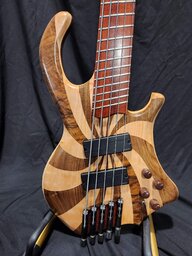
Believe me, I'm a sucker for old tools, the "jeweled" aluminum trim on this one, Circa 1947, that I inherited from my Grandfather is way cool. It's getting harder to find parts for these, in my case the quill return spring is broken and effectively unobtanium, so I crank it up and down by hand with no "assist". :D A modern drill press would be great, but I somehow can't bring myself to ditch this one until it's entirely un-useable. This one is on at least it's second motor, and I replaced some of the bearings, so don't feel precious about that old motor. I find I need at least 1-1/4 HP to cut stuff like guitar blanks, and I put the linking section drive belts to run smooth. The other thing that wears out is the overload breaker on the motor. I though I was going to have to buy a new 1.5HP motor for my Jet tablesaw, it kept tripping the breaker on the motor, turns out it was the breaker, not the motor.
AbTWAQY.jpg
 
  • Like
Reactions: TomB
My current table saw is a 1959 Craftsman, it is not in good shape and underpowered, but it makes perfectly straight cuts and it's got a good fence on it. I just bought a used 90's era Jet tablesaw that is a dramatic upgrade, but since we're moving soon I didn't feel like dragging it into the basement, then back out 9 months from now (and I'm not sure it would fit). Neither of these saws have riving knives or any safety attachments. In the 5 years I've used this Craftsman, I've never had kickback of any consequence. I've had a few boards bind up by tension being released as I cut it, but really that's the only time it's bogged down. I keep a sharp blade on it, that makes a huge difference (of course) in cut quality and pressure it takes to push a board through.

When I bought this Jet I had the guy who owned it show me a test cut, he ripped a pine board - he got half way through the cut and lifted the wood up off the blade while it was still running, my heart skipped a beat. Somehow it didn't kick back. He got lucky.
 
My current table saw is a 1959 Craftsman, it is not in good shape and underpowered, but it makes perfectly straight cuts and it's got a good fence on it. I just bought a used 90's era Jet tablesaw that is a dramatic upgrade, but since we're moving soon I didn't feel like dragging it into the basement, then back out 9 months from now (and I'm not sure it would fit). Neither of these saws have riving knives or any safety attachments. In the 5 years I've used this Craftsman, I've never had kickback of any consequence. I've had a few boards bind up by tension being released as I cut it, but really that's the only time it's bogged down. I keep a sharp blade on it, that makes a huge difference (of course) in cut quality and pressure it takes to push a board through.

When I bought this Jet I had the guy who owned it show me a test cut, he ripped a pine board - he got half way through the cut and lifted the wood up off the blade while it was still running, my heart skipped a beat. Somehow it didn't kick back. He got lucky.
I’ve never owned (or even used!) a saw with a riving knife. While a riving knife is very, very highly recommended, creative use of featherboards, a splitter (if your saws don’t have splitters you should definitely find or modify one for each of them) and great care and attentiveness can keep you quite safe.
Of course, all of those things would be even safer with a riving knife but paying attention and concentrating are the best safety equipment we have.
 
  • Like
Reactions: Jisch
I'm new to this thread. I'm a woodworking bass player, but have never (yet) built a guitar. I build furniture, but only as a hobby, so there's no productivity pressure.

I got rid of my table saw some years ago, and mitre saw even earlier. I have a decent band saw that is far less violent for ripping and resawing, and all crosscuts (and all joinery) I do by hand. My life is far better without the noise-and-dust monster dominating my shop floor space.

The point of a table saw is that it can cut accurate straight edges fast. I'm not sure how that's useful in building guitars with curved edges. If you're just rough-cutting blanks, then a band saw is safer, capable of curves, and more space-efficient. But you have to renounce the cult of the table saw-centred shop!
 
I use a tablesaw al the time in guitar building. Certainly there are workarounds, like a circular saw and a cutting guide, or just using a bandsaw to rough things out and then pattern-routing against a straightedge, but those techniques involve some risk as well. Broken record here, but the Sawstop technology makes a tablesaw a pretty safe tool, and it does the job of cutting straight lines better and quicker than the other common options. I wish they would license it for jointers, planers, and bandsaws too. I admire people who can do an entire guitar with hand tools, but that isn't me. I trade power tools for time, of which I have so little free. The drawback is the price, but a brand new Sawstop is cheaper than the deductible most people carry for one Emergency Room visit. No High Horse here, I'm still using my old jet 10" Contractor saw, what's my excuse?
 
  • Like
Reactions: Andy_R
If anyone is looking at old Craftsman saws, let me warn you away from the smaller ones with tilting table vs tilting arbor. I never met a more dangerous saw than that one - that I used just once.
That's the type that I "inherited" via my grandfather's tool shed. One time I tilted the table with the spindle raised - made a nice crack in that table....
 
Remember back in the day we had home room to go to after our first class in middle school.
In grade 10 my home room changed to the wood work room.
Took wood word that year and witnessed a bad table saw accident that was real bad.

Some fellow students would not go to home room any more at all after that.

Three things came out of that event; I never saw my friend again ( he lived just he never returned to school )I have not used a table saw since and I have great respect for those Luthiers/wood workers who do.
Many years later my Father asked me to help him in cutting some wood on his table saw and got mad at me for refusing.

One day he got real mad at me about it and I told him if he wants help real bad come to my Fencing class, there is a beginners section.
He never asked me again.
 
  • Like
Reactions: instrumentalist

Latest posts