• TalkBass has been independent since 1998. Add your voice.
    Create a free account to reply to discussions, view embedded media, and browse with fewer display ads.
    Join freeLog in
    Want zero display ads or expanded classifieds tools? Compare plans.

Double Bass Tailpiece exploded, need to replace

Chris Fitzgerald

Student of Life
Staff member
Administrator
Gold Supporting Member
Oct 19, 2000
27,574
38,476
Louisville, KY
www.chrisfitzgeraldmusic.com
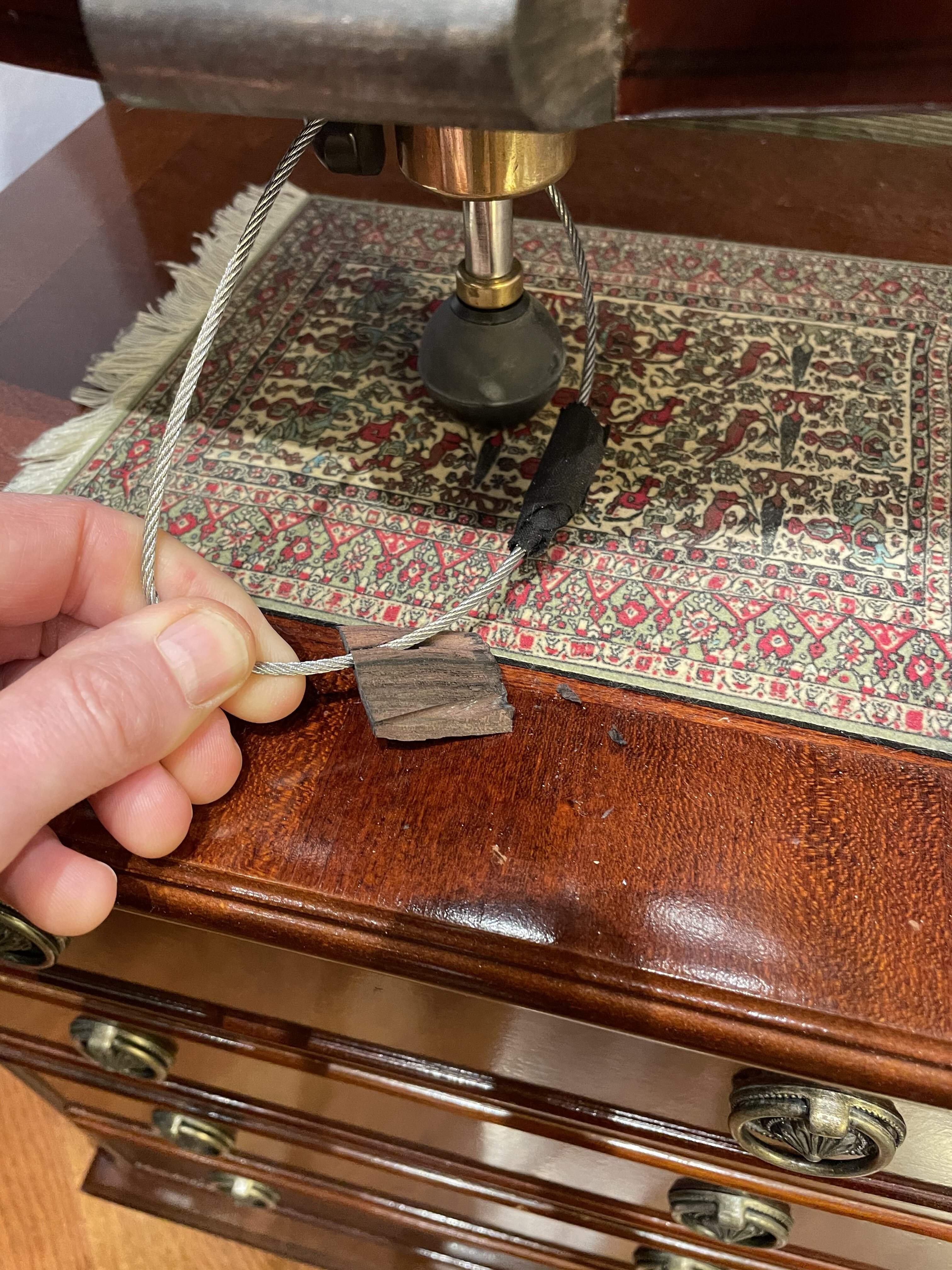
I was working the other day and heard a loud CRACK behind me. The tailpiece on my travel bass had come apart and the bridge fell. Otherwise, no real harm done that I can see.
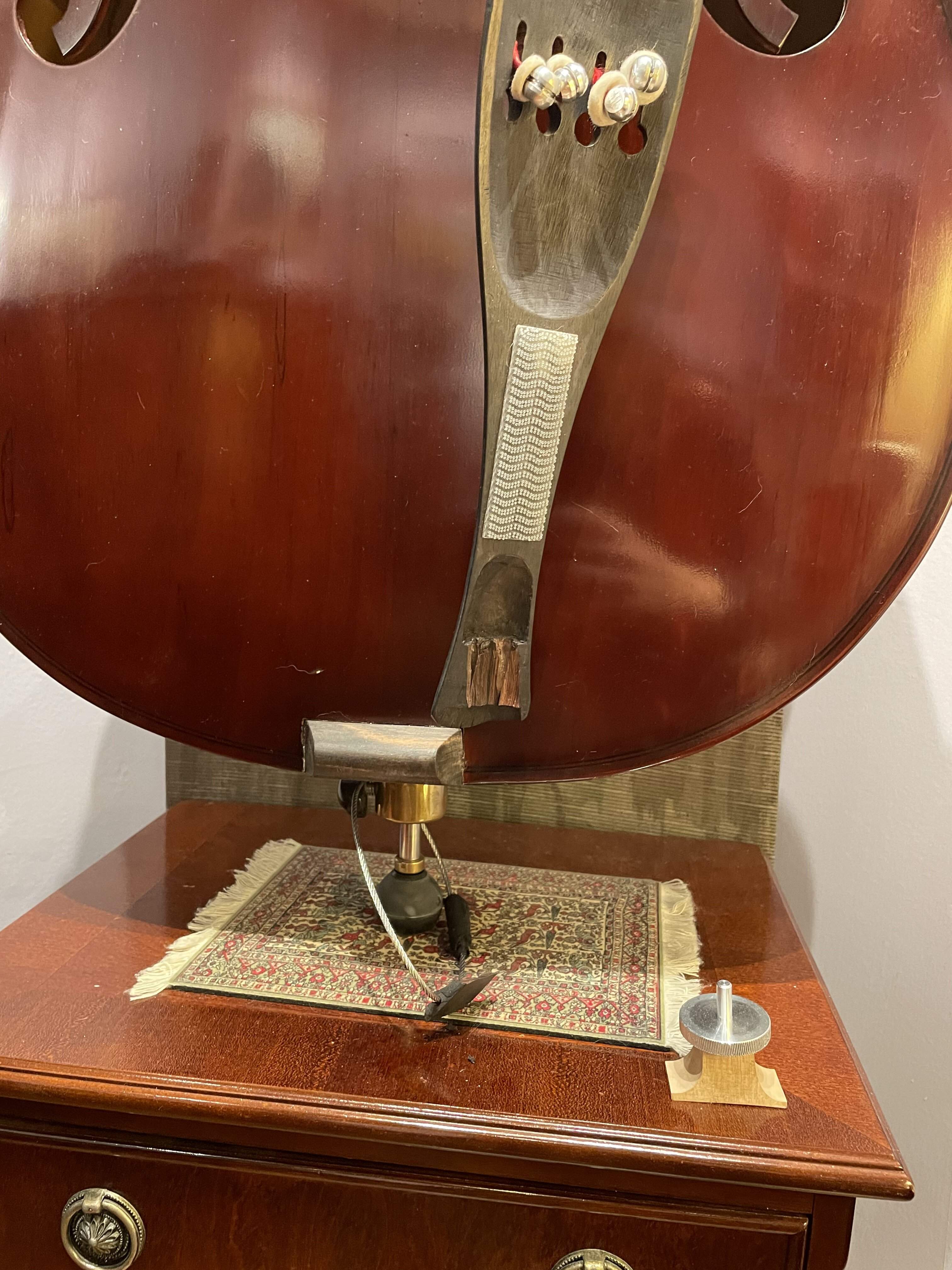
Tailpiece 1.JPG
Tailpiece 2.JPG


I don't really want to have to make a day trip to Cincy over this if I can help it, but in order to avoid that, I would need a little help in a few areas:

1) Finding the right size replacement to order. The one that broke is 11" long and the distance from where the strings come out on the front to the bridge end is about 7/8". I don't know if a shorter tailpiece could be used or if it would cause problems. I do know that using 4/4 Spiros, the silks were going all the way up to the bridge, but with 3885's, they fell just short. Wondering if a shorter tailpiece might be a good or a bad idea.
Tailpiece 3.JPG


2) Finding the right sort of material for it to be made of. In general, I have never liked composite or light tailpieces. In my experience they tend to sound more resonant, but it's a random sort of resonance that don't really care for because it makes amplification more difficult. For whatever reasons, I like a very "tight" and controlled sound.

3) I would need a few pointers about how to do the replacement. I'm not a total idiot, but also not exactly Bob the Builder with tools. I feel confident that I could manage this with some good advice from the collective Talkbass Luthier Cognoscenti.

I look forward to absorbing the wisdom!
 
+1 day trip to the cellar. Ask them if you can hang/watch/ask questions then you’ll know for next time. I only say this because you’re the caliber player that doesn’t need to mess around with DIY on your main axes, imho. Buy a fixer upper bass to tinker with and learn on, but leave your main work horses for the best in the biz to keep 100%.
 
Last edited:
@zootsaxes Thanks! I hear you, but this isn’t really one of my main axes. It’s just the one I take to international gigs that I have to fly to. And given the whole pandemic scene, I don’t know when that will happen again. Plus, I’ve had to put this thing together and take it down a bunch of times for travel, so it seems a reasonable candidate for tinkering.

If either of my LaScalas need anything bigger than a string change, though, I go to Cincy.
 
  • Like
Reactions: zootsaxes
To me it seems clear what happened. The steel tailgut, looped through the tailpiece holes, simply sliced through. In contrast with a threaded tailgut, where the 'pull' is inline, the loop exerted a sort of pinch pressure between the drillings and split the wood.

I expect you can get anything you want in a tailpiece from Cinci or Kolstein's by mail in short order. You probably want the replacement to be the about same length to maintain your setup as it was. 11" is a couple inches shorter than most.

The challenge you set out seems to be in setting up the tailgut and afterlength. In your place I would simply ask your tailpiece supplier to attach a tailgut measured to put you back where you were. Just hang it on the endpin and Bob's-yer-uncle.
 
Thanks gents - I agree about the ebony. That's what both of my main basses are sporting, and they have the feel and sound that Like - or at least, am used to.

What about the length of the tail piece, though? My measurements show that the after length of my main basses is about 2" longer than that of the travel bass. Wouldn't this make a difference?
 
  • Like
Reactions: Chris Symer
If it were me, I'd check in with Barrie Kolstein. He'll know all the details about what you need or could change, plus he might (should?) cut you a deal since it was his tailpiece that failed in the first place. My limited dealings with him have been really wonderful so I'd be surprised if he doesn't go above and beyond for you.

At least this happened at a time where you don't need your travel bass, so a little down time shouldn't disrupt anything...
 
Tension pulling in the direction of minimal short grain; I've never liked that design. American Standards and a lot of basses use the same idea and about 50% of them fall apart like this. But....it is not the end of the world.

Do you have access to a simple drill? If so & you just want a simple fix without a world of pomposity here goes:

-It is ebony; not much holds well so...you can superglue the small part back in place.
-After it cures out, take a simple hand drill and a 1/8" bit and drill two holes through the TOP of the tailpiece, just like an old Kay.
-rewire it through the top and it should hold up just fine.

Yes, the afterlength does make a difference and many people will obsess over it ad infinitum. Since this bass is not that important to you, measure what it was at the start and mimic that. It may not be ideal, but it will feel and sound the way it was when you started.

The other obvious option is to bring it to your favorite luthier to solve. That will involve $$$$$ and time and effort well beyond the above simple fix.

DSCN8865.JPG


"Bob the Builder"; definitely a reference from someone who has small kids...
 
Tension pulling in the direction of minimal short grain; I've never liked that design. American Standards and a lot of basses use the same idea and about 50% of them fall apart like this. But....it is not the end of the world.

Do you have access to a simple drill? If so & you just want a simple fix without a world of pomposity here goes:

-It is ebony; not much holds well so...you can superglue the small part back in place.
-After it cures out, take a simple hand drill and a 1/8" bit and drill two holes through the TOP of the tailpiece, just like an old Kay.
-rewire it through the top and it should hold up just fine.

Yes, the afterlength does make a difference and many people will obsess over it ad infinitum. Since this bass is not that important to you, measure what it was at the start and mimic that. It may not be ideal, but it will feel and sound the way it was when you started.

The other obvious option is to bring it to your favorite luthier to solve. That will involve $$$$$ and time and effort well beyond the above simple fix.

View attachment 4271106

"Bob the Builder"; definitely a reference from someone who has small kids...
This looks like a excellent solution. The original design looks like it was planned to fail. Only thing that I cant tell by looking at your photos is how the wire is joined together. Should be pretty straightforward. And if for some reason it doesn't work, go to plan B (roadtrip). If you do so, I'd follow @james condino advice and have it mounted in holes on top of the tailpiece, rather than the way that the original was installed.
 
  • Like
Reactions: robobass
Mine didn’t fail, I just wanted the after-lengths longer. The only way to do that was to shorten the tailpiece a bit (it was already resting on the saddle). Had my luthier chop off a couple inches and remount the tail wire just like James describes. The wood on the shortened tailpiece is kind of thin but has held fine so far. I think the bass sounds better now too.
A667E17A-0C9D-4A48-AD1B-D8C8E2C44DFB.jpeg
 
  • Like
Reactions: Chris Fitzgerald
James was quicker than me. I would have recommended the same: drill two holes top to bottom and maybe use a longer tailpiece wire due to the additional distance through the wood (or drill lower).
That way you can keep the tailpiece (and sound) and it is quickly done. If you don’t want to do it yourself it is a quick task for a luthier.

I had a cello tailpiece on my first bass because the music shop had no bass tailpiece and sold my parents one for a cello. I was about 15 years old and put an old ply bass together that was planned to be used for heating.
I could rescue it and put it back together with a new bridge and tailpiece (the cello one) which had the same kind of tailpiece wire mounting as your broken bass tailpiece.

That cello tailpiece broke in the same way as yours … about six to eight years after I put the bass together.
Not bad for a tailpiece made for a much lower tension.
 
I recently bought a new tailpiece from Thomann for my LaScala but haven’t had it installed yet…it’s flame maple French style. I prefer lighter tailpieces. I had a custom compensated boxwood TP made for my Kolstein by a fella from India…he is on Facebook name is Sudip Roy. He makes great fittings…you can get an ebony or regular one if you want. He does beautiful work.