Hi all, I had a problem recently and I was able to figure out a solution by searching talkbass, but it was information gleaned from a number of different threads, so I'm going to write up what happened and what I did about it so if someone else has the same problem, it might save them a little time.
tl;dr:
DR long-necks don't seem to be suited for a Carvin SB5000 without a little jury-rigging.
Ok, here goes...
I recently got a Carvin SB5000 and I love it. It's replaced my 15+ yr old MIM Fender P/J Special as my main axe. I played a couple of gigs with it to *make* myself get used to it using the stock Carvin strings (LaBella-made custom nickel set, as I understand it), but I found I really missed my DR hi-beams so I got a set from bassstringsonline.com (which I highly recommend) and I also got a single 130 gauge tapered (DR long neck since there's not a tapered hi-beam) B string since the stock B was tapered and I didn't want to deal with a massive intonation/string height change. (I've since read that the saddles are expecting a tapered string, and a non-tapered string would involve more adjustments than I care to deal with). The string change made the SB5000 sound even more fantastic, so I was pleased.
However, I found that when I started recording some stuff, *something* was out of tune. I investigated further and realized that it was the B string. Specifically, the further up the neck I played on it, the worse it got. A single note would be out of tune with itself. After searching talkbass (and a few other online resources, but mostly talkbass), I came to the conclusion that the taper length was too long at the bridge and the pickup was registering not only the vibration of the full part of the string, but also the smaller tapered end, and the multiple notes being sounded as a result were causing the issue. This is my first experience with tapered strings in over 20 years of playing, so I'm kind of just making it up as I go along here.
I compared the DR long-neck to the stock string and found that the taper was indeed longer on the DR:
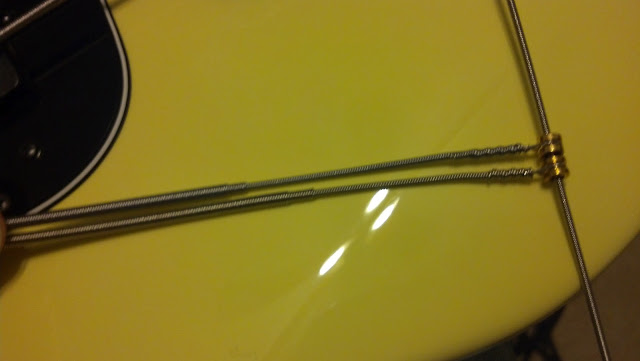
(top: DR bottom: stock)
I put the stock strings back on and the problem went away. I wasn't sure if it was the taper length or a bad string, so I emailed DR strings, and Steve in support was very helpful and sent me a new string to make sure it wasn't a defect. I got it yesterday and installed it, and found the same problem. The taper length on the new string wasn't as long, but it was still longer than the stock string, so I concluded that's the issue. I'm a total DR fanboy, I've been using hi-beams for years, so I really wanted to be able to have those without a radically different sounding B, so I did the following:
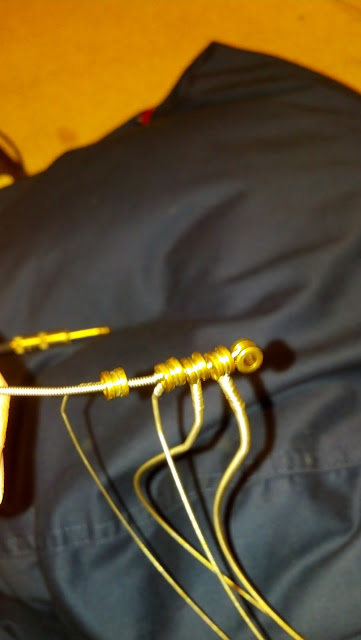
Fortunately, the ball ends from the existing nickel strings fit around that string. Hopefully this works, because there's no going back now:
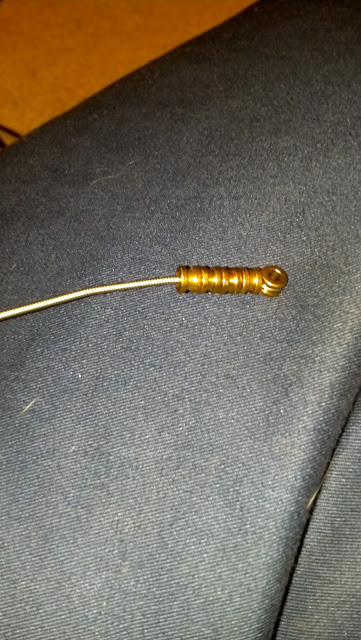
Now, if this is a commonly known thing that everyone who knows what they're doing does, I don't want to know about it because I feel super clever right now since it worked:

I have the tapered part coming across the bridge, but there's hardly any excess, which is perfect. The ringing is gone, and my B sounds growly and mean like I want. This happened though, but I'm not too worried about it:
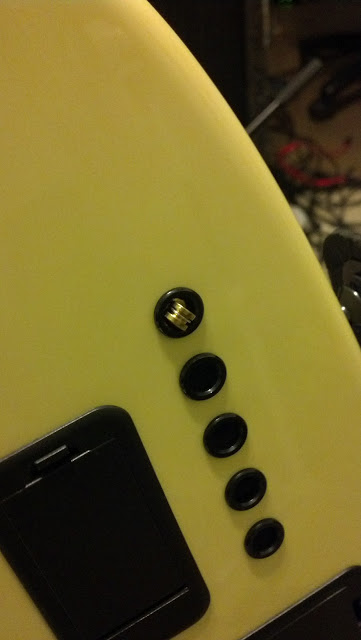
Now, if there is a compelling reason for why I should not be doing this, PLEASE let me know.
During my initial investigation, I found that stringing through the body vs through the bridge made no difference - the point at which the string came across the bridge was the same. I took this shot to compare how it was vs how it is (I strung the first DR through the bridge and the replacement DR is through the body):
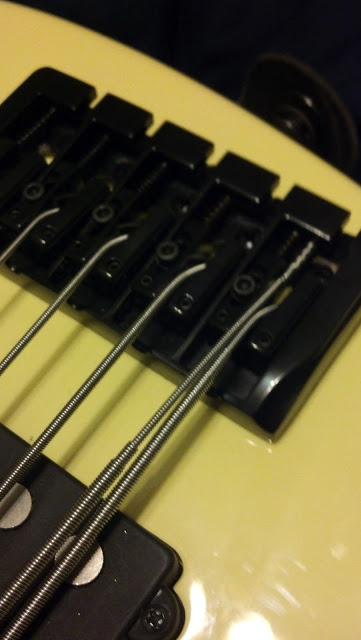
As you can see, the taper extended almost to the edge of the bridge pickup.
Another benefit of this was that the string winding at the post did not include any of the full part of the string, as it had previously:
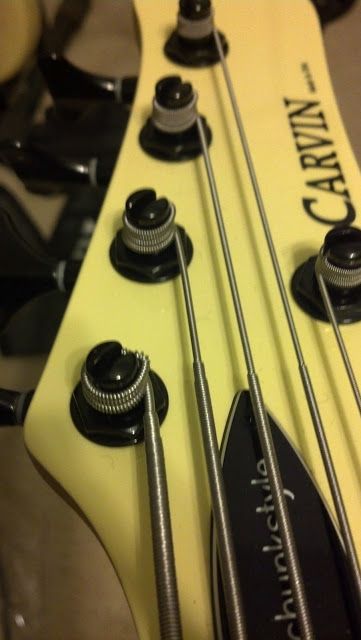
If there are unforseen consequences to doing this, I'd love to know them because I have a show this weekend, and I'd hate for something to happen mid-gig. Otherwise, I hope someone else can benefit from my hair-rending and teeth-gnashing.
tl;dr:
DR long-necks don't seem to be suited for a Carvin SB5000 without a little jury-rigging.
Ok, here goes...
I recently got a Carvin SB5000 and I love it. It's replaced my 15+ yr old MIM Fender P/J Special as my main axe. I played a couple of gigs with it to *make* myself get used to it using the stock Carvin strings (LaBella-made custom nickel set, as I understand it), but I found I really missed my DR hi-beams so I got a set from bassstringsonline.com (which I highly recommend) and I also got a single 130 gauge tapered (DR long neck since there's not a tapered hi-beam) B string since the stock B was tapered and I didn't want to deal with a massive intonation/string height change. (I've since read that the saddles are expecting a tapered string, and a non-tapered string would involve more adjustments than I care to deal with). The string change made the SB5000 sound even more fantastic, so I was pleased.
However, I found that when I started recording some stuff, *something* was out of tune. I investigated further and realized that it was the B string. Specifically, the further up the neck I played on it, the worse it got. A single note would be out of tune with itself. After searching talkbass (and a few other online resources, but mostly talkbass), I came to the conclusion that the taper length was too long at the bridge and the pickup was registering not only the vibration of the full part of the string, but also the smaller tapered end, and the multiple notes being sounded as a result were causing the issue. This is my first experience with tapered strings in over 20 years of playing, so I'm kind of just making it up as I go along here.
I compared the DR long-neck to the stock string and found that the taper was indeed longer on the DR:
(top: DR bottom: stock)
I put the stock strings back on and the problem went away. I wasn't sure if it was the taper length or a bad string, so I emailed DR strings, and Steve in support was very helpful and sent me a new string to make sure it wasn't a defect. I got it yesterday and installed it, and found the same problem. The taper length on the new string wasn't as long, but it was still longer than the stock string, so I concluded that's the issue. I'm a total DR fanboy, I've been using hi-beams for years, so I really wanted to be able to have those without a radically different sounding B, so I did the following:
Fortunately, the ball ends from the existing nickel strings fit around that string. Hopefully this works, because there's no going back now:
Now, if this is a commonly known thing that everyone who knows what they're doing does, I don't want to know about it because I feel super clever right now since it worked:
I have the tapered part coming across the bridge, but there's hardly any excess, which is perfect. The ringing is gone, and my B sounds growly and mean like I want. This happened though, but I'm not too worried about it:
Now, if there is a compelling reason for why I should not be doing this, PLEASE let me know.
During my initial investigation, I found that stringing through the body vs through the bridge made no difference - the point at which the string came across the bridge was the same. I took this shot to compare how it was vs how it is (I strung the first DR through the bridge and the replacement DR is through the body):
As you can see, the taper extended almost to the edge of the bridge pickup.
Another benefit of this was that the string winding at the post did not include any of the full part of the string, as it had previously:
If there are unforseen consequences to doing this, I'd love to know them because I have a show this weekend, and I'd hate for something to happen mid-gig. Otherwise, I hope someone else can benefit from my hair-rending and teeth-gnashing.
 Many players don't realise this and then complain about tapered strings sounding bad, it's actually the design of the string which is bad, the taper is actually good for tone if minimised.