• TalkBass has been independent since 1998. Add your voice.
    Create a free account to reply to discussions, view embedded media, and browse with fewer display ads.
    Join freeLog in
    Want zero display ads or expanded classifieds tools? Compare plans.

Tapewounds causing electrical hum

Diabolus - You're right. Never remove the bridge ground. And that's my point. However, his new tapewound strings don't conduct electricity from their surface, so they're defeating the reason that the bridge ground exists. Using those tapewounds is like not having the bridge ground.
 
Diabolus - You're right. Never remove the bridge ground. And that's my point. However, his new tapewound strings don't conduct electricity from their surface, so they're defeating the reason that the bridge ground exists. Using those tapewounds is like not having the bridge ground.

I am still confused why this would affect anything? I apologize I am not trained in depth with electricity but as I understand it, if these tapewounds strings defeated his ground wire, the bass would then hum louder when the metal parts were touch, the OP's issue goes away when he touches the metal. The buzz going away when he touches the metal is a sure fire sign of a shielding issue and that the ground connection is good.

Again, my bass has no hum with no strings on it. So I cannot see how using tapewounds would defeat a ground connection from an electrical stand point.
 
I am still confused why this would affect anything? I apologize I am not trained in depth with electricity but as I understand it, if these tapewounds strings defeated his ground wire, the bass would then hum louder when the metal parts were touch, the OP's issue goes away when he touches the metal. The buzz going away when he touches the metal is a sure fire sign of a shielding issue and that the ground connection is good.

Again, my bass has no hum with no strings on it. So I cannot see how using tapewounds would defeat a ground connection from an electrical stand point.

If it goes away when you touch the metal it means you're completing the ground. tapewounds are insulated, which defeats the ground wire.
 
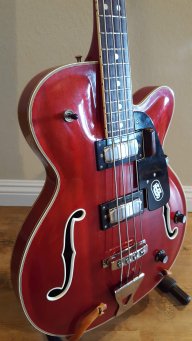
I use them on my fretless, which has two preamps, is well shielded but uses EMG J bass pickups. I had a student who bought a used PV with a P pickup. It came with Labellas. I completely shielded the bass, but it still hummed, unless he touched the bridge. We switched to metal wound strings, and no hum.

My old maple neck 70's P bass didn't hum with Labella Tapewounds. I had Duncan active P and J pickups in it. The next owner switched to PJ Marx passive pickups (he used to work for PJ) and he has no hum problems.
 
themoreyouknow.jpg
 
Let's not confuse things here. The reason that the OP's bass buzzes is because of external environment and lack of shielding. The flatwounds don't cause the buzzing. Things like florescent lights, dimmers, and electrical equipment emit static and the like which are picked up by the instrument and sent to the amplifier. Shielding helps prevent this and that's good.

The problem with the OP is his bass is not shielded and he defeated the bridge ground by using the non-conductive strings.
 
To the OP, if the tapewound strings hum loudly enough that you cannot stand it, replace them with any conductive string of your choice.

This is not a shielding issue, it's the nature of tapewounds. Yes, "wearing jewelry" is ridiculous, I only suggested the conductive bracelet with a wire connected to a conductive part of the bass to illustrate more clearly what is happening electrically.

With my D'addario tapewounds, the noise isn't objectionable, but it is there, and it is caused be the non-conductive nature of the strings.
 
These instruments are designed to use the player as a ground to shunt spurious electrical noise. I can't see for certain, but on the last poster's pics, even with the shielding, the bridge is grounded. The player is supposed to be connected to ground.

This is very wrong. Humans are not grounded in most cases, so expecting players to "ground" the instrument is completely backwards. The instrument is already grounded via the instrument cable, which in turn is connected via ground wires to the electronics and the string bridge (and therefore strings too, if they are conductive).

In fact, when the player touches the bridge (or conductive strings), the player becomes grounded due to the contact. While grounded, your body stops acting like a big antenna/reflector that radiates interference into your instrument's pickups, and this noise stops. But as soon as you stop grounding yourself (i.e., once you remove your hand), you once again become an antenna/radiator, which is why the noise occurs when you're playing non-conductive tapewounds.

With that said, it should not be necessary to depend upon this grounding effect to play without such noise. You should be able to play an open string without touching anything and still be relatively noise-free. You need to ground-shield your electronics cavities to reduce this effect.
 
  • Like
Reactions: Mostyn
To the OP, if the tapewound strings hum loudly enough that you cannot stand it, replace them with any conductive string of your choice.

This is not a shielding issue, it's the nature of tapewounds. Yes, "wearing jewelry" is ridiculous, I only suggested the conductive bracelet with a wire connected to a conductive part of the bass to illustrate more clearly what is happening electrically.

With my D'addario tapewounds, the noise isn't objectionable, but it is there, and it is caused be the non-conductive nature of the strings.

There is absolutely nothing about the nature of tapewounds which introduces noise. If your bass only becomes quiet when you touch a grounded part of the instrument (therefore grounding yourself), then you need a shielding job. (Otherwise, you will hear noise when you play open strings without touching anything!)

The noise you hear in this case is coming from interference actually radiating from your body into the guitar. Humans are a semi-conductive material. We therefore are susceptible to external electromagnetic fields, which induce dynamic charge displacements in our tissues that cause us to turn into a weak dipole antenna. But as soon as we touch a ground conductor, however, this antenna behavior ceases, since the strong ground resists any weakly induced field in our tissue/skin. While held at a single potential (e.g., ground), we act like a static monopole and mostly stop dynamic radiation. Hence no more noise.
 
  • Like
Reactions: Rick M and Mostyn
As Troph said, and posted while I was composing this:

There is some misconception and it's all not very complicated.

The bass bridge (and metal wound strings) are connected to ground through a length of conductive wire.
You are connected to nothing. When you touch the strings or bridge, you are not grounding anything; the
strings are grounding you. Nothing on the bass, ground-wise is changing; it's already connected directly
to ground.

So why does this reduce or eliminate 60 Hz buzz? The electrical fields, which are pretty much all around us,
are picked up by ourselves as well as by the bass wiring. Because of our large surface area, and close proximity
to the bass, we are a strong source of noise while we are holding the bass. This is partly through the back of
the bass and partly through the front from our hands. When you touch a grounded element on the bass, you
reduce the 60 Hz noise on yourself to zero. So that particular noise source is now gone. In addition, just as you
were a noise source, you are now a shield, further reducing any other noise picked up by the bass.

If the bass is well shielded, it will make no difference if you are grounded or not, by touching the strings. The bass
will already be immune to the 60 Hz electrical signal present on yourself. If the buzz is reduced when grounding
yourself, it is therefore an indication that the bass is not shielded.

Anyone who has used an oscilloscope is likely aware of the 60 Hz signal on ourselves. It is common to touch the
probe tip to see if it is "live", or to identify the 'scope channel - as evident by the 60 Hz waveform on the screen.

Or if you have ever touched the tip of a cable disconnected from the bass (and connected to an amp), you are
very likely aware of the signal present on us.
 
The noise you hear in this case is coming from interference actually radiating from your body into the guitar. Humans are a semi-conductive material. We therefore are susceptible to external electromagnetic fields, which induce dynamic charge displacements in our tissues that cause us to turn into a weak dipole antenna. But as soon as we touch a ground conductor, however, this antenna behavior ceases, since the strong ground resists any weakly induced field in our tissue/skin. While held at a single potential (e.g., ground), we act like a static monopole and mostly stop dynamic radiation. Hence no more noise.

Your explanation also explains why tapewounds do not, (like most conductive strings) cause the dipole antenna behavior to cease, because with tapewounds, you are not touching ground. My bass is shielded and with every other string type I have used it is quieter than mouse - without my hands touching the strings. I AM DONE here...:hmm:
 
Your explanation also explains why tapewounds do not, (like most conductive strings) cause the dipole antenna behavior to cease, because with tapewounds, you are not touching ground. My bass is shielded and with every other string type I have used it is quieter than mouse. I AM DONE here...:hmm:

You mean to say, "quieter than a mouse... as long as I'm touching the strings!" Forcing yourself to maintain string/bridge contact at all times to prevent noise is not a good solution. If you raise your hands up to clap, for instance, you don't want a sudden burst of hum/buzz from your amp. I think most players would not find that acceptable.

And for the record, if your instrument is significantly noisier when you remove your hands from the strings/bridge (or play tapewounds, same difference), then something is very likely amiss with your shielding system, or possibly your pickups are just ultra-sensitive to such noise. And while no shielding system is perfect, the bottom line here is that hum/buzz is not a normal characteristic of a properly shielded instrument with tapewounds.