• TalkBass has been independent since 1998. Add your voice.
    Create a free account to reply to discussions, view embedded media, and browse with fewer display ads.
    Join freeLog in
    Want zero display ads or expanded classifieds tools? Compare plans.

Tapewounds for Fender CB-60SCE

Jun 20, 2019
171
326
Hi - just wondering if anyone has experience using either of the following strings on a 32” scale acoustic bass?


D'Addario ETB92 Tapewound

or


La Bella 760N


I’m not sure which ones to get - would there be any issues with the string tension being too high for the acoustic bass?

I’m not keen on the brass strings so want to try a set of tapewounds for a warmer sound.

Thanks.
 
I have the D'addario Nylon Tapes on that same bass. Huge fan! Match made in heaven for my tastes.

They are definitely smoother to play than the bronze rounds that came on it and I find them to still move the soundboard enough for good tone and decent volume.

The thing that seals it for me is that they are lively sounding. Typical flats and some other nylon tapes deliver a lot of fundamental and thud, but not much else. The D'addarios have harmonic content that I haven't found elsewhere. It works for me since I play pretty aggressively with my fingers and I can get a pretty wide range of tones just from playing dynamics and technique.
 
  • Like
Reactions: Shak_2112
How do you find the tension? I was concerned that I might find them too floppy and didn’t know which set would have a higher tension. Cheers
So you're concerned with too much AND too little tension?

Let's establish a field of reference by looking at tensions for phosphor bronze sets.

The D'Addario EPBB170 (45-65-80-100) have a little under 170 pounds' total tension at 32", but they're on the tight side for bronze sets.
Conversely, the old, discontinued GHS phosphor bronze rounds (40-56-76-96) had as little as 116 lbs at the same scale.
Tensions for the Ibanez IABS4XC32 carbon-coated bronze set (which may be what the bass came with, or the more expensive version thereof) aren't known, but it has similar gauges to the latter (namely, 40-60-75-95), bar a fatter D, which could realistically mean about 6 or 7 pounds more.

The D'Addario ETB92M pulls 130 lbs, which is in the ballpark, and won't need work on the nut slots (gauges 50-65-85-105).
The GHS 3060 tapes have 50-70-90-105 gauges, and at 32" scale will clock in at 150 lbs on account of the larger middle strings and the fact they're flatwound under the tape.
The Rotosound Tru Bass 88 medium-scale set (RS88M), with its 65-75-90-115 diameters, are also 150.5 lbs total.
The La Bella 760N-M are 60-70-94-115, so I would expect them to pull somewhere around 140 to 145 asterisks? I may be wrong.
 
Thanks - yes initially I wasn’t sure whether tapewounds were for electric basses primarily - so like a set of flats might, I thought they might pull too much on the neck of an acoustic bass. I hadn’t realised just how low tension tapewounds were which made me think will they feel loose and floppy? The bronze strings on here are quite loose tension-wise so anything less might be a bit strange to play for me. I think I’ll have to get a set and just try them out as there’s more to it than just tension alone in how it feels. Thanks for your help.
 
  • Like
Reactions: HaphAsSard
I think I’ll have to get a set and just try them out as there’s more to it than just tension alone in how it feels.

If I were in your position, I would try the D'A Black Nylons first. Comparing the same gauges (50-105), they're not quite as loose and floppy as the La Bella, and they provide enough of the roundwound tone to be "middle of the road" among tapewounds in their tonal character.
 
  • Like
Reactions: Shak_2112
I thought they might pull too much on the neck of an acoustic bass.
With high-tension strings on an acoustic, I'd expect bridge lifting and/or top bulging behind the bridge (due to defects in the bracing, or simply to the instrument - bracing and top thickness - being "underbuilt" for the tension exerted by that set) sooner than damage to the neck, which has a truss rod after all.
Furthermore, flats may have higher inherent tension than rounds and tapes, but what that amounts to in real life obviously depends on specific gauges: get a 40-95 flatwound set and you will get a little more tension than the stock Ibanez set, but a *lot* less than, say, your garden variety 45-105 nickel-plated steel roundwound "electric" set.
 
  • Like
Reactions: Shak_2112
I have the D'addario Nylon Tapes on that same bass. Huge fan! Match made in heaven for my tastes.

They are definitely smoother to play than the bronze rounds that came on it and I find them to still move the soundboard enough for good tone and decent volume.

The thing that seals it for me is that they are lively sounding. Typical flats and some other nylon tapes deliver a lot of fundamental and thud, but not much else. The D'addarios have harmonic content that I haven't found elsewhere. It works for me since I play pretty aggressively with my fingers and I can get a pretty wide range of tones just from playing dynamics and technique.
Can I just check did the medium set fit this bass fine? I think they are 34” from ball to taper. Thanks.
 
Can I just check did the medium set fit this bass fine? I think they are 34” from ball to taper. Thanks.

Yes, fit is fine. I didn't have to alter the nut slots or anything.

No issues with the silk going over the bridge saddle or nut, either.
20230908_234149.jpg
 

Attachments

  • 20230908_234133.jpg
    20230908_234133.jpg
    974.7 KB · Views: 109
Yes, fit is fine. I didn't have to alter the nut slots or anything.

No issues with the silk going over the bridge saddle or nut, either. View attachment 5184720
Hi Bass-shy
That's strange, as I bought a set of D'addario and tried to fit them to my Fender (same guitar, other than in 'natural'). The ball to nut length was correct, but the bridge pin wouldn't fit into the hole on top of the ball... it would only sit on top of the silk, which obviously shortened the length of the string. I contacted Fender, and the guy told me he didn't think they would fit unless I was willing to 'modify' the bass.
 
Hi Bass-shy
That's strange, as I bought a set of D'addario and tried to fit them to my Fender (same guitar, other than in 'natural'). The ball to nut length was correct, but the bridge pin wouldn't fit into the hole on top of the ball... it would only sit on top of the silk, which obviously shortened the length of the string. I contacted Fender, and the guy told me he didn't think they would fit unless I was willing to 'modify' the bass.
I assume you know, but let's review, for anyone's sake, the correct placement of the string ball-end in a pin-style acoustic-guitar bridge, which is against the plate as opposed to the tip of the pin:

1726034620611.jpeg

The above having been said, silk throws a wrench into this scenario because it can make the overall diameter of the lowest string(s) too bulky to fit in the bridge pin slot.
For those large strings, with end-silked roundwounds and flatwounds, one can solve the problem by removing the silk entirely (a combination of X-Acto knife and cigarette lighter works fine: cut, burn, repeat until necessary). This is however not an option with tapewounds, because silk is funcional on those: it secures the nylon tape to the metal string underneath (I've only ever seen one or two testimonies of people successfully removing them from tapes).

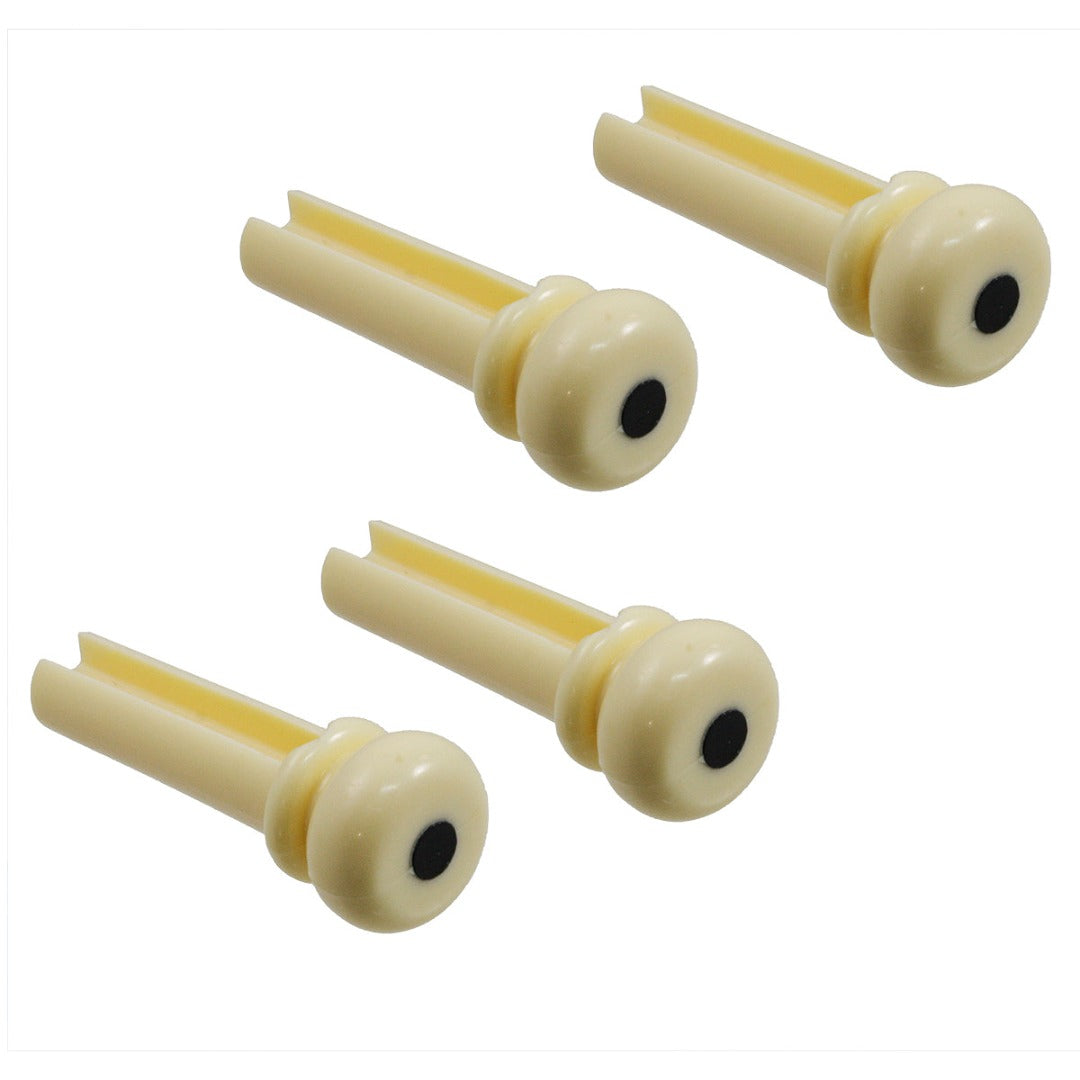
Where to act upon, then? The instrument itself need not be altered, IMO. What you could do is 1) carve the problematic pin until the string fits or 2) put away the existing pins, buy a new set of acoustic bass guitar bridge pins (and if necessary a second one from a different source, in case the first doesn't fit - there's no standard size AFAIK), and have at those with no reserves.
 
Last edited:
  • Like
Reactions: MrBEAC
Thanks for that HaphAsSard. Your diagram explains it far better than my description. :thumbsup: It was even worse than diagram 2 in my case... the silk is so thick that the tip of the pin would have been sitting on top of the silk winding.
I had thought about the solutions that you mention, but I think that the holes are too narrow for that to even work. The guy at Fender indicated the same. I don't want to start widening the bridge holes. Maybe a good excuse for adding a second ABG... if I can get it by the wife. :laugh:

 
  • Like
Reactions: HaphAsSard
I think that the holes are too narrow for that to even work.
I would still try, for shites and geigles. A pin is really only there for the ball end not to leave laterally that position under the bridge plate, and escape through the hole. Ideally, all you need is a thin strip of plastic. See here:

^ One should be able to knock down the sides of the central slot, leaving only the back, and further thin down the latter if necessary.
 
  • Like
Reactions: MrBEAC
I would still try, for poopiees and geigles. A pin is really only there for the ball end not to leave laterally that position under the bridge plate, and escape through the hole. Ideally, all you need is a thin strip of plastic.

^ One should be able to knock down the sides of the central slot, leaving only the back, and further thin down the latter if necessary.
Fair enough... you've persuaded me. :D I'm in the UK, but Amazon will have some.
 
  • Like
Reactions: HaphAsSard
Hi Bass-shy
That's strange, as I bought a set of D'addario and tried to fit them to my Fender (same guitar, other than in 'natural'). The ball to nut length was correct, but the bridge pin wouldn't fit into the hole on top of the ball... it would only sit on top of the silk, which obviously shortened the length of the string. I contacted Fender, and the guy told me he didn't think they would fit unless I was willing to 'modify' the bass.

That's interesting. I'm sorry you had that experience. Mine fit with zero issues.

I wonder if this is either a QC issue or if there was a spec change on those basses at some point.
 
  • Like
Reactions: MrBEAC