
Tried it so far using my rick, sounds amazing! I need a second FRFR speaker though. I don’t have a 2112 to compare this to side by side though…. I’m guessing it’s similar because the drive section of the 2112 is based on the Paradriver.I'm just curious how it turns out.

Enjoy the benefits of a premium membership!
Upgrade Account
-
TalkBass has been independent since 1998. Add your voice.
Create a free account to reply to discussions, view embedded media, and browse with fewer display ads.
Join free Log in
Want zero display ads or expanded classifieds tools? Compare plans.
You are using an out of date browser. It may not display this or other websites correctly.
You should upgrade or use an alternative browser.
You should upgrade or use an alternative browser.
More options
Who Replied?Tonight I played around with this setup a bit more on my Aria bass. In conclusion: this may actually be BETTER than a 2112. You get the Bass Driver’s presence knob, AND the mid shift knob from the para/2112. This allows much more control over the “deep” channel… of course buying both a new BDDI and a new PDDI is probably more expensive at this point than getting a 2112, but since I already owned a BDDI I felt I may as well expand it “2112 spec” by adding a paradriver to it… it works perfectly! I was able to dial in a very satisfactorily “Geddy” style tone. I really don’t feel the need for a 2112 model SansAmp having done this setup.I'm just curious how it turns out.
Last edited:

After much tweaking, here’s my BDDI/PDDI max blend bi-amp settings…. For anyone curious…. Cut treble, boost bass, boost presence on BD. On the PD, boost treble, boost mid, cut bass. Mid shift about halfway between the 750 and 3k marks. Drive doesnt need to be too high on either, these sansamps have potent distortion.
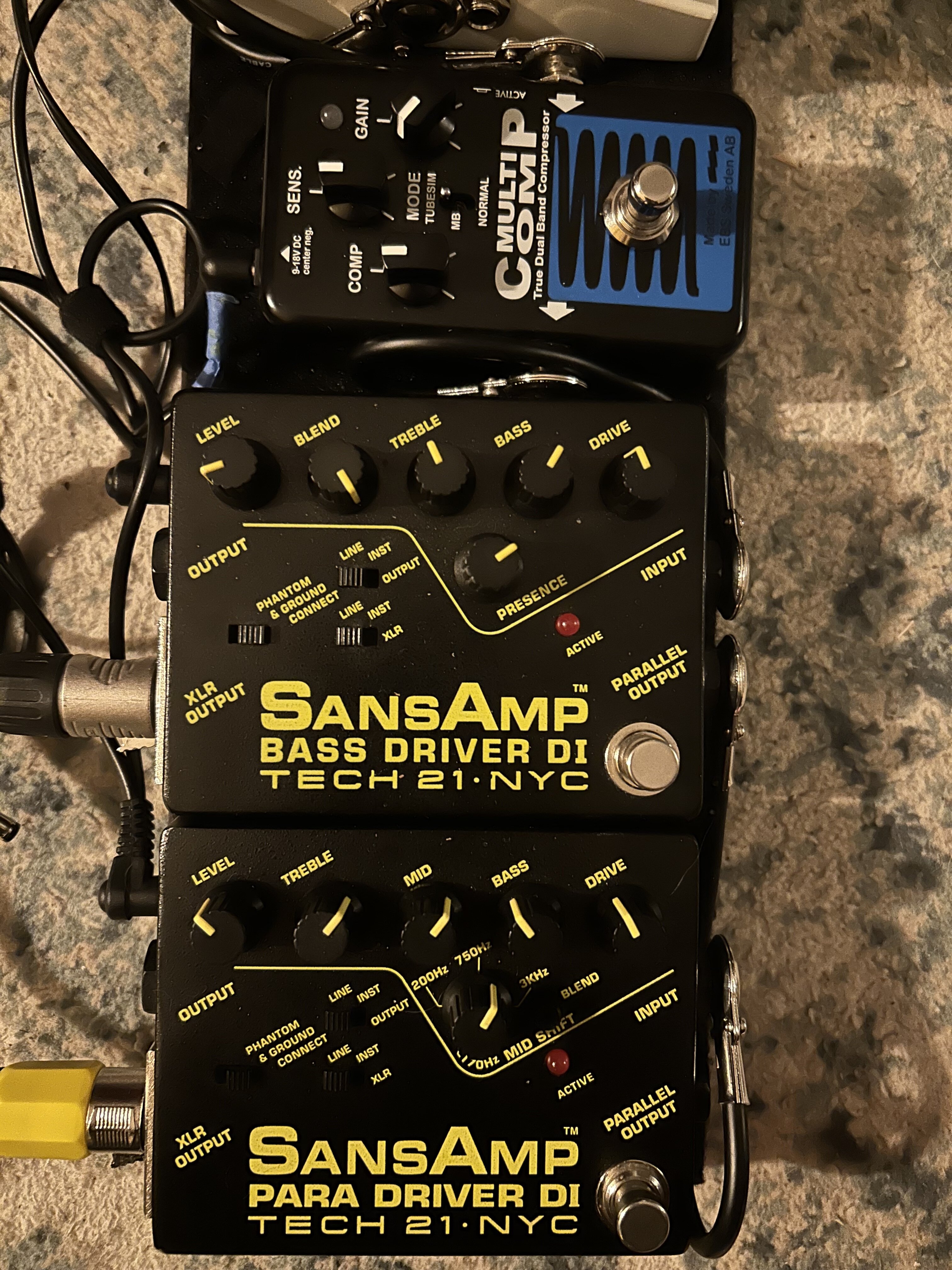
Sorry to triple post, but this thread has been kinda dead so I guess it’s fine
Sorry to triple post, but this thread has been kinda dead so I guess it’s fine
Last edited:

@Azari thanks for showing the details. Looks like you’re taking both XLR signals…are you mixing them at a console for live sound, sending them to a DAW, or??
For band rehearsal and recording I am sending both XLRs to the mixing desk and using IEMs. For practicing at home I just plug both cables into the back of my FRFR speaker with two inputs. For gigs I would just use two channels at FOH, Geddy Lee style. I may grab a 2:1 mixing box of some kind just in case I’m ever forced to use one XLR… but my band only has one guitarist, so there’s more likely to be room for both.@Azari thanks for showing the details. Looks like you’re taking both XLR signals…are you mixing them at a console for live sound, sending them to a DAW, or??
I also can send my bass driver into my Q/strip, QSC power amp, and 410 cab. Then place the FRFR speaker on top and run my para driver into it for a really badass stack, but it’s way too loud for the bedroom and too heavy to carry to most gigs lol.
The Q/Strip used after the bass driver when going into a regular bass cab instead of an FRFR speaker helps compensate for frequencies that get buried when using a cab instead of an FRFR speaker.
Last edited:
So… Any SansAmp Frank Bello Street Driver owners here yet?? Opinions? I consider T21 to be the king of bass preamps and the Street Driver looks amazing. The fewer knobs is appealing to me…
I’ve had the Street Driver for some time know and love it! I don’t use it as a stand alone preamp but run it before either the BDDI or SH1 . But I’ve also ran it in front of a Subway pre and a couple of others. It always adds something extra , in a great way, when used at low drive settings. Like adding some nice saturation. As an overall distortion pedal, it’s the best I’ve used. It goes from slightly overdriven to flat out nasty. But always sounds great while retaining bass.

Soo
I’ve used the QStrip with either driver pedal, but I haven’t tried using both driver pedals together, although it would be pretty easy just using another channel in the mixer.

For band rehearsal and recording I am sending both XLRs to the mixing desk and using IEMs. For practicing at home I just plug both cables into the back of my FRFR speaker with two inputs. For gigs I would just use two channels at FOH, Geddy Lee style. I may grab a 2:1 mixing box of some kind just in case I’m ever forced to use one XLR… but my band only has one guitarist, so there’s more likely to be room for both.
I also can send my bass driver into my Q/strip, QSC power amp, and 410 cab. Then place the FRFR speaker on top and run my para driver into it for a really badass stack, but it’s way too loud for the bedroom and too heavy to carry to most gigs lol.
The Q/Strip used after the bass driver when going into a regular bass cab instead of an FRFR speaker helps compensate for frequencies that get buried when using a cab instead of an FRFR speaker
Ok, so I have a BDDI, a PDDI, and a QStrip.For band rehearsal and recording I am sending both XLRs to the mixing desk and using IEMs. For practicing at home I just plug both cables into the back of my FRFR speaker with two inputs. For gigs I would just use two channels at FOH, Geddy Lee style. I may grab a 2:1 mixing box of some kind just in case I’m ever forced to use one XLR… but my band only has one guitarist, so there’s more likely to be room for both.
I also can send my bass driver into my Q/strip, QSC power amp, and 410 cab. Then place the FRFR speaker on top and run my para driver into it for a really badass stack, but it’s way too loud for the bedroom and too heavy to carry to most gigs lol.
The Q/Strip used after the bass driver when going into a regular bass cab instead of an FRFR speaker helps compensate for frequencies that get buried when using a cab instead of an FRFR speaker.
I’ve used the QStrip with either driver pedal, but I haven’t tried using both driver pedals together, although it would be pretty easy just using another channel in the mixer.
Try your BDDI and PDDI in parallel and see what tones you come up with. Let us know how you like itSoo
Ok, so I have a BDDI, a PDDI, and a QStrip.
I’ve used the QStrip with either driver pedal, but I haven’t tried using both driver pedals together, although it would be pretty easy just using another channel in the mixer.
View attachment 7065416

I have one and it can cover a diversity of tones. Really like it.So… Any SansAmp Frank Bello Street Driver owners here yet?? Opinions? I consider T21 to be the king of bass preamps and the Street Driver looks amazing. The fewer knobs is appealing to me…

As a Tech21 fan I've been seriously tempted by the Street Driver. One reason I didn't pull the trigger is that I already have the SH1 -- different feature set obviously, but also a versatile device. A second reason is that my main pedal these days is the dUg pedal (DP3X), which does its own thing. The main reason: I've been holding out for the XB Driver, which could be called the dUg-plus-plus.
The XB is a complicated device, so I understand the appeal of the Street Driver. And I'm sure the Street Driver can do things that the XB can't. I wish I could afford both, but at this moment my budget won't allow either.
The XB is a complicated device, so I understand the appeal of the Street Driver. And I'm sure the Street Driver can do things that the XB can't. I wish I could afford both, but at this moment my budget won't allow either.
I get the feeling that a street driver in parallel with another sansamp would be absolutely killer. A Street Driver connected to the parallel out of a Bass Driver sounds like it would be absolutely killer.As a Tech21 fan I've been seriously tempted by the Street Driver. One reason I didn't pull the trigger is that I already have the SH1 -- different feature set obviously, but also a versatile device. A second reason is that my main pedal these days is the dUg pedal (DP3X), which does its own thing. The main reason: I've been holding out for the XB Driver, which could be called the dUg-plus-plus.
The XB is a complicated device, so I understand the appeal of the Street Driver. And I'm sure the Street Driver can do things that the XB can't. I wish I could afford both, but at this moment my budget won't allow either.
I’ve been GASing for a Street Driver since Rodney McG’s demo. I love the sounds in the SH1 but the format isn’t ideal for my use. I tend to step on the wrong switch or bump controls on gigs. Yes I have Big feet, and maybe not super coordinated 
The single switch simplicity of SD48 and wide variety of sounds calls to me…
The single switch simplicity of SD48 and wide variety of sounds calls to me…

The thing I like about a lot of the Tech21 stuff is that it may have a signature on it which might not totally appeal to your taste, but the capability seems to transcend the signature. I don't have any special interest in Rush, but the 2112 is a nicely versatile box that I've managed to get a lot out of. Hell, I just enjoy playing through it. Looking at the demos for the Street Driver 48 (curse you @Fuzzbass), my interest in Anthrax is even further away, other than to say FB seems like a lovely guy, but damn it if I don't dig the grind coming out of that pedal.
I can confirm the Street Driver 48 sounds nothing like the RBI, nothing like the Drive section of the 2112. It's very much a different voicing. The distortion is much more centered around the upper-mids and treble area (unlike the lower-mid, spongy amp thing the 2112/RPM does) and is definitely in that "grindy" territory that one might invoke another product (rhymes with Bark Class) to describe, but not as heavy. Also not voiced as high like the DP3X, from what I can tell. But this is a real option when you want to hear some clank. It's naturally clanky, and I was looking for something that did that.
Combining the RBI and the SD48 is fun; you get a lot of sizzle and a lot of bottom end, although unless you blend in the DI sound, or go negative numbers on the SD48's EQ, it's kind of "Scoop-on-scoop" and may disappear in some style of music.
I like the SD48. The other pedal I wonder about now is the XB Driver.
Combining the RBI and the SD48 is fun; you get a lot of sizzle and a lot of bottom end, although unless you blend in the DI sound, or go negative numbers on the SD48's EQ, it's kind of "Scoop-on-scoop" and may disappear in some style of music.
I like the SD48. The other pedal I wonder about now is the XB Driver.
Last edited:
My BDDI v1 is broken, has been for years. Not really bad, it mostly works except the XLR out doesn't.
The XLR socket is connected to the PCB with 4 thin metal rods and one of these broke. The inside of the BDDI is really cramped and I'm just a bit better at soldering than at playing the bagpipes, so there's no way I can possibly fix the broken rod. I was thinking of breaking the 3 remaining rods, getting the socket out and replacing the rods with wires (easier to solder this way). Thoughts?
The XLR socket is connected to the PCB with 4 thin metal rods and one of these broke. The inside of the BDDI is really cramped and I'm just a bit better at soldering than at playing the bagpipes, so there's no way I can possibly fix the broken rod. I was thinking of breaking the 3 remaining rods, getting the socket out and replacing the rods with wires (easier to solder this way). Thoughts?
We can repair the pedal for you or you could purchase a replacement jack if you think you can do the job yourself. Please contact our customer support department.
The one caveat when blending it with another preamp is when you have the DIRT button in, you need to flip the phase. No big deal, it's almost perfectly 180º out of phase.Combining the RBI and the SD48 is fun; you get a lot of sizzle and a lot of bottom end, although unless you blend in the DI sound, or go negative numbers on the SD48's EQ, it's kind of "Scoop-on-scoop" and may disappear in some style of music.
DIRT out:
DIRT in:

Over the past few days I’ve been doing some side-by-side comparisons between my GED-2112 and my new RBI. In an effort to have a level playing field, I’ve been using my pair of Aguilar GS112 speaker cabinets and powering them with my Yamaha PX5 stereo power amp.
I’m very happy to find that each model sounds quite a bit different. This makes me happy to own one of each model. I really can’t find a lot of overlap at this time.
Right off the bat, the RBI sounds a bit more versatile. It definitely has more top end. I’ve been using the “Fat Tube”, “Bassman”, and the “SVT” settings in the Owners Manual as starting points. I’ve then made some small adjustments to get each preset to where I’m happier with them.
One observation: The “SVT” setting in the manual sounds much brighter and mid-scooped from the SVTs that I once owned. No big deal, though. I simply turned up my “Mids” control slightly and I slightly turned down my “Presence” control, and I quickly had a more satisfying sound. And it’s front panel controls are super sensitive; in a good way. A little adjustment goes a long way IMO.
The “Drive” Channel’s controls on the GED-2112 are equally sensitive IMO. Because I’ve been using the GED for quite a few years now, and I’m much more comfortable with it’s operation, I can quickly dial in a warmer, more natural sound from it’s “Drive” channel, then use the “Deep” channel to fill things in. But I believe that’s simply my inexperience with the RBI at this time.
BTW, the “ Fat Tube” eq setting on the RBI is a sound that I can envision using quite a bit for live playing. In fact, the “Fat Tube” setting for me is pretty darn close to the sound of the SVT-CL/810E setup that I owned about 20 years ago.
I’m very happy to find that each model sounds quite a bit different. This makes me happy to own one of each model. I really can’t find a lot of overlap at this time.
Right off the bat, the RBI sounds a bit more versatile. It definitely has more top end. I’ve been using the “Fat Tube”, “Bassman”, and the “SVT” settings in the Owners Manual as starting points. I’ve then made some small adjustments to get each preset to where I’m happier with them.
One observation: The “SVT” setting in the manual sounds much brighter and mid-scooped from the SVTs that I once owned. No big deal, though. I simply turned up my “Mids” control slightly and I slightly turned down my “Presence” control, and I quickly had a more satisfying sound. And it’s front panel controls are super sensitive; in a good way. A little adjustment goes a long way IMO.
The “Drive” Channel’s controls on the GED-2112 are equally sensitive IMO. Because I’ve been using the GED for quite a few years now, and I’m much more comfortable with it’s operation, I can quickly dial in a warmer, more natural sound from it’s “Drive” channel, then use the “Deep” channel to fill things in. But I believe that’s simply my inexperience with the RBI at this time.
BTW, the “ Fat Tube” eq setting on the RBI is a sound that I can envision using quite a bit for live playing. In fact, the “Fat Tube” setting for me is pretty darn close to the sound of the SVT-CL/810E setup that I owned about 20 years ago.
Last edited:


