Enjoy the benefits of a premium membership!
Upgrade Account
-
TalkBass has been independent since 1998. Add your voice.
Create a free account to reply to discussions, view embedded media, and browse with fewer display ads.
Join free Log in
Want zero display ads or expanded classifieds tools? Compare plans.
You are using an out of date browser. It may not display this or other websites correctly.
You should upgrade or use an alternative browser.
You should upgrade or use an alternative browser.
The Acoustic Club
- Thread starter The Owl
- Start date
More options
Who Replied?
My 220 has the white switch and it's broken in the "always on" position. Much better than the a"always off" position!
Define "stuck"; do you mean it is physically stuck or just doesn't work when you try to cut it off.
Mine had the 2nd problem, the power switch would go on and off physically but the amp stayed on.
I suggest you guys pull out the chassis and take a peek because mine can't be the only one with this problem.
The power switch has a great big honkin ceramic cap from the switch to some other location.
My 220 power switch stopped working and a couple of years later (I did not use the amp much) I pulled the chassis out of the shell/case (very easy to do) and found one of the legs of the cap had snapped off.
I just resoldered that leg from the cap back on and it worked perfectly after that.
So that's an easy fix to check, mine has been working now for the past 10 years.
The interesting thing was it started doing that after I broke it out of retirement and was hauling it around to open mic things, and later on to practice with this new band.
Seemed like about a year after I stopped using it at practice (got replaced by an Ampeg rig) the switch stopped working so I think just moving it around after sitting for a number of years managed to break that solder joint.
Easy to check and easy to fix.
Let me know guys if yours is like this!
Analogeezer

Define "stuck"; do you mean it is physically stuck or just doesn't work when you try to cut it off.
Mine had the 2nd problem, the power switch would go on and off physically but the amp stayed on.
Same, physically switches, no effect.
Same, physically switches, no effect.
Try my fix then, well if your big ceramic cap is snapped off one side. Takes about 10 minutes (tops) to pull the chassis out and the 220 is like working on an old car, plenty of room under the hood.
Let me know if this is the problem with yours.
Analogeezer
Mine had the 2nd problem, the power switch would go on and off physically but the amp stayed on. ... The power switch has a great big honkin ceramic cap from the switch to some other location. ... I pulled the chassis out of the shell/case (very easy to do) and found one of the legs of the cap had snapped off. I just resoldered that leg from the cap back on and it worked perfectly after that. ... Seemed like about a year after I stopped using it at practice ... the switch stopped working so I think just moving it around after sitting for a number of years managed to break that solder joint.
Something ain't quite right here ^^^ There should be a .01uF ceramic disc cap soldered across two of the SPDT power switch terminals (paralleled) in order to reduce switch contact pitting. If the switch is good and the cap is missing (or one leg breaks loose like you described) the amp should still turn on and off like normal until arcing takes out the internal contacts (amp won't turn on) or fuses them (amp won't turn off). If your amp doesn't turn on with one of the capacitor legs disconnected but does turn on (with the switch) when the cap is connected then it sounds like somebody wired it in series with the switch which would mean the cap really isn't doing anything useful.
Edited to remove previous stupidity
Last edited:
Something ain't quite right here ^^^ There should be a .01uF ceramic disc cap soldered across two of the SPDT power switch terminals (paralleled) in order to reduce switch contact pitting. If the switch is good and the cap is missing (or one leg breaks loose like you described) the amp should still turn on and off like normal until arcing takes out the internal contacts (amp won't turn on) or fuses them (amp won't turn off). If your amp doesn't turn on with one of the capacitor legs disconnected but does turn on (with the switch) when the cap is connected then it sounds like somebody wired it in series with the switch which would mean the cap really isn't doing anything useful.
Edited to remove previous stupidity
All I know is my power switch would not work, but if you plugged/unplugged the amp it would turn on and off.
I opened it up, found the big disc cap with one leg missing and resoldered it; then the power switch worked.
The amp was purchased new (in 1978), and had never been in a shop, before that or since. Now it works fine and has for about 10 years.
Analogeezer
All I know is my power switch would not work, but if you plugged/unplugged the amp it would turn on and off.
I opened it up, found the big disc cap with one leg missing and resoldered it; then the power switch worked.
The amp was purchased new (in 1978), and had never been in a shop, before that or since. Now it works fine and has for about 10 years.
Bizarre, can't really explain that.
Here's a picture of the power switch and cap in my 320 which is identical to what's in my 220 and 330 and also consistent with those amps' power supply schematics. As you can see the disc cap is soldered across the middle and bottom terminals of the switch, parallel to the two wires.
The only other way I've seen them do it is in a 120 chassis where the cap was outboarded to that little multi-lug terminal strip in the foreground with the internal fuse, however the cap was still effectively paralleled across the switch terminals. Either way, these amps would still turn on/off if a cap lead was disconnected -- the power switch contacts would just arc and spark more.
I can't quite fathom why your 220 is different or what the function of the cap is in your case. The other odd thing is that a lead would have come loose at all... those terminations are usually soldered solidly in place.
Last edited:
Bizarre, can't really explain that.
Here's a picture of the power switch and cap in my 320 which is identical to what's in my 220 and 330 and also consistent with those amps' power supply schematics. As you can see the disc cap is soldered across the middle and bottom terminals of the switch, parallel to the two wires.
The only other way I've seen them do it is in a 120 chassis where the cap was outboarded to that little multi-lug terminal strip in the foreground with the internal fuse, however the cap was still effectively paralleled across the switch terminals. Either way, these amps would still turn on/off if a cap lead was disconnected -- the power switch contacts would just arc and spark more.
I can't quite fathom why your 220 is different or what the function of the cap is in your case. The other odd thing is that a lead would have come loose at all... those terminations are usually soldered solidly in place.
View attachment 4489896
Mine was above the switch and the cap had fairly long legs on it.
The termination didn't break, the lead coming off the cap is what broke, so I just soldered the lead from the cap (had to bend it a slight bit) back to the location of the original lead after taking off the original lead.
If the serial number would help (you are like the authority on these old ACC Acoustics it seems, I bow before your knowledge) I can post that; I bought the amp in September of 1978 so it was made earlier that year I suppose.
Analogeezer
p.s. Similar to all those threads about Class D amps flying off their cabinets, I actually had the 220 fly off my stack onto a concrete floor at practice, from like 5 feet up. Crazy because the amp just kept going, I only noticed it after I turned around and saw it on the floor!
This was around 1981 - 1982 so the bit with the cap leg breaking off was another good 18 years later.
After the 2nd time it did this I just wound up putting a folded black towel under the head and it was never a problem again.
Those old ACC Acoustics had really hard feet on the bottom, and were designed to fit into the cups on the tops of their cabinets (the ACC cabs).
My cabs were large, single 15" cabs (stacked) with JBL K130's, later on E140's. I played in some very loud bands up to 1981 - 1982 but for some reason (maybe the concrete floor at practice) it had never been a problem prior to that.
The big mystery (to me) is why one lead of the cap coming loose would prevent the switch from turning the amp on and off since I've never encountered an Acoustic amp with a disc cap in series with the power switch and ever seen one in a schematic. I can't imagine what's going on there.
I can't/won't use my 220 as a reference since when I got it the power switch had obviously been changed out, so all bets are off. I did just take a quick peek at my circa-1978 model 330 and see that connections to the power switch are via Quick Connect connectors crimped to the two wires rather than being soldered. Each lead of the disc cap was soldered to the outside surface of a QC connector before attaching to the switch terminals. But for whatever reason my late 1979-early 1980 model 320 in the picture above has the power wires and cap soldered directly to the switch, so perhaps they were addressing some reliability issues.
I hear you about the hard plastic feet. I'm usually a stickler for keeping things as original as safely possible but I usually do replace the bottom feet with rubber feet. That's crazy that your 220 survived a 5-foot drop test onto concrete, the marketing department could have really made hay with that testimonial.
I can't/won't use my 220 as a reference since when I got it the power switch had obviously been changed out, so all bets are off. I did just take a quick peek at my circa-1978 model 330 and see that connections to the power switch are via Quick Connect connectors crimped to the two wires rather than being soldered. Each lead of the disc cap was soldered to the outside surface of a QC connector before attaching to the switch terminals. But for whatever reason my late 1979-early 1980 model 320 in the picture above has the power wires and cap soldered directly to the switch, so perhaps they were addressing some reliability issues.
I hear you about the hard plastic feet. I'm usually a stickler for keeping things as original as safely possible but I usually do replace the bottom feet with rubber feet. That's crazy that your 220 survived a 5-foot drop test onto concrete, the marketing department could have really made hay with that testimonial.
The big mystery (to me) is why one lead of the cap coming loose would prevent the switch from turning the amp on and off since I've never encountered an Acoustic amp with a disc cap in series with the power switch and ever seen one in a schematic. I can't imagine what's going on there.
I can't/won't use my 220 as a reference since when I got it the power switch had obviously been changed out, so all bets are off. I did just take a quick peek at my circa-1978 model 330 and see that connections to the power switch are via Quick Connect connectors crimped to the two wires rather than being soldered. Each lead of the disc cap was soldered to the outside surface of a QC connector before attaching to the switch terminals. But for whatever reason my late 1979-early 1980 model 320 in the picture above has the power wires and cap soldered directly to the switch, so perhaps they were addressing some reliability issues.
I hear you about the hard plastic feet. I'm usually a stickler for keeping things as original as safely possible but I usually do replace the bottom feet with rubber feet. That's crazy that your 220 survived a 5-foot drop test onto concrete, the marketing department could have really made hay with that testimonial.
TWICE!
It must have been the speaker cables reigning it in or something because both times it landed flat on the floor.
The only physical damage it sustained was one of the hard rubber feet got slightly crushed. In fact I only replaced the feet about 6 months ago because I thought "why I have I not changed those in all these years?"
So I got some that were slightly wider and of course softer.
One thing is with these amps is the existing hard feet are actually rather close to the corners of the bottom of the head, so you can't stick a large foot under there without it peaking out from the side.
Obviously this head shifting thing was a problem because why else would ACC have put those indented cups into the tops of their cabinets?
Analogeezer
It took me a little while, but I've done a deep clean and service to my newly acquired 120.
This was sold and shipped to me from our brother @ghostinthemach .
It's in great shape and sounds fantastic! Thanks @ghostinthemach !
@JacklegBass , I can't see any difference between this amp and my 126, other than the heat sinks on the power board. All the caps and transformers are the same value. At the bottom i'll post an earlier pic of the 126 for comparison.
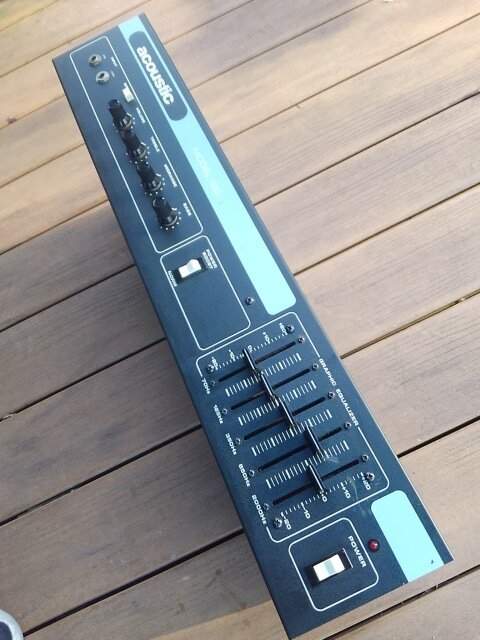
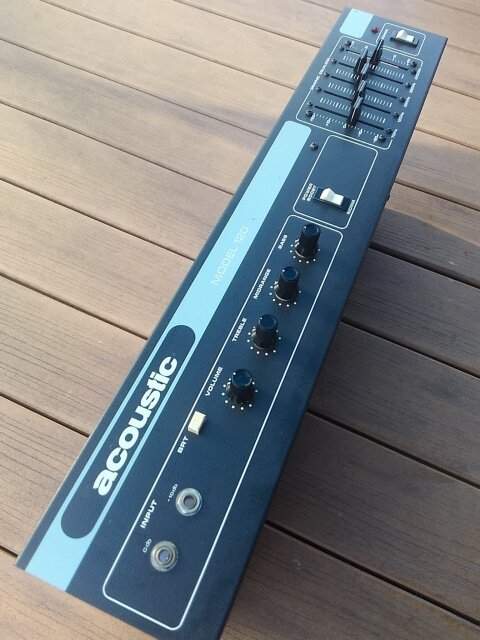
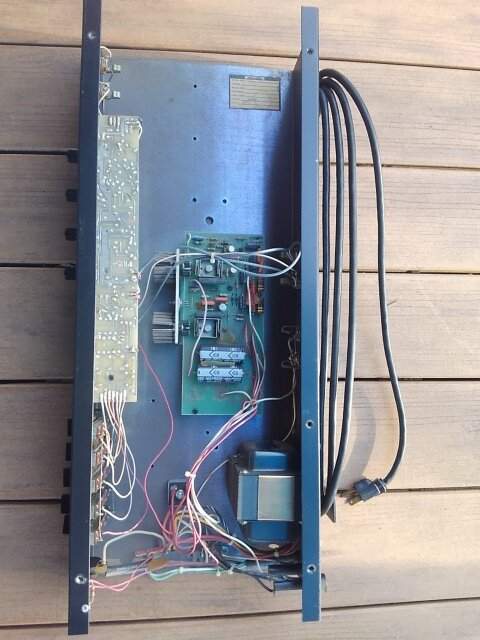
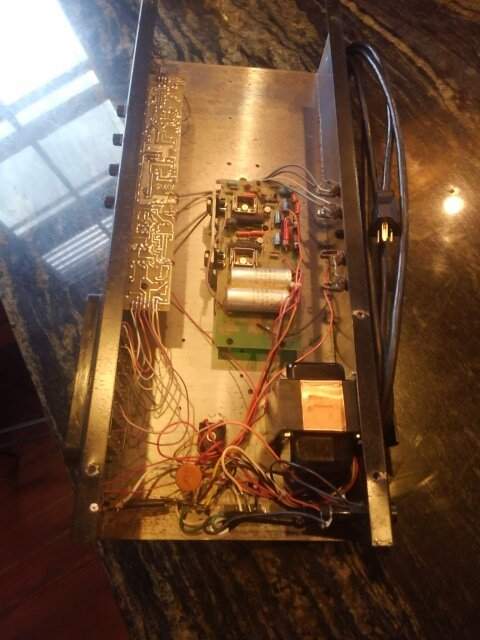
This was sold and shipped to me from our brother @ghostinthemach .
It's in great shape and sounds fantastic! Thanks @ghostinthemach !
@JacklegBass , I can't see any difference between this amp and my 126, other than the heat sinks on the power board. All the caps and transformers are the same value. At the bottom i'll post an earlier pic of the 126 for comparison.
Attachments

@JacklegBass , I can't see any difference between this amp and my 126, other than the heat sinks on the power board. All the caps and transformers are the same value.
Right, by the time I put the final EDIT on my earlier post #6071 I realized that your 126 was a revised version that I never knew existed. By the time the 120 amp was introduced they were using that updated chassis, therefore just like your later version 126 there's no separate EQ board, a dual-polarity power supply and no output cap. Interesting that they still used the same transformer from the old single-polarity PS.
Congrats on the good score!

Hello, my name is Stu and I am coming back to the fold this Sat. When I pick up my 1972 Acoustic Control Corp. 371 system!
In 1968-69 I purchased a ACC 360 system and when the 371 system came out I bought 1 head and 2 cabs, one for each side of the stage. I almost closed out the 70's with this system but in 1979 I just had to have the SVT with the 2 cabs, still one on each side of the stage. Anyway, I am returning to the fold, oh yeah, no picture it's not real, so this is my amp!

In 1968-69 I purchased a ACC 360 system and when the 371 system came out I bought 1 head and 2 cabs, one for each side of the stage. I almost closed out the 70's with this system but in 1979 I just had to have the SVT with the 2 cabs, still one on each side of the stage. Anyway, I am returning to the fold, oh yeah, no picture it's not real, so this is my amp!

Congrats!Hello, my name is Stu and I am coming back to the fold this Sat. When I pick up my 1972 Acoustic Control Corp. 371 system!
In 1968-69 I purchased a ACC 360 system and when the 371 system came out I bought 1 head and 2 cabs, one for each side of the stage. I almost closed out the 70's with this system but in 1979 I just had to have the SVT with the 2 cabs, still one on each side of the stage. Anyway, I am returning to the fold, oh yeah, no picture it's not real, so this is my amp!View attachment 4491930
My 371

Thank you! I'm feeling very good about it!
Yessir, tone for days!Thank you! I'm feeling very good about it!
I bought my cab new in 1973. I was in 11th grade. The head came a few years later.
Heck my 11th grade was in 1967-68, so I was still running my Fender bassman with two 15's or maybe my 2- Ampeg B-15's.Yessir, tone for days!
I bought my cab new in 1973. I was in 11th grade. The head came a few years later.
I am 70 now.