• TalkBass has been independent since 1998. Add your voice.
    Create a free account to reply to discussions, view embedded media, and browse with fewer display ads.
    Join freeLog in
    Want zero display ads or expanded classifieds tools? Compare plans.

The Aleph - A Call for Opinions

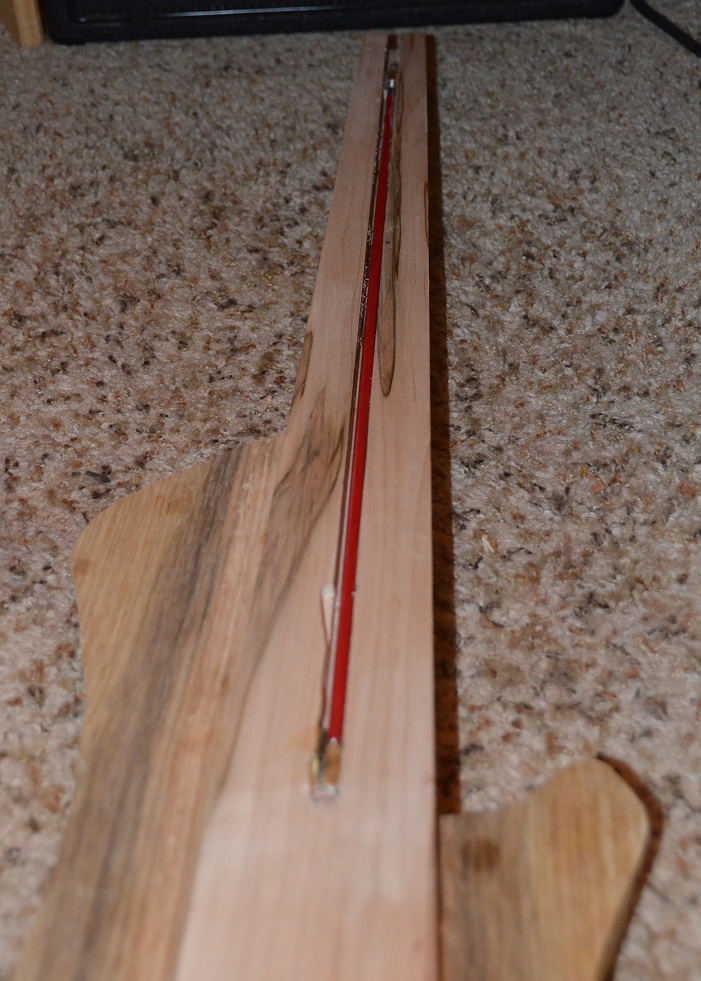
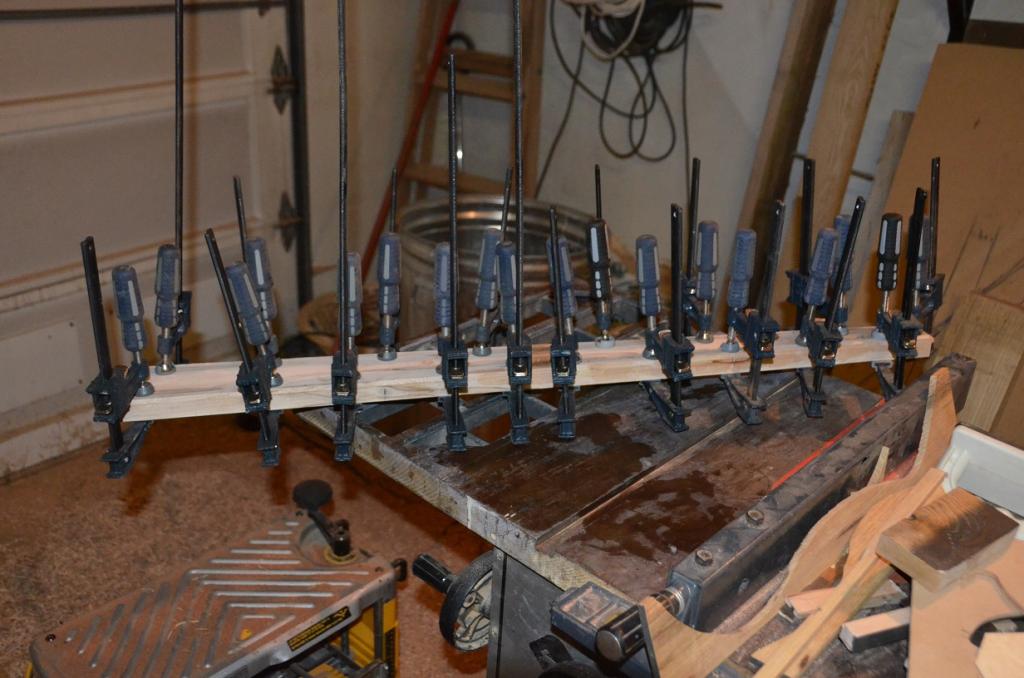
Tonight saw a less than perfect truss rod channel routed out, and a fingerboard glued to the neck. Somehow I fished out the wrong sized bit and did not realize it until too late, and the router jumped on me when I was not expecting it to. It was not a disaster - a few side shims and the rod is snugly in place, and the ugly job will be hidden by the fingerboard. At least this is not a job for a customer. ;)


DSC_0551_zpsf9ac46e8.jpg

DSC_0552_zps06e18b50.jpg
 
That truss rod rout isn't that bad. I would have just wrapped some electric tape around the rod in about 4 places, one on each end and two in the middle to keep it from vibrating. If anything, a slightly loose rout keeps the rod from binding.
 
That truss rod rout isn't that bad. I would have just wrapped some electric tape around the rod in about 4 places, one on each end and two in the middle to keep it from vibrating. If anything, a slightly loose rout keeps the rod from binding.
Thanks for the encouragement! The neck came out of the clamps this morning and there is zero rattle, so I dodged a bullet. I will keep your offered advice for the next time I bork up a route. ;)
 
No pix at the moment, but the neck has been profiled using a 3/4" radius roundover and the process of filling the wormholes has begun. The neck and fingerboard look *very* nice and I am now struggling with whether or not to cut and fill reference lines. If I choose to proceed without lines I think I will need to install side dots to avoid being completely lost.
 
No pix at the moment, but the neck has been profiled using a 3/4" radius roundover and the process of filling the wormholes has begun. The neck and fingerboard look *very* nice and I am now struggling with whether or not to cut and fill reference lines. If I choose to proceed without lines I think I will need to install side dots to avoid being completely lost.

You can always try it no lines for a while, then add them in later if you are struggling. Been a few projects on here with like just 10mm worth of line which have looked pretty nice.
 
This evening I routed out the pocket for the neck. A quick bathroom scale check has her weighing in at 5 1/2 pounds. She still looks rough around the edges, but things are progressing.

DSC_0554_zps510c730a.jpg
DSC_0555_zpsd3f71a77.jpg

DSC_0556_zps34133ecb.jpg
 
Last edited:
As scary as it feels I think I am going to move forward without lines OR side dots. The 12th fret position lands just a bit shy of the tip of the bass side horn, and the 24th falls just a bit shy of the treble side horn. This give me 2 main reference points I can find by feel, and with the extreme variation of the grain and spalting on the fingerboard I *should* be able to find my way around without too much problem.

Mayhap I am focusing too much on aesthetics, but worst case scenario I can add lines or dots of some sort after the fact as @gmjhowe suggested.
 
As scary as it feels I think I am going to move forward without lines OR side dots. The 12th fret position lands just a bit shy of the tip of the bass side horn, and the 24th falls just a bit shy of the treble side horn. This give me 2 main reference points I can find by feel, and with the extreme variation of the grain and spalting on the fingerboard I *should* be able to find my way around without too much problem.

Mayhap I am focusing too much on aesthetics, but worst case scenario I can add lines or dots of some sort after the fact as @gmjhowe suggested.
No need to be scared, lots of kids play violin, viola, and cello without markers. :) You'll bee fine.
Rondo
 
No need to be scared, lots of kids play violin, viola, and cello without markers. :) You'll bee fine.
Rondo
My understanding that those instruments, as well as the double bass, are built in such a way to provide tactile reference points that assist in finding the correct position for good intonation. That being said Steve Bailey is a strong advocate for practicing in the dark and doing your best to learn to play the fretless bass without looking at the fingerboard. I agree with you in spirit - I should not let my fear keep me from pursuing it.
 
The neck is glued in and after waiting 24 hours to make sure of the bond I will clean up the protruding maple on the bottom. A hole has been bored and is ready to receive a jack and an Electrosocket jack mount. The slot for the saddle was cut prior to gluing, and at glue up a wire was fished through to make sure that the channel did not get closed by squeeze out.

Due to the length of the piezo transducer and the absence of an above body bridge it was necessary to recess the neck further into the body. I ended up making the neck flush with the rest of the body similar to the original piano pin tuner prototype. The fingerboard radius will remain flat, and some material at the end may need to be removed to create a decent break angle for the strings over the saddle. We will see.

DSC_0572_zps7cc6824f.jpg
 
My eight year old daughter sat down with me tonight and spent some time sanding. She's a quick student and absorbed the basics immediately. It was a zen moment with the bass in my lap and my daughter at my side with a serious expression on her face as she plied abrasive to wood and explored the grain with her fingers to check her work.
 
I roughed out a headpiece using some ambrosia maple scrap and drilled the holes for the tuning pins tonight. The string spacing is tight, so to check that out and see if I could get away with not digging out material on the end of the body to create a decent string break angle over the saddle I went ahead and strung her up using some rosewood scrap as a temporary nut and saddle. I use an E through C tuning, and so I started with the low E. While tuning to pitch a loud snap ripped through my basement. I thought for sure it was either the tuning pin or the headpiece giving up the ghost, but it was the string blowing up on me.

The taper on the E string of the long scale flats I have ended before the string was up to pitch and the main part of the string started to wrap around the pin, but the diameter of the pin is too small and the string broke. This was not an issue on my 34" prototype that used the piano pins, and the other strings (A through C) are fine. I was planning on stringing it up with a set of D'Addario Black Nylon Tapewound's I have, but they are long scale and are not going to work without my replacing the E string with a short or medium scale string. Not a huge deal, and it gave me some good info going forward that I can use to my advantage when planning future instruments using the pins.

The string spacing is set at 16mm at the saddle, and the 0" position where the nut will be is just a little over 1.5" wide. I have really small hands and this is the most comfortable bass I have ever played. The neck profile feels comfortable, and the flat fingerboard radius is familiar. The lack of lines and side dots is taking a LOT of getting used to, though I am starting to pick out visual reference points using the grain on the fingerboard. When this bass is finished I am goignt o have a hard time playing anything else.

Oh - and the parts and wood cost less than $100 if you don't count the strings.

;)

DSC_0574_zps5a82dc5b.jpg

DSC_0573_zps7bff774e.jpg

DSC_0576_zps196f7413.jpg
 
I roughed out a headpiece using some ambrosia maple scrap and drilled the holes for the tuning pins tonight. The string spacing is tight, so to check that out and see if I could get away with not digging out material on the end of the body to create a decent string break angle over the saddle I went ahead and strung her up using some rosewood scrap as a temporary nut and saddle. I use an E through C tuning, and so I started with the low E. While tuning to pitch a loud snap ripped through my basement. I thought for sure it was either the tuning pin or the headpiece giving up the ghost, but it was the string blowing up on me.

The taper on the E string of the long scale flats I have ended before the string was up to pitch and the main part of the string started to wrap around the pin, but the diameter of the pin is too small and the string broke. This was not an issue on my 34" prototype that used the piano pins, and the other strings (A through C) are fine. I was planning on stringing it up with a set of D'Addario Black Nylon Tapewound's I have, but they are long scale and are not going to work without my replacing the E string with a short or medium scale string. Not a huge deal, and it gave me some good info going forward that I can use to my advantage when planning future instruments using the pins.

The string spacing is set at 16mm at the saddle, and the 0" position where the nut will be is just a little over 1.5" wide. I have really small hands and this is the most comfortable bass I have ever played. The neck profile feels comfortable, and the flat fingerboard radius is familiar. The lack of lines and side dots is taking a LOT of getting used to, though I am starting to pick out visual reference points using the grain on the fingerboard. When this bass is finished I am goignt o have a hard time playing anything else.

Oh - and the parts and wood cost less than $100 if you don't count the strings.

;)

DSC_0574_zps5a82dc5b.jpg

DSC_0573_zps7bff774e.jpg

DSC_0576_zps196f7413.jpg

Perhaps some sort of 'bushing' made from a piece of tube for the thicker strings, to sit over the part of the pin you wrap the strings around.
 
Perhaps some sort of 'bushing' made from a piece of tube for the thicker strings, to sit over the part of the pin you wrap the strings around.
That's a good thought! For this build I am going to work on getting the strings and scale matched up.
 
I am working on fashioning a rosewood saddle and nut today. Based on the action I want I am going to have to recess the tuners by 1/8" to 1/4" to get a decent break angle. She buzzes like an angry bee at the 12th fret - some fingerboard leveling is on the horizon.

DSC_0578_zpsd5a2676c.jpg

DSC_0577_zpsc951c9a4.jpg
 
The D'Addario short scale Black Nylon tapewounds came in today, and though they are advertised to work with up to a 32" scale there is actually only 31" of string not covered in string wraps. I found a [Invalid or Expired Link Removed] that explains how they measure string scale, and it appears that their version of 32" goes from the ball end all the way to the protective wraps at the end of the string. Perhaps this is common knowledge, but I was quite surprised at this development. My ignorance has been addressed and hopefully further challenges with strings will not present themselves once I order the right set as I am returning the strings and ordering the same strings in a medium scale.