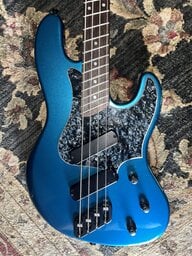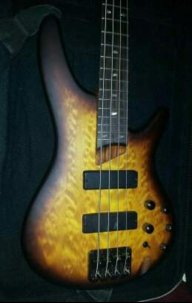
Not sure the car/bass comparison works. A fender style bass but made in the custom shop with neck reinforcement and some modern manufacturing methods would still be a modern monster bass. Just the style is “retro” at that point.

TalkBass has been independent since 1998. Add your voice.
Create a free account to reply to discussions, view embedded media, and browse with fewer display ads.
Join free Log in
Want zero display ads or expanded classifieds tools? Compare plans.


Maybe, but we have already been there with the Steinberger and almost nobody followed up.Composits will be the future for guitar/bass instruments.
No more wood.
P-bass = Ford Model T
You are presuming that water gets in the engine. You do realize I hope that internal combustion engines in use since 1885 until now are water-cooled and water channels run throughout the block of all of them except the VW Beetle, which was air-cooled.
The current batch of Hydrogen fuel cell cars use the hydrogen in the fuel cell to generate electricity by the interaction of oxygen from the air and hydrogen in the fuel cell. It uses this hydrogen/oxygen interaction to generate electricity, which powers the vehicle by combining them in the fuel cell and emits water vapor as the exhaust.
Most hydrogen is produced from natural gas and that process produces carbon emissions. The most emission free method is to separate out the H from the H2o using another permeable membrane. Then energy becomes easily processed from H2o by splitting the H from the 2o, using the H to power the fuel cell and the o to supply the fuel cell with the needed oxygen for the interaction to produce electricity...but we're not there yet.
Current Hydrogen cars have a hydrogen fuel tank that needs to be filled up as it is used. Not a lot of filling stations around. Good news is that an amount of hydrogen comparable to a gallon of gas gets over 2½ times as many miles per gallon compared to gasoline and currently emits water vapor as an exhaust. And, the water vapor exhaust is no more that what a gas engine produces.
No, it comes from people who don't have any understanding of the actual practicalities of what they are suggesting.
And this proves the point. You have zero idea of the practicalities of the use or cost of use of large scale generators. I was an engineer in the industry for a long time. I have no problem with alternatives, but I am not interested in massively increasing my power bill because of impractical unicorn generation schemes whether grid or local.
I said before, not the forum.
Your projection, and this sort of comment I've found in the past to mean you don't really understand it. Can't be bothered any further with this subject. Want to take it to an appropriate forum, I'll continue.Actually, despite your attempts to portray any/all who think differently than you as morons,

It only ever was amongst those that need to buy 'cool' however you wish to define that.Omg, is the mid-life testosterone crisis no longer a thing?
It only ever was amongst those that need to buy 'cool' however you wish to define that.


I like the performance of some of them, like the Teslas I've driven, but they're not really a driver's car.
Well, it's really not meant to be a high performance car, per se.
Actually, the future for cars is self-driving, so....

Vintage Fender necks don't need to be removed or loosened for truss rod adjustmentI'm gonna quickly jump on my soapbox, and just as quickly jump back off.
I can only hope the future includes making the truss rod adjustment at the heel of the neck instead of the headstock (where it should be), an illegal design specification. I have often said that design engineers, regardless of what they design, should be forced to use their design about 1000 times. Would the neck heel truss rod adjustment still exist if the designers (and actually current manufacturers) had to take the neck off to adjust it, 1000 times? I doubt it. Would a poorly designed (purely an example) wine bottle opener exist for long if the engineer had to open 1000 bottles with that poor design? I doubt it.
Now I'm stepping down.
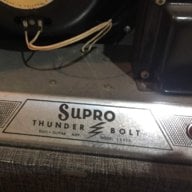
for me personally, the future is BASSLAB (I've got one on order...)...
What is the future for the bass guitar?
they are called...wagonsUm. Electric for basses too. They're working on it. Some are battery driven. Mains driven basses didn't take off much. Photo-voltaic maybe.
How many acoustic cars have there been?

No.I wonder if fan frets is the future - the multiscale neck?