Guitars and basses obviously haven’t changed much, and they probably won’t. They’re set it in like the piano/keyboard. The changes and innovations are around the instrument. How easy is it to plug straight into an interface and record? Some quality digital amps out there. Effects pedals. Tuners. Etc etc.

Enjoy the benefits of a premium membership!
Upgrade Account
-
TalkBass has been independent since 1998. Add your voice.
Create a free account to reply to discussions, view embedded media, and browse with fewer display ads.
Join free Log in
Want zero display ads or expanded classifieds tools? Compare plans.
You are using an out of date browser. It may not display this or other websites correctly.
You should upgrade or use an alternative browser.
You should upgrade or use an alternative browser.
The bass for now!
- Thread starter BazzaBass
- Start date
-
- Tags
- bass guitar future modern
More options
Who Replied?



Well, you get to choose from old school type passive stuff to more modern active stuff (70's) to the fanned fret thing that Dingwall started making in the early 90's. And then there's this:The 50’s are 70 years ago.
Imagine a 1950’s, 60’s 70’s automobile vs a 2021 auto. How things have changed.
What bass epitomises the modern bass?
The future for cars is electric.
What is the future for the bass guitar?
And no matter what may come down the pike, it all comes down to playing well and being creative. And that's why I couldn't give a rat's ass when something was originally designed.

The bassoon in its modern form, or something quite close, was birthed in the mid 1600s.
It's hardly changed since then not because no one could think of something better in that range, but because every "improvement" ended up being a different instrument; nothing could do what a bassoon does better than the bassoon. Maybe the contrabassoon for us ultra-low heads, but it can't dance in multiple octaves the way a bassoon does, either.
If an instrument works, it just works. Overall, the varieties of design of the bass guitar are relatively minor: it's an electric stringed instrument centered in the range of the contrabass, and designers experiment with it in much the way they did with brass instruments (developing keys, and then rotary & piston valves to control them) and every other range of instruments out there.
Those changes all happened over centuries as far as a new design really coming to dominate. The bass guitar has not been alive for nearly a century. Ultimately, if the math and the playability of fanned-fret design wins, it will overtake several centuries of fretted instruments (but hey, the equal-temperament-capable grand piano overtook several centuries of harpsichords and clavichords and the like, so that's not impossible!), and if the music it can make provides a forward direction in innovation, then it SHOULD take over.
Musical instruments experience long periods of evolution punctuated by moments of sheer revolution, as I think Jean Paul Sartre wrote. Maybe it was John Paul Jones? One of those Johns or Pauls
It's hardly changed since then not because no one could think of something better in that range, but because every "improvement" ended up being a different instrument; nothing could do what a bassoon does better than the bassoon. Maybe the contrabassoon for us ultra-low heads, but it can't dance in multiple octaves the way a bassoon does, either.
If an instrument works, it just works. Overall, the varieties of design of the bass guitar are relatively minor: it's an electric stringed instrument centered in the range of the contrabass, and designers experiment with it in much the way they did with brass instruments (developing keys, and then rotary & piston valves to control them) and every other range of instruments out there.
Those changes all happened over centuries as far as a new design really coming to dominate. The bass guitar has not been alive for nearly a century. Ultimately, if the math and the playability of fanned-fret design wins, it will overtake several centuries of fretted instruments (but hey, the equal-temperament-capable grand piano overtook several centuries of harpsichords and clavichords and the like, so that's not impossible!), and if the music it can make provides a forward direction in innovation, then it SHOULD take over.
Musical instruments experience long periods of evolution punctuated by moments of sheer revolution, as I think Jean Paul Sartre wrote. Maybe it was John Paul Jones? One of those Johns or Pauls
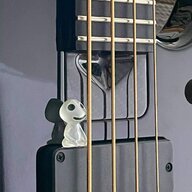
And no matter what may come down the pike, it all comes down to playing well and being creative. And that's why I couldn't give a rat's ass when something was originally designed.
If anybody thinks the original electric bass guitar is "old" in terms of being a tool of artistry, wait until they hear about the paint brush!

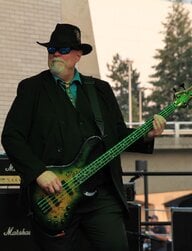
Fanned frets are here to stay, but they're never going to displace basses with standard 90 degree frets.Ultimately, if the math and the playability of fanned-fret design wins, it will overtake several centuries of fretted instruments (but hey, the equal-temperament-capable grand piano overtook several centuries of harpsichords and clavichords and the like, so that's not impossible!), and if the music it can make provides a forward direction in innovation, then it SHOULD take over.




Something multiscale, headless, etc. You could get real wild and do a True Temperament fretboard, or even wilder and do a Torzial Twist neck.
Still wish Ibanez would do a higher quality version of the EHB series. I was a little disappointed in their tone, the knobs felt cheapy, etc. Just do it all more deluxe and sell it for $2k or something.
Still wish Ibanez would do a higher quality version of the EHB series. I was a little disappointed in their tone, the knobs felt cheapy, etc. Just do it all more deluxe and sell it for $2k or something.
Last edited:
D
Deleted member 165050
Guest
These never seemed to catch on. Played an early prototype before they were made by Willcox. Very interesting.
Quite a few of us in here have them...

I don’t care that my bass is the same shape and layout of so many other basses. I don’t care that it sounds similar to so many other basses or that it’s an old design. I didn’t pick it up to break new ground. I don’t have an issue with those who want to innovate but I started out for the sheer joy of making music. I just happen to be doing that on an electric bass. It does what I want it to very nicely. It might have been a piano except my parents traded ours in on a tv set when I was five years old. It’s music that interests me, not the esoterica of the bass guitar so the fact that the bass I play is quite an old concept sits fine with me. I imagine orchestral players might feel a similar way.
I’ve seen some very interesting and attractive new designs but I don’t have any desire to own one. They won’t make me play any better nor will they make me any more creative. The music is in me, not the the wooden thing with wires on it.
New stuff can be interesting but some old stuff is good too. The basic concept of the bass guitar has endured and I believe it will for a long time yet. The physical, tactile sensation of playing an instrument is alluring, has an expressive immediacy and is great fun. That part doesn’t demand innovation.
I’ve seen some very interesting and attractive new designs but I don’t have any desire to own one. They won’t make me play any better nor will they make me any more creative. The music is in me, not the the wooden thing with wires on it.
New stuff can be interesting but some old stuff is good too. The basic concept of the bass guitar has endured and I believe it will for a long time yet. The physical, tactile sensation of playing an instrument is alluring, has an expressive immediacy and is great fun. That part doesn’t demand innovation.
Last edited:

Why bother about the future while most of the people here still talks about old stuff?The 50’s are 70 years ago.
Imagine a 1950’s, 60’s 70’s automobile vs a 2021 auto. How things have changed.
What bass epitomises the modern bass?
The future for cars is electric.
What is the future for the bass guitar?

D
Deleted member 165050
Guest
That reminds me of the early Roland synth guitars - the bar was to damp neck resonance I think for better synth tracking.

Heh, I used to have a student who owned a Harley dealership. The mid-life crowd, usually those turning 50, accounted for a real big chunk of his income. And not just the bike but all the branded accessories to go with it - jackets, boots, etc. Think of the movie 'Wild Hogs' and you have it.Omg, is the mid-life testosterone crisis no longer a thing?

tHe FUturE Of bASs is aLL mIdI...lol
Shut up.
You kind of squashed your own point in a way. The appeal of those artists, and that video, and that song, is the fact that it's retro. It's intentionally old-school. It's not "the future", or even "now". It's a throw-back.
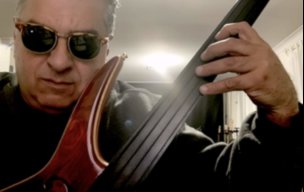
I'm all for new ideas, designs and technology. It seems the P Bass is here to stay, I mean engineers and sound guys just love them and they do an admirable job of supplying the bottom end.
I suppose weight is one consideration, balance, less susceptibility to seasonal changes, quiet operation and other stuff that seems to matter to people.
Now if we could have one instrument that had all of these features, what would it look like? Things I liked along the way were Spector's curved body, Status headless bass, Kubicki E string extension to low D, all nice innovations. Do we have a bass with all that?
I suppose weight is one consideration, balance, less susceptibility to seasonal changes, quiet operation and other stuff that seems to matter to people.
Now if we could have one instrument that had all of these features, what would it look like? Things I liked along the way were Spector's curved body, Status headless bass, Kubicki E string extension to low D, all nice innovations. Do we have a bass with all that?

Hmm - a bass based on a 70 year old design, with a mod commonly done 50 years ago, and....a different shaped headstock? I'd have to say that Dingwall has your bass beat a bit when it comes to modernity.
The step change improvement in the quality of basses being made these days is a modern trait. If you want to limit "modern" selection to shape then you'll miss a lot of what makes many modern basses so good, interesting to play and unique.

I've not heard anyone call an electric bass a wagonthey are called...wagons


