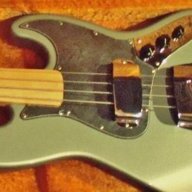
Wanted to buy a Fender Marcus Miller Jazz Bass but noticed it has 1 dead spot on the G string, 5th fret. Is it still worth getting? I heard Fenders have this problem alot. Is it something that can be fixed? Guitar Center is doing 15% off and getting a MM Signature Bass at a reduced price is Rare. Any thoughts?

Enjoy the benefits of a premium membership!
Upgrade Account
-
TalkBass has been independent since 1998. Add your voice.
Create a free account to reply to discussions, view embedded media, and browse with fewer display ads.
Join free Log in
Want zero display ads or expanded classifieds tools? Compare plans.
You are using an out of date browser. It may not display this or other websites correctly.
You should upgrade or use an alternative browser.
You should upgrade or use an alternative browser.
The Bass I want has a Dead Spot..
- Thread starter slapfunk987
- Start date
More options
Who Replied?

only way to fix a dead spot is get a new neck.
i dont think i've ever played a fender without a dead spot between the 5-7th frets. most do. some are just worse than others.
if its real bad, dont get the bass. there are plenty of other marcus basses out there.
i dont think i've ever played a fender without a dead spot between the 5-7th frets. most do. some are just worse than others.
if its real bad, dont get the bass. there are plenty of other marcus basses out there.

Try another Fender Marcus Miller if you can. But i wouldnt worry about a deadspot with your alias  Maybe if you got to sustain 3 bars with that note you are in trouble, but thats all.
Maybe if you got to sustain 3 bars with that note you are in trouble, but thats all.
The deadspots really kill the fundamental in a bass note. Trying lighter strings, set up, and adjusting mass at either the headstock or the bridge generally seems to work in lessening the dead spot.
i dont think i've ever played a fender without a dead spot between the 5-7th frets. most do. some are just worse than others.
What?! isn't a dead spot when a fret doesn't sound out at all? If so, then that would be impossible for most of the Fender basses, which are arguably the most popular and best selling basses out there, to have dead spots. I've never played a bass with a dead spot, except for old beat to hell basses. I always figured it was something wrong with the setup or fretjob.

(sounds like another soft bash on Fender but i'll play along)
i say, if something bothers you bad enough, run. i've had one bass in my life that had an annoyance. this particular bass use to have an extra loud note.
i remember the location of it and adjusted my touch to compensate.
that procedure allows one to play through dead spots, hot spots, etc. sounds like you really are looking for an excuse to buy the MM. gl.
i say, if something bothers you bad enough, run. i've had one bass in my life that had an annoyance. this particular bass use to have an extra loud note.
i remember the location of it and adjusted my touch to compensate.
that procedure allows one to play through dead spots, hot spots, etc. sounds like you really are looking for an excuse to buy the MM. gl.
sounds like you really are looking for an excuse to buy the MM. gl.
Yes you are absolutely correct. And what does "gl" mean?
P.S. I just set my alarm clock for tomorrow to go get it...
only way to fix a dead spot is get a new neck.
Well, that's not necessaily true. Deadspots can result from three main factors, as I've been able to figure:
1. Poor fingerboard to neck vibration transmission, either due to some "flaw" in the fingerbaord or the neck wood, such as a knot (this one is bad from a fix perspective) or glueing problems;
2. Headstock to body mass ratio; and
3. Neck truss-rod profile.
In the case of #1, you've likely got to walk away from a sale, or if you own one, it's not a terribly good situation. In the case of #2, there are a number of easy fix tries, but they'll cost you a bit of $$. In the case of #3, a minor truss rod adjustment can redistibute tension on the neck to fix this, but this situation is typically observed on basses with dual truss rods like Rickenbacker.
I have a number of electric basses, and I've noted problems in two Fenders, a Warwick and a Rickenbacker.
Fender deadspots are on the G string between C and E;
Warwick deadspot is on G string E; and
Rickenbacker deadspot is on D string B and/or C.
Since so many Fenders have this issue in the same location, #1 above is not likely the problem. Try reducing the weight of your headstock by removing the E tuner and the E string. See what happens on your G string.
If it improves, get a set of lighter tuners to reduce headstock mass. It has worked for me. Alternatively, a higher-mass bridge might accomplish the same thing. It's all about mass ratios between headstock and body (well, it is if that's the problem).
If that doesn't work, try a very small tweak of the truss rods (either direction; experiment here). Even if you don't have dual truss rods, sometime just relieving pressure in a small spot and redistributing to another can help resonance, which is what you are going for. You may get lucky and send the deadspot a few mm to a spot that isn't critical to a fretted posiion.
Yes you are absolutely correct. And what does "gl" mean?
P.S. I just set my alarm clock for tomorrow to go get it...
lol,... i thought so! (i love the one my buddy has)
gl = good luck

I wouldn't do it, sounds like you're making am impulse buy. Not to mention you know there's something wrong with the bass and you're trying to convince yourself (or have us convince you) to go ahead and get it. I would never buy a bass with a dead note, you'll be playing around that spot as long as you own it. It will grow to bug the you-know-what out of you!
Fender basses are dime a dozen, find a good one! People have been sorting through Fenders to find a "good one" for 50 years.
Fender basses are dime a dozen, find a good one! People have been sorting through Fenders to find a "good one" for 50 years.

Ric5
Inactive
- Jan 29, 2008
- 29,772
- 30,452
- Disclosures
- I like 5, 8, 10, and 12 string basses
Wanted to buy a Fender Marcus Miller Jazz Bass but noticed it has 1 dead spot on the G string, 5th fret. Is it still worth getting? I heard Fenders have this problem alot. Is it something that can be fixed? Guitar Center is doing 15% off and getting a MM Signature Bass at a reduced price is Rare. Any thoughts?
Fender basses quite often have that same exact dead spot. This is a common problem.
All basses have flaws. If you like the bass then can you put up with its flaws? If yes then buy it.
One of my Fenderbirds has a dead spot. But it is such a nice bass I put up with its fault.

You could have just titled this thread "The Bass I Want Is A Bolt-On." Seriously, no less an authority than Roger Sadowsky has said (I'm paraphrasing) that dead spots are almost unavoidable with bolt-on basses, and he didn't exclude his own company's from that.
That doesn't make dead spots any less of a pain, but it shows that the issue goes beyond Fender. If you can deal with it, grab the bass.
Seriously, no less an authority than Roger Sadowsky has said (I'm paraphrasing) that dead spots are almost unavoidable with bolt-on basses, and he didn't exclude his own company's from that. That doesn't make dead spots any less of a pain, but it shows that the issue goes beyond Fender. If you can deal with it, grab the bass.
You could have just titled this thread "The Bass I Want Is A Bolt-On."
That doesn't make dead spots any less of a pain, but it shows that the issue goes beyond Fender. If you can deal with it, grab the bass.
You won't find a dead spot on any of my basses!!!!!!!!!

What?! isn't a dead spot when a fret doesn't sound out at all? If so, then that would be impossible for most of the Fender basses, which are arguably the most popular and best selling basses out there, to have dead spots. I've never played a bass with a dead spot, except for old beat to hell basses. I always figured it was something wrong with the setup or fretjob.
No, a dead spot is a fretted note that has a really weak fundamental and possibly a few extra harmonics thrown in. Just sounds really weak, like the bottom fell out. Typical on Fender basses between the 5th and 9th fret on the G string. Every bolt-on neck has one, but some basses are more pronounced than others. My old P bass had a fairly pronounced one (but I've heard much worse) on the 6th fret G string, but if I played a Db, same octave, anywhere else on the neck it sounded just fine. My current AVRI '57 has one on the 7th fret, but it is mostly fine, just a slightly weaker fundamental.

could I get a hell yea for fretless mainly !!
please make a stickey out of this.
In addition I would add having played Fender basses since 1967 I always; when tweaking a neck after making a screw or truss rod adjustment , grab the neck and give it "semi" gentle yank front to back and very gently side to side.!! I usually put the bass between my legs (no jokes here please) and give it a firm forward (towards me) tug and rearward the same semi gentle push backwards.
I have cured many deadspot/wolftone issues with several very simple fixes as described above. as always yyymmmvry etc. ha
peace Kirk
please make a stickey out of this.
In addition I would add having played Fender basses since 1967 I always; when tweaking a neck after making a screw or truss rod adjustment , grab the neck and give it "semi" gentle yank front to back and very gently side to side.!! I usually put the bass between my legs (no jokes here please) and give it a firm forward (towards me) tug and rearward the same semi gentle push backwards.
I have cured many deadspot/wolftone issues with several very simple fixes as described above. as always yyymmmvry etc. ha
peace Kirk
No, a dead spot is a fretted note that has a really weak fundamental and possibly a few extra harmonics thrown in. Just sounds really weak, like the bottom fell out. Typical on Fender basses between the 5th and 9th fret on the G string. Every bolt-on neck has one, but some basses are more pronounced than others. My old P bass had a fairly pronounced one (but I've heard much worse) on the 6th fret G string, but if I played a Db, same octave, anywhere else on the neck it sounded just fine. My current AVRI '57 has one on the 7th fret, but it is mostly fine, just a slightly weaker fundamental.
Every bolt on has one?????????? I've got a Lull M4V, and a Pedulla Rapture. You won't find a dead note on either.

No, a dead spot is a fretted note that has a really weak fundamental and possibly a few extra harmonics thrown in. Just sounds really weak, like the bottom fell out. Typical on Fender basses between the 5th and 9th fret on the G string. Every bolt-on neck has one, but some basses are more pronounced than others. My old P bass had a fairly pronounced one (but I've heard much worse) on the 6th fret G string, but if I played a Db, same octave, anywhere else on the neck it sounded just fine. My current AVRI '57 has one on the 7th fret, but it is mostly fine, just a slightly weaker fundamental.
People confuse dead spots with fretting out constantly. I wonder if people even notice true dead spots? Personally I find wolf tone/hot spots far more disruptive.
Every bolt on has one?????????? I've got a Lull M4V, and a Pedulla Rapture. You won't find a dead note on either.
^ Yes you will. It may not be as obvious as it is on other basses, but both basses will have a "dead" spot somewhere. If you don't think it has one, then you don't know what a dead spot is. If Roger Sadowsky says that all bolt-on basses have, you'd better believe that all bolt-on basses have them. Unless the dead spot is severe, they are not as big a deal as some folks make them out to be anyways.
Hint: an analog octave pedal will reveal your dead spots very quickly. Try using one, play a note on your G string between the 4th and 9th frets and let them sustain. One or two of them will cause the octave pedal to glitch much faster than the other notes. For me, it Db (6th fret) on my P-bass. Haven't tried it with my Jazz yet.


