History
A Squier Bronco was my first short-scale bass. I bought it mainly to see if going short-scale was a good option for me. It turned out that it was a good option, but also it turned out that I wanted a better bass. Which was done and the Bronco was sidelined until I decided what to do with it. The Bronco's not a bad little budget instrument. It has a rather nice neck, and it's pretty, but its hardware and its electronics are really cheap. For example, the first thing that happened to mine was the volume control broke. So I just removed the pots entirely.
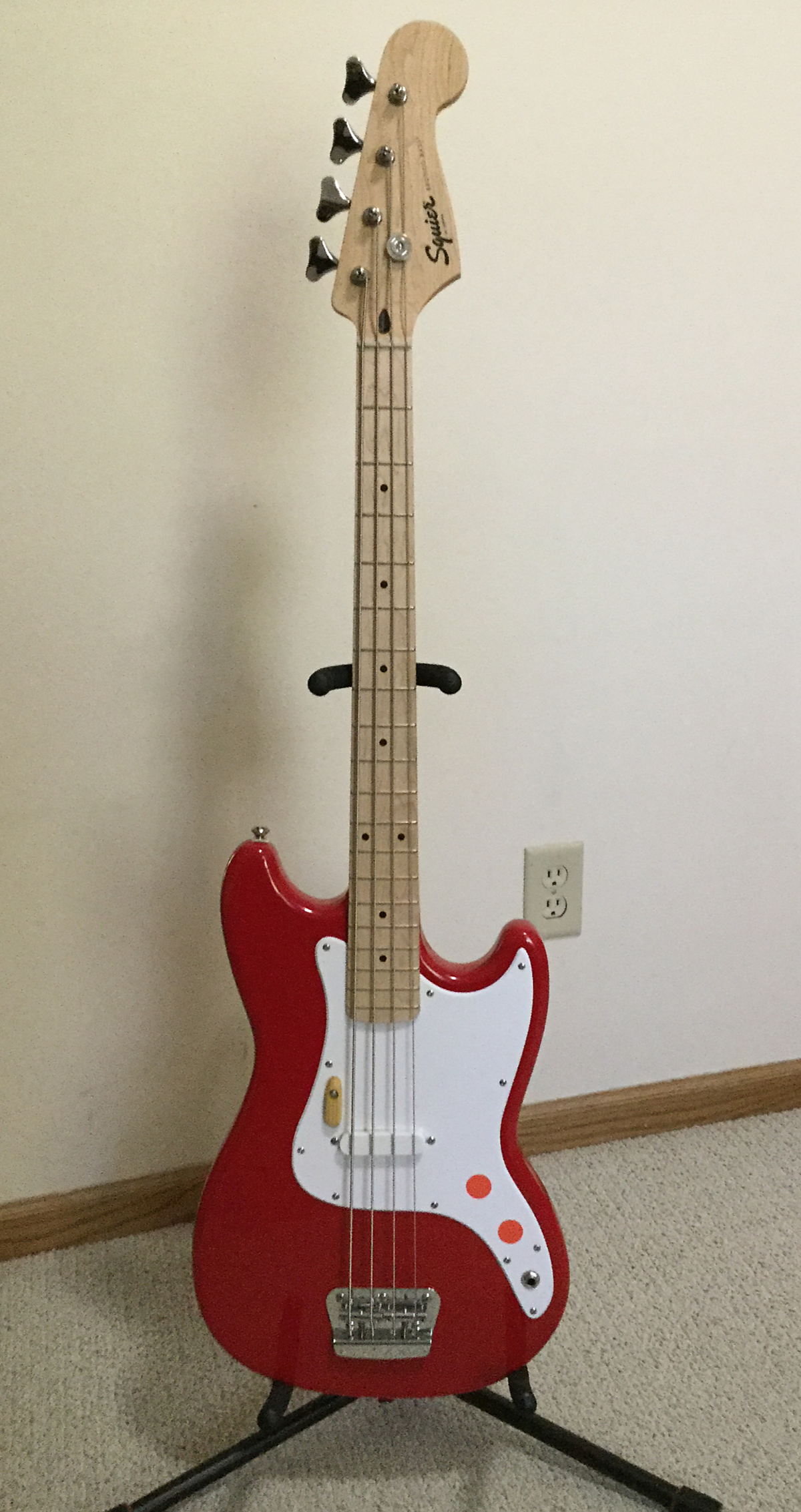
Next I swapped out the original pickup and I also replaced the bridge. That helped quite a bit. But after some mind games about how I use volume and tone controls on my other basses I came up with a plan on how to remake my Bronco project bass.
Design Philosophy
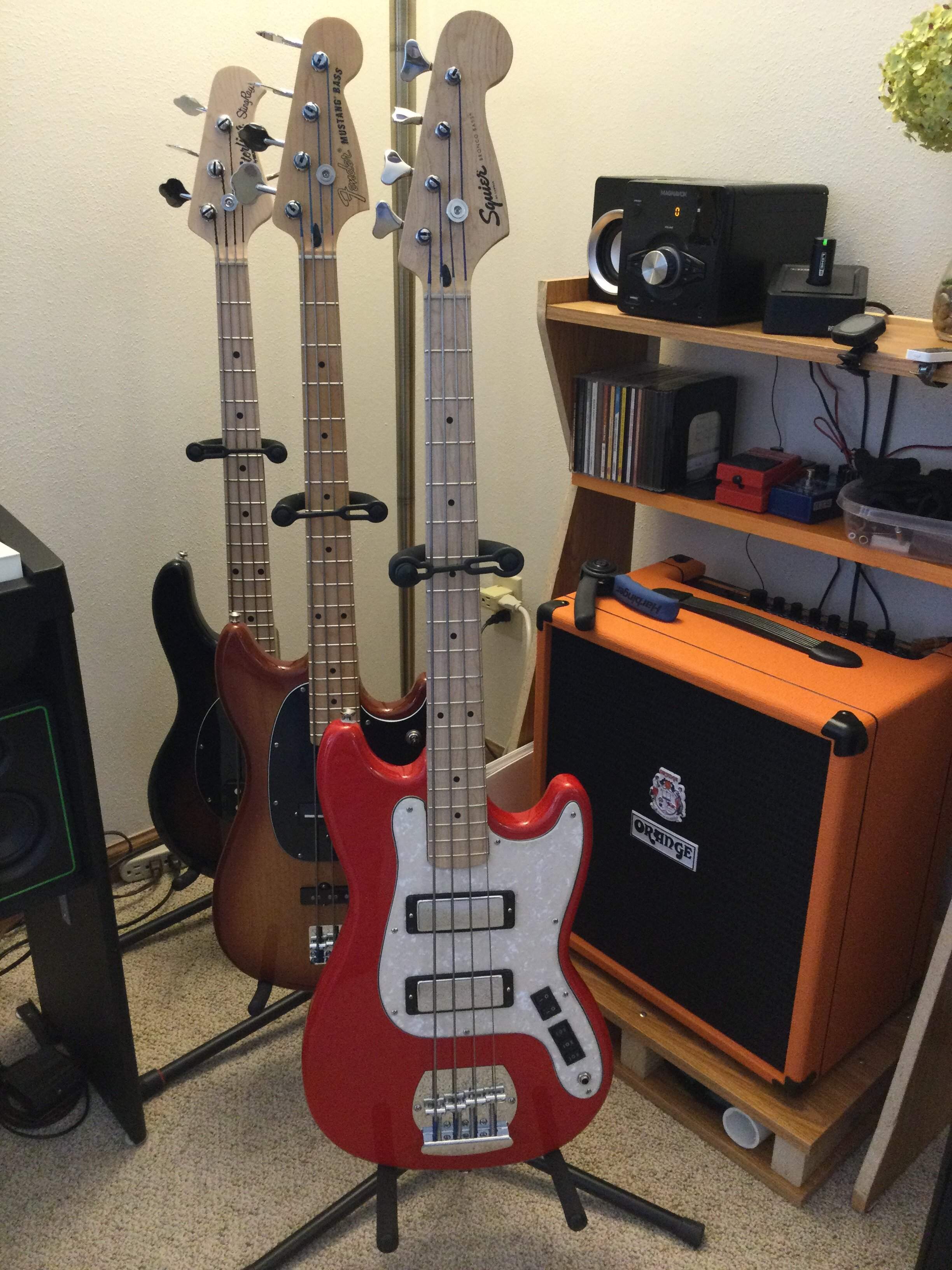
I don't make much use of volume and tone control pots. They normally just stay cranked wide open. An instrument with two pickups that only has single volume and tone controls doesn't make much sense to me. It would make some sense to have two volume controls and two tone controls for pickup blending. But since I wanted to try something different anyway, I came up with a plan to control instrument output using switches only. No pots at all. So, here I present my modded Squier Bronco gone potless:
Project Result
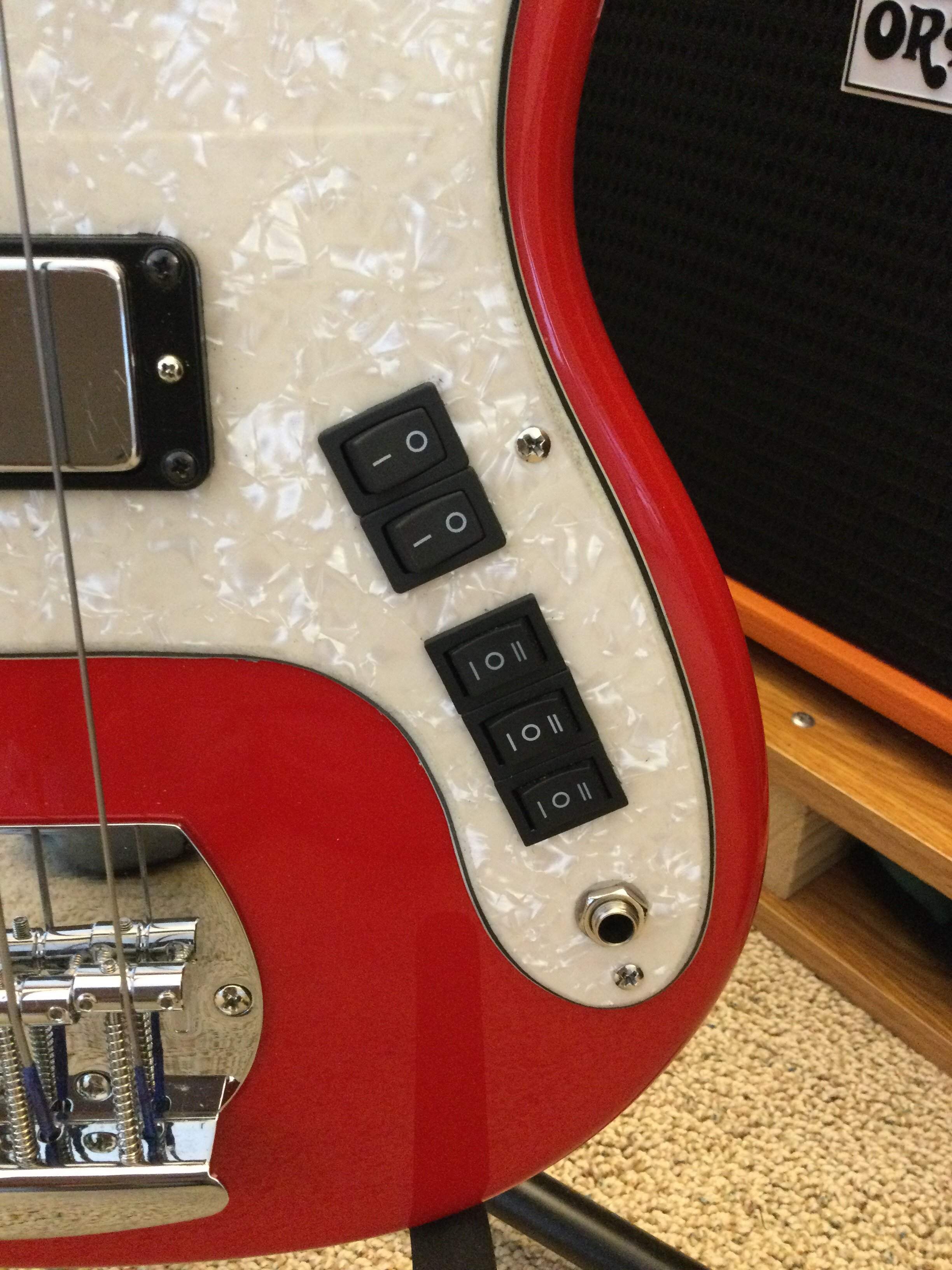
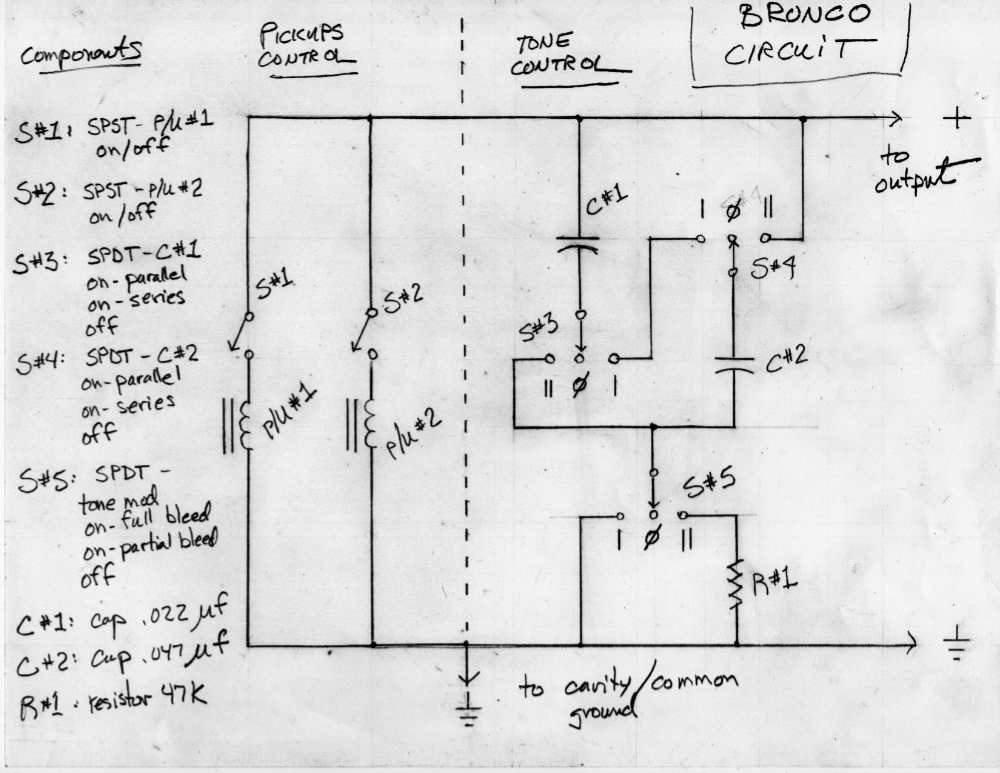
The Bronco now has two pickups in a new pickguard, a new bridge, and new electronics. The pickups came off another bass that I disassembled for parts. The pickguard was cut from a blank. The five rocker switches are grouped into two sets. The first two switches are single pole single throw on/off switches for the pickups. The set of three switches are single pole double throw on/off/on switches that control tone modification. The first two of these three control how two tone capacitors are switched into the tone circuit. They can be singly switched off and on, both on in series, or both on in parallel. The third switch controls the tone circuit, whether it's off, on with full bleed to ground, or on with partial bleed to ground through a fixed resistor.
Circuit Diagram
Status
The design concept for the rocker switch implementation does actually work, but maybe it needs some tweaking. The tone variations aren't dramatic. Also, new tuners would be nice. And some more setup tweaking. So, the project status is "to be continued".
I'm sorry, I don't have any way right now to make a decent audio recording and post it here for public access. If I can get that done, I'll post it here, so you can hear and judge for yourself.
A Squier Bronco was my first short-scale bass. I bought it mainly to see if going short-scale was a good option for me. It turned out that it was a good option, but also it turned out that I wanted a better bass. Which was done and the Bronco was sidelined until I decided what to do with it. The Bronco's not a bad little budget instrument. It has a rather nice neck, and it's pretty, but its hardware and its electronics are really cheap. For example, the first thing that happened to mine was the volume control broke. So I just removed the pots entirely.
Next I swapped out the original pickup and I also replaced the bridge. That helped quite a bit. But after some mind games about how I use volume and tone controls on my other basses I came up with a plan on how to remake my Bronco project bass.
Design Philosophy
I don't make much use of volume and tone control pots. They normally just stay cranked wide open. An instrument with two pickups that only has single volume and tone controls doesn't make much sense to me. It would make some sense to have two volume controls and two tone controls for pickup blending. But since I wanted to try something different anyway, I came up with a plan to control instrument output using switches only. No pots at all. So, here I present my modded Squier Bronco gone potless:
Project Result
The Bronco now has two pickups in a new pickguard, a new bridge, and new electronics. The pickups came off another bass that I disassembled for parts. The pickguard was cut from a blank. The five rocker switches are grouped into two sets. The first two switches are single pole single throw on/off switches for the pickups. The set of three switches are single pole double throw on/off/on switches that control tone modification. The first two of these three control how two tone capacitors are switched into the tone circuit. They can be singly switched off and on, both on in series, or both on in parallel. The third switch controls the tone circuit, whether it's off, on with full bleed to ground, or on with partial bleed to ground through a fixed resistor.
Circuit Diagram
Status
The design concept for the rocker switch implementation does actually work, but maybe it needs some tweaking. The tone variations aren't dramatic. Also, new tuners would be nice. And some more setup tweaking. So, the project status is "to be continued".
I'm sorry, I don't have any way right now to make a decent audio recording and post it here for public access. If I can get that done, I'll post it here, so you can hear and judge for yourself.
Last edited: