• TalkBass has been independent since 1998. Add your voice.
    Create a free account to reply to discussions, view embedded media, and browse with fewer display ads.
    Join freeLog in
    Want zero display ads or expanded classifieds tools? Compare plans.

Double Bass The DEFINITIVE Palatino EUB Modification Thread

Now enjoy a real Portable upright. it stands tall over its flawed brother, laughing and snickering..
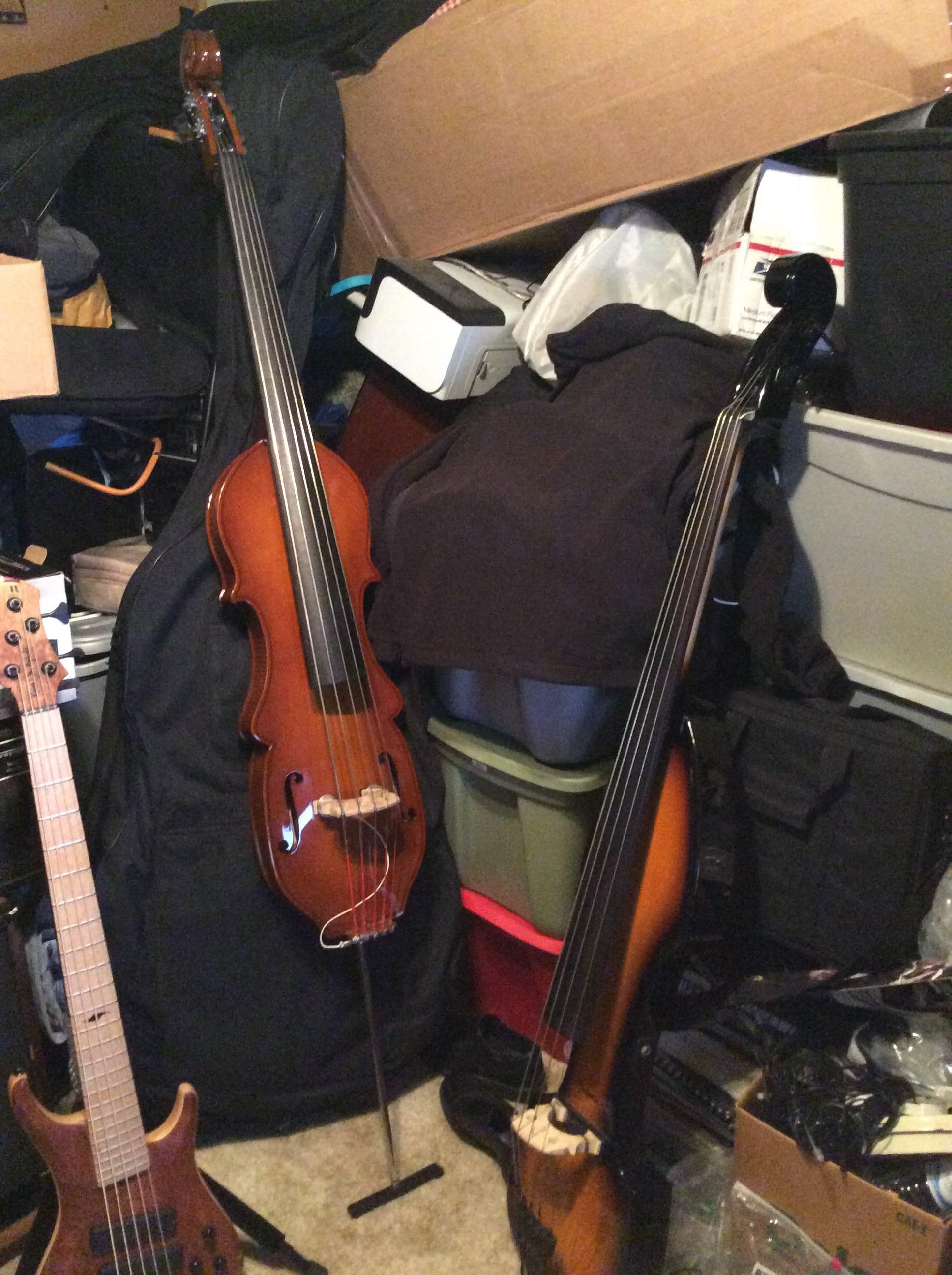

image.jpg
 
Ok, we get it. You hate your Palatino.

That's all yes.

I bought it because it looked kinda cool to be honest..and while it looks kinda cool then I started playing it on a gig.. actually it was a Cruise ship gig and I played it everyday as you work everyday on a cruise ship.. It just didn't work for the sound was an electric bass, and then it also felt weird.. I was forced to use it for so long until the gig was over (I was traveling of course) and it put a really bad stain on me as you can tell..
 
Last edited:
  • Like
Reactions: John Chambliss
I gave cork some thought, but it is much stiffer and figured the softness of the rubber is the benefit, rather than bulk filler.

I've tried lots of materials over the years as mechanical "filters" to deal with piezo pickups on various instruments - natural rubber, silicone rubber, foam rubber, latex, neoprene and neoprene foam rubber, felt, wool, - virtually anything that is softer than Spruce. What I've found, is there's really two properties to consider: Stiffness and damping. Solid rubber is really soft, but it doesn't damp so well - it still acts like a spring even under extreme pressure. Felt or cork on the otherhand, might be a little more stiff (at these thicknesses, everything is essentially still stiff), but they damp a whole lot better and act less like a spring. It seems that damping is the key to remove the quack and highest frequencies. Also, look at foam rubber instead of just solid rubber which is what an inner tube simulates. foam rubber is softer still, and damps better than solid rubber. I found some at Hobby Lobby in sheets of 1/16". You can double it or triple it if its compressing too much. Anyway, the inner tube material works well enough. I'd like to hear more folks' results with other materials.
 
  • Like
Reactions: Ortsom and GKon
My results with other materials - regarding clamping - is that most of them compress and any softness they may have had when uncompressed is lost under load. They all turn into a board of different densities, whereas rubber retains its natural give and continues to function without changing its properties. In some situations this doesn't really matter, but I like to see the piezo suspended and "free" to respond, rather than clamped. I prefer a fuller signal rather than a damped one. It is easier (and quieter) to remove unwanted than to boost something that isn't there.

Regarding quack, my thoughts were that it is a function of impedance mismatch rather than an interaction with wood. This was another reason to swap out the electronics to something more appropriate, and really, under $50 is pretty reasonable when you consider the cost of a really cheap set of strings for one of these. Before chasing strings in a tone quest I'd take a hard look at matching the impedance and then see what things sound like.
 
  • Like
Reactions: GKon
I've tried lots of materials over the years as mechanical "filters" to deal with piezo pickups on various instruments - natural rubber, silicone rubber, foam rubber, latex, neoprene and neoprene foam rubber, felt, wool, - virtually anything that is softer than Spruce. What I've found, is there's really two properties to consider: Stiffness and damping. Solid rubber is really soft, but it doesn't damp so well - it still acts like a spring even under extreme pressure. Felt or cork on the otherhand, might be a little more stiff (at these thicknesses, everything is essentially still stiff), but they damp a whole lot better and act less like a spring. It seems that damping is the key to remove the quack and highest frequencies. Also, look at foam rubber instead of just solid rubber which is what an inner tube simulates. foam rubber is softer still, and damps better than solid rubber. I found some at Hobby Lobby in sheets of 1/16". You can double it or triple it if its compressing too much. Anyway, the inner tube material works well enough. I'd like to hear more folks' results with other materials.

I wish I had something to add, but all I've ever used was the inner tube rubber.

The only tinkering I have done was to try the inner tube under various points. I tried putting it only under the piezzo,
then under the piezzo and under both feet of the bridge, then under just the bass foot, then just under the treble foot,
then under both feet but NOT under the piezzo, so on and so forth.

In the end I settled with rubber under the piezzo and under only the treble side of the bridge.
 
  • Like
Reactions: carl h.
Someone sez: <It just didn't work for the sound was an electric bass, and then it also felt weird.. I was forced to use it for so long until the gig was over (I was traveling of course) and it put a really bad stain on me as you can tell..>

Yep, it has a lot of sustain like a BG, but, so does an upright with a pickup. If you could listen your upright thru an amp without hearing the bass itself (very hard to do without a remote helper), you'll find it sounds a lot like...an EUB. Its because the signal from bridge-style pickups doesn't decay as much, as the natural acoustics of a DB. The pickup is direct coupled to the bridge and strings, bypassing the other 95% of the instruments contribution. So, an EUB is not much different than a DB with a pickup since its all going from the string to the bridge and then to the pickup. All this brings up a good point: why do [you/me/us] own an EUB? For me, its three things: transportable where a DB is not, silent practice at night, and superior gain before feedback when my upright w/pickup won't work (loud bars, tight but loud cafes, electric instruments and loud drummers). I'll always take a DB if at all possible. There's just times when its can't happen, and the EUB is an acceptable compromise.
 
Last edited:
  • Like
Reactions: Rivoli and GKon
Someone sez: <It just didn't work for the sound was an electric bass, and then it also felt weird.. I was forced to use it for so long until the gig was over (I was traveling of course) and it put a really bad stain on me as you can tell..>

Yep, it has a lot of sustain like a BG, but, so does an upright with a pickup. If you could listen your upright thru an amp without hearing the bass itself (very hard to do without a helper), you'll find it sounds a lot like...an EUB. Its because the signal from bridge-style pickups doesn't decay as much, as the natural acoustics of a DB. The pickup is direct coupled to the bridge and strings, bypassing the other 95% of the instruments contribution. So, an EUB is not much different than a DB with a pickup since its all going from the string to the bridge and then to the pickup. All this brings up a good point: why do [you/me/us] own an EUB? For me, its three things: transportable where a DB is not, silent practice at night, and superior gain before feedback when my upright w/pickup won't work (loud bars, tight but loud cafes, electric instruments and loud drummers). I'll always take a DB if at all possible. There's just times when its can't happen, and the EUB is an acceptable compromise.
[/QUOTE]
Well put!

As reasons for using an EUB I would like to add:
I enjoy unconventional things, including instruments. My EUB definitely falls in that category.

I don't own and can't afford an AUB so it's my only choice for upright playing.
 
image.jpeg

Here's my idea for a better looking anti-resonance treatment.

Not sure if I like the pattern of the weave, but it gets the desired result - ringing is gone, and from a distance it really is not drawing the eye like a rag or other hunk of something.
image.jpeg

I'd think a black thong might be even less visually obtrusive.
 
Last edited:
  • Like
Reactions: Ben YHWH and GKon
Well, I just got my Pal about a week ago. Love it so far! Probably going to experiment with a couple of different materials to cushion the bridge and pickup. One thing that puzzles me...

I've been playing around with it, and the one thing that might keep me from being able to take it to a gig is the endpin sliding all over the place. It's gradual, but after a three minute tune it's 2-3 inches closer to the floor and I have to readjust. The force required to tighten the knobs puts a strain on my wrists as it is :/

Anyone else experience this dilemma? Any fixes uncovered?

Side note, parting out my old AUB after a neck separation from the body. Any parts you think I might be able to salvage for this new guy?

Thanks!
 
  • Like
Reactions: GKon
I cleaned off any paint from the threaded portion of the locking screw assemblies and gave any rotating parts that made contact (and were supposed to move easily) a good polishing and coating with graphite (#2 pencil). No issues with mine since, though I did have to go back in after the first clean/lube and hit the parts I had overlooked.

I also recommend the better crutch end from a good pharmacy. Seems minor, but it does grab the floor better than the discount hardware store variety.
 
Well, I just got my Pal about a week ago. Love it so far! Probably going to experiment with a couple of different materials to cushion the bridge and pickup. One thing that puzzles me...

I've been playing around with it, and the one thing that might keep me from being able to take it to a gig is the endpin sliding all over the place. It's gradual, but after a three minute tune it's 2-3 inches closer to the floor and I have to readjust. The force required to tighten the knobs puts a strain on my wrists as it is :/

Anyone else experience this dilemma? Any fixes uncovered?

Side note, parting out my old AUB after a neck separation from the body. Any parts you think I might be able to salvage for this new guy?

Thanks!

Interesting, as I've not encountered that problem at all. If anything, my endpin is in very tightly. Even with the clamps
completely loose it takes some effort to move it up or down.

@carl h. suggestions sound good and worked for him. Try that out and let us know how it works for you.

+1 on a new rubber tip for the endpin. Make sure you get one that specifically has a metal insert inside the bottom portion, otherwise,
the endpin will cut through the rubber.

As far as salvaging parts, I'm not really sure. Strings, I guess. You could also see how the tuners match. If they are at all close, hold on to those.
 

Latest posts