• TalkBass has been independent since 1998. Add your voice.
    Create a free account to reply to discussions, view embedded media, and browse with fewer display ads.
    Join freeLog in
    Want zero display ads or expanded classifieds tools? Compare plans.

The Douglas Fir thread!

So for as long as I've been paying attention to bass playing and bass construction,pine has not been used for bass construction.
At least amongst mass producers.
But you are using it.

So am I correct in assuming that the only reason that pine has not been used by mass producers for bass bodies,is because it's just not used?
They could use it,but they just don't?
 
Last edited:
So for as long as I've been paying attention to bass playing and bass construction,pine has not been used for bass construction.
At least amongst mass producers.
But you are using it.

So am I correct in assuming that the only reason that pine has not been used by mass producers for bass bodies,is because it's just not used?

I think there are some pine bodies out there.

For me, the biggest knock is how soft it is.
 
  • Like
Reactions: Reedt2000
So for as long as I've been paying attention to bass playing and bass construction,pine has not been used for bass construction.
At least amongst mass producers.
But you are using it.

So am I correct in assuming that the only reason that pine has not been used by mass producers for bass bodies,is because it's just not used?
They could use it,but they just don't?
I think you should start a separate "pine" thread.
 
  • Like
Reactions: Beej
I wasn't specific because I didn't want to look it up, but I believe that there were some Telecaster guitars.

But you didn't address that being soft might be the reason, not merely tradition.

Haha, nice ninja edit
Some really early Fenders were pine, and they may have reissued them from time to time (I say may cause I don't feel like looking up specifics either :smug:).

The Tobias Toby models made by Epiphone are radiata which is a species of pine (Monterey Pine). Probably because its soft and easier to work for an inexpensive bass.
 
@gebass6 There have been a couple commercial bodied made with pine or similar softwoods over the years. I think it's less popular for a few reasons - firstly, for a mass market painted instrument, there are cheap hardwoods that arguably work and finish more easily. Flatsawn softwoods can be a bit of a challenge to finish, the alternating grain patterns vary significantly in density and it's hard to get a non-wavy surface. If you're just going to blast a body with an opaque finish, that's a liability compared to something like poplar or alder. I'm writing this post right now with my laptop on a side table that is made from flatsawn doug fir, and even though I finish sanded it with long hard sanding blocks, I can see the waves in the surface from the grain. No one wants to deal with that in a bass body.

And the really good quartersawn or figured softwoods are scarfed up for other industries. No one is going to pay a premium for quartersawn doug fir just to get the consistency and density to make a good bass body, when you can slice that board up and sell it on specialty markets instead.

I really don't think it's just hardness, and at any rate hardness is a moving target. Softwoods can vary over a gigantic margin in density, and the denser pine and fir can get very hard. It'll hold screws fine and resist dents as well as some low density hardwoods used for bass bodies, at least.
 
So it's not too soft for Telecasters,but too soft for basses?
Why is the OP using it?

I would guess it was too soft for Telecasters, so lesson being learned, they didn't reproduce in basses.

OP will use it because Doug Fir has different physical properties than common pine. And because he has access to it. And because that is a sexy board.
 
  • Like
Reactions: Watchootognbout
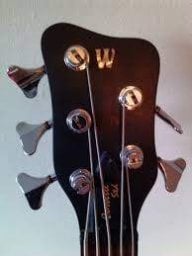
Warwick have made some models with softwood bodies too, but I don't remember the details.

Sometimes I think we give too much credit to early instrument builders in terms of how or why they selected wood. My guess is that Leo called up the lumber yard and said, "what's cheap?" and that's what he used that year.
 
I would guess it was too soft for Telecasters, so lesson being learned, they didn't reproduce in basses.

OP will use it because Doug Fir has different physical properties than common pine. And because he has access to it. And because that is a sexy board.
Question answered.
Thank you.
 
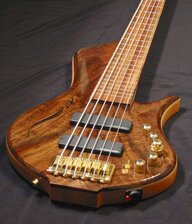
Some nice looking douglas fir tops... The CB bass is own by a TBer I believe.

custom-basses-zz9.jpg
BA6860A7-57B3-4E5F-A9FD-16C93236FB1A_1_201_a_1200x.jpg
DSC_4017-1-768x1160.jpg
 
I've got a chunk of that board in my OP in the oven right now... gonna see what happens to it in a "home roast" scenario. People do it successfully with maple. I'm told this is because maple is especially good for roasting/torrefying due to its natural sugar content? Ah what do I know!? anyhoo... I'm interested to see what happens.
 
OK, so here is the piece of curly Douglas Fir that has sat in my stash for 20+ years. It measures 1.5x11x25”, and is quite dense for DF; I worked it out to 39.9 lbs/cu ft, compared to the average 32-33 lbs/cu ft. I’ve thought about resawing it to use for a semi-hollow top, but never got around to it. Fact is, my bass collection is just about as big as I want it to be (only two!!!! :woot:), and actually practicing would be a much better use of my time.
Invalid Link Removed Invalid Link Removed Invalid Link Removed
 
Being a woodworker born and raised here on the West Coast… You’d think I’d have a stash of Douglas fir in my wood collection dedicated to instrument building. Instead, I have handled and gone through hundreds of pieces of Doug fir... whether be reclaimed or fresh off the mill or stock shelves at the local Lumberyard. Many of which were of a very high-quality… Very tight, straight grained, heavy beautiful stuff.

Up until yesterday, I have assumed Doug Fir wasn’t really a suitable Tonewood for instrument making. Thus, its use has been relegated to largely finishing Millwork and or fine furniture pieces IME.

Yesterday, I was at the lumberyard grabbing some jamb material for my own home renovation… And across from me in the VG Fir section (not hem-fir) was this big ol’ banana’d s4s 2x10 (1.5x9.25) that looked to have been there quite a while. Being the wood snob that I am... I immediately noticed the figure popping out of this board along its entire 10 foot length. Upon closer inspection… I realize the whole thing is curly, right through to the other side and is heavy as hell. Well as you can imagine… I excitedly bought the thing for a measly $7.50 per board foot. After loading it up in my van, I Google search “Douglas Fir guitar” thinking; someone must be using this stuff in guitar builds!?

Well, I find out that I have been sadly misinformed about this useful species of wood. After seeing several dozen fantastic images of solid body and acoustic guitars with curly Douglas for tops... I go down the rabbit hole only to discover that Doug Fir can and is being used today for everything from acoustic tops & bracing as an alternative to spruce, to solid body tops and even bass/guitar necks instead of maple! Too cool. I’m so excited to build on my specialty Doug fir stash and incorporating the species into future builds!

For the sake of inspiration... Show me your Douglas Fir! :)

View attachment 4137497 View attachment 4137498 View attachment 4137499


That's a beauty of a board. I reckon that would be killer in a neck...
 
Good thread. Fir seems underrated as a tonewood. I built this Hem-Fir bass about 15 years ago from jobsite scrap wood. Hem-Fir body and neck, rosewood fingerboard; the lighter areas of the body are from the HiBor termite treatment...so no bugs. It's not beautiful, but it's probably the most resonant bass I've ever played, and definitely the loudest unplugged.

tempImageosKlhj.png
tempImagenPEYXd.png