• TalkBass has been independent since 1998. Add your voice.
    Create a free account to reply to discussions, view embedded media, and browse with fewer display ads.
    Join freeLog in
    Want zero display ads or expanded classifieds tools? Compare plans.

The Fifths Tuning Club

This might be sacrilegious but I’m gonna try out fifths tuning on my 5 string jazz bass except a fourth for the last string. I just ordered a set with gauges 130, 80, 50, 30 and 20 that will be tuned CGDAD. I’m a fan of the descending tension and it’s really fun to be able to play the higher strings like a guitar and have nice bend to them. Plus I can bar my finger on the highest three strings and make a power chord (theyre tuned the same as dropped d on a guitar). Anyways, I’ll try and remember to tell y’all how it goes. Maybe it makes no sense to most of you and maybe it’s against the ways of the fifths tuning society but I’m excited!

 
  • Like
Reactions: w3stoner
This might be sacrilegious but I’m gonna try out fifths tuning on my 5 string jazz bass except a fourth for the last string. I just ordered a set with gauges 130, 80, 50, 30 and 20 that will be tuned CGDAD. I’m a fan of the descending tension and it’s really fun to be able to play the higher strings like a guitar and have nice bend to them. Plus I can bar my finger on the highest three strings and make a power chord (theyre tuned the same as dropped d on a guitar). Anyways, I’ll try and remember to tell y’all how it goes. Maybe it makes no sense to most of you and maybe it’s against the ways of the fifths tuning society but I’m excited!
I used to tune a guitar CGDADG, I think Chapman sticks are "fourths over fifths" as well. I'll allow it.
 
  • Like
Reactions: Schizo Sapiens
I find the standard bass 34 inch Scale length a bit too long for fifths tuning,you need the ability to play four notes per string scales from the lowest fingered note"C sharp on a Cello" , and this becomes a hassle with a 34 inch scale! A 27.4 inch scale is probably a maximum scale length for convenience when it comes fifth tuning"if you do not have very long fingers, of course."

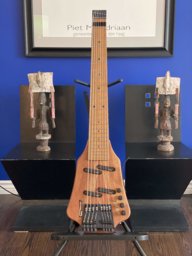
Personally I use one of these instead when I want Range!
My first instrument is violin, so when I started playing bass, I thought, "4ths, what an idiotic tuning system."

Only after playing bass for awhile did it start to make sense. Due to the scale length, the important notes like 3rd, 5th 7th and high octave are spread out causing much unnecessary hand movement when tuned in 5ths. Even just alternating between root and 5th requires sliding back and forth. I suppose it's interesting to experiment with, but it certainly doesn't conserve hand motion when playing.
 
My first instrument is violin, so when I started playing bass, I thought, "4ths, what an idiotic tuning system."

Only after playing bass for awhile did it start to make sense. Due to the scale length, the important notes like 3rd, 5th 7th and high octave are spread out causing much unnecessary hand movement when tuned in 5ths. Even just alternating between root and 5th requires sliding back and forth. I suppose it's interesting to experiment with, but it certainly doesn't conserve hand motion when playing.

Fifths on bass guitar is not for everyone, many feel as you do. If it doesn't work for you then just move along, you will be in good company. On a short scale bass however the reaches range from not much different to the same as those on a cello, depending on the bass's scale length, and the cello is rather well established as a practical instrument, is it not? When I was starting in fifths I found it useful to watch what orchestral cellists did. I play my standard scale bass occasionally but mostly I play short scale these days. Some even find the tuning quite practical on a double bass so the popular 34 and 35 inch bass guitar scale lengths are quite practical as well. It was the double bassist Red Mitchell and his followers who inspired many of us to try fifths after all.

The reaches to any interval are actually exactly the same in fourths and fifths! The two are inverted from one another which gives a very different flavor to bass lines if you play them inverted in fifths to keep the reaches the same as in fourths. You will probably find that your muscle memory of favorite patterns in fourths will be totally screwed up by playing them inverted in fifths!
 
  • Like
Reactions: jharms80439
I doubt anyone here will object to interval mixes, i expect some of us are inspired by Robert Fripp's NST tuning (i am) which has a minor third on top. There are now several 'Crafty' tunings which have different intervals on top, 8 string Warr Guitars and Touchguitars use a BbFCGDACD tuning: fifths plus minor third plus major second. Smaller intervals on top are useful for when there is 'too much range', and create potential for interesting chords.

My first fifths tunings were CGCGD and CFCGD, i have tried a minor third on top and on the bottom too.
 
I've been following this thread with much intrigue and recently took the plunge for fifths tuning, so I made a TalkBass account just to share my thoughts! :D

(I've also followed several threads on TalkBass for a while now so I might as well make an account while I'm at it. )

Some background: I played clarinet and saxophone in high school and took up keyboard on the side for my church's worship team. A friend of mine gave me his old, beat up Ibanez SR200 a few years ago and I got hooked on bass ever since. It was perfect timing, since we needed someone to take over playing bass in the worship team. I was fascinated by tuning in fifths for having extra range across only 4 strings, with the added benefit of being a regular tuning. I first experimented by down tuning the bottom 3 strings to get that fifths relationship, but I quickly found that the stretch was too much for me at the time, so I kept the Ibanez in E standard.

Fast forward to this year: I got a Yamaha TRBX305 and that B string fulfilled all of my low note needs. Since I still had that Ibanez, I was again curious to try out fifths tuning again, and hoped that I had gotten better since the first time I tried it to give the tuning another chance. I tuned it in CGDA with Kalium strings (130,86,57,37) for ~40 lbs of tension per string. I chose the "contra cello" tuning since it was the best compromise between BEAD and EADG to me while also having the most open strings in common with both.

(It took almost a month to get my strings in the mail after ordering them. If I didn't call Skip multiple times, I'd still be waiting for them.)

As others have pointed out, large intervals like 6ths and 10ths are much easier, but at the expense of 3rds and 7ths. Having to reach behind the root for octaves feels weird. Spread triads past the 12th sound great, I can't overstate how much I love playing those. And yes, the Bach cello suites fall naturally under the fingers; that ol' Bach guy really knew what he was doing.

I might try fifths tuning on the 5 string later on for an insane 4 octave + perfect 3rd range. CGDAE seems like the most natural one to try, but I'm more interested in starting lower, like AEBF#C#.

Now I'm in a similar position to @khutch's first experience where I get to play fifths tuning "live" for worship tomorrow. It will be... interesting to say the least.

-Cal
 
Not sure its made it to this thread yet, but apparently Gollihur music is offering a 5ths set for the NS Omnibass that is for 34” scale CGDAE. Im considering getting a set to make a contracello out of my Omni. I can hen align my arco playing between bass and cello.
 
  • Like
Reactions: Reg Braithwaite
So some updates on my experiences with this tuning.

For curiosity's sake I tuned my 4 string in CGDA down to BF#C#G#. Finding the notes on the new strings was a bit challenging, but it was fun matching the same lowest string as my fiver in BEADG, and even with only 4 strings and 22 frets, it only missed the top note on the fiver with 24 frets!

Now imagine the fiver in fifths tuning with those 24 frets... :drool:

I'm really excited to try fifths tuning on the fiver now, but I'm anxious about having to order from Kalium again. I might order a set from Stringjoy instead. They don't have as many options with gauges, but after all the hassle with my Kalium order, I think I'll settle for Stringjoy's selections.

One more thing, messing with harmonics has been a blast! Gotta thank @~M.o.M~ for inspiration with that little piece way back in the thread.
 
I finally strung up my fiver in CGDAE, using a custom set from Stringjoy (130, 90, 60, 40, 25). Got them in the mail within the week I ordered them, an immense improvement over the wait time for Kalium.

The range on the fiver is insane! I already knew just how wide the range would be, but it's still quite the experience trying it out myself. The high E really sings, and as others in this thread have pointed out, it starts to sound more like an electric guitar up there. I'd like to try a capo on the 7th or 12th fret to fully take advantage of those high notes with some mandolin-type chords.

Now, as much as I've enjoyed fifths tuning, the honeymoon phase with my four string tuned CGDA has started to wear off, and I can see that fourths tuning still has its advantages in many areas. I don't need to have one in fourths since I'm only playing this in my church's Worship Team and for my own little projects, but if I ever played "seriously," say for a cover band or the like, I would keep one of my basses tuned in fourths. Ideally, I would like to be proficient in both tunings, but for the meantime I'll make do with what I have.
 
  • Like
Reactions: BarfanyShart
I'm intrigued by this set. Have you (or anyone else) tried these on a 34" scale bass guitar? If so, do they work well?

I have a five-string Omni Bass, so I’m waiting on the E strings to get back in stock, at which point I have a two-set order queued up. I don’t have an opportunity to try them on a bass guitar, my “Kwaku Anansi” is an eight-string. But when I get them, I will try them on my Omni Bass.

In the mean time... Perhaps others have tried them and can buzz in?
 
Currently staying with family for the remainder of the summer, so I've had the chance to mess around with the tunings of a couple of other string instruments. This might not be specifically about bass guitars or double basses tuned in fifths, but I thought it might be an interesting experience to share, as I suspect many of us in this thread have experimented with other tuning systems on other instruments before.

First on the list was a Takamine GMini acoustic guitar. I've tried to pick up guitar in the past and was always thrown off by that weird major third interval. So I tuned it in perfect fourths (Eb2 to E4), and I was surprised that I still remembered all of my familiar patterns and shapes from perfect fourths tuning. I've gone all in with fifths tuning on BG for about six weeks now, so this was the first time I went back to fourths since taking the plunge. I didn't mention it before, but this was one fear I had about switching to fifths: losing all of the skills I had built up on fourths and having to start from square one. As it turns out, there's plenty of crossover and you don't forget all of it immediately. I'll admit it was such a relief to not have to shift as much, though of course this was exaggerated by this guitar's 22" scale vs. the standard 34" scale for a BG.

Next up was a tenor ukulele! And boy, if I was ever irked by the guitar tuning, the re-entrant uke tuning drove me nuts! Tuning it in a re-entrant fourths tuning made it more manageable, but I eventually gave up on that high G string and tuned the other three in fifths (GDA). And this is where fifths tuning can really shine! The spread triads sounded fantastic, and the super duper short scale length of a uke (this specific one was 17") made it comfortable. The chord shapes for fifths tuning only needs 3 or 4 strings, and since they're usually in a spread voicing, the chords can still sound full.

So TL;DR, the two lessons I got out were:
  • Fourths tuning is still a very logical and flexible tuning system for BG, and really for any string instrument. Conserving hand motion is a big deal for the long scale of a BG. I should probably keep one of my basses tuned in fourths.
  • Fifths tuning really shines with smaller 4-string instruments. I admittedly had very little regard for ukuleles before, but the possibility of tuning them in fifths changed my outlook entirely for the better.
All in all, this may be the gateway to an avalanche of extreme GASing. I fear I may end up having two 6-string basses, one in fourths and the other in fifths, and a whole array of ukes tuned in fifths! :laugh:
 
  • Like
Reactions: Reg Braithwaite