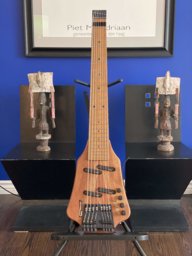
Tempted to buy a new bass, and it's shortscale. Haven't bought strings in years! What are the current options for 30" scale strings in fifths-friendly gauges?

TalkBass has been independent since 1998. Add your voice.
Create a free account to reply to discussions, view embedded media, and browse with fewer display ads.
Join free Log in
Want zero display ads or expanded classifieds tools? Compare plans.

Tempted to buy a new bass, and it's shortscale. Haven't bought strings in years! What are the current options for 30" scale strings in fifths-friendly gauges?

I've moved my SRMS800 from fifths tuning to tritone tuning, C F# C F#. Nearly the range of a five string and I find myself more inspired by it. I might be back at some point though...I do tend to get easily distracted. Keep the lights on for me.
I'm liking it. I've settled on D G# D G# though, in part because it's a lot easier to find strings that will work well for that (and on my Dingwall I can have a low G# which is a lot of fun).I haven't really considered symmetric tunings using other intervals before, but now you got me interested. I'll try it out on my guitar scale ABG just to see how it's like.


Hello fellow fifths enthusiasts, I just wanted to share another foray of exploration with all fifths tuning, albeit on another string instrument that's not a BG nor a DB.
Back in August of last year, I theorized that ukuleles would make the perfect candidates for changing the tuning to fifths. The shorter scale length would help a lot with the extra shifting, and having only 4 strings makes it easier to implement, unlike on a guitar where some scale lengths are almost impossible (I myself gave up on trying it my tele...). The chord shapes are best suited for 4 strings anyway, and most other instruments already tuned in fifths only have 4 strings (or 4 courses of strings), so I can easily just reference, say, violin/fiddle or mandolin resources. I even conjectured if it was possible to reverse-engineer an SATB quartet to match the mandolin family...
After scouring the interwebs, it turns out that a fair number of uke enthusiasts do in fact tune in fifths, and Aquila has even made string sets for both Invalid Link Removed and Invalid Link Removed tunings. Rob MacKillop has recently published a Mel Bay method book for playing fifths-tuned uke (might be of interest to the club here). He has also uploaded several videos on his YouTube channel playing a tenor uke tuned in fifths, wonderful playing throughout!
So I decided to try it out for myself and bought a cheap baritone uke to tune GDAE (octave mandolin tuning). And my hunch was pretty much spot on. It is effectively a nylon string tenor guitar, and the chord shapes sound different enough from a regular guitar to set it apart. I can move all over the fretboard with minimal shifting or stretching. And of course, the spread triads sound sweet and lovely on an acoustic instrument. I'm eager to try this on other uke sizes to match the mandolin family like I theorized.
I know this wasn't quite bass-related, but I wanted to share this experience for any of those interested. I may post an update when I get around to trying this idea again.

I've got an eight string uke that I tuned up CGDA like a mandola. It works good. Aquila makes uke strings for that tuning.Interesting. My basses are B G D A (or A D G B, lol), but my son plays the uke (not me). With the alternate tuning, do you re-order the sequence of string gauges also?

Hello fellow fifths enthusiasts, I just wanted to share another foray of exploration with all fifths tuning, albeit on another string instrument that's not a BG nor a DB.
Back in August of last year, I theorized that ukuleles would make the perfect candidates for changing the tuning to fifths. The shorter scale length would help a lot with the extra shifting, and having only 4 strings makes it easier to implement, unlike on a guitar where some scale lengths are almost impossible (I myself gave up on trying it my tele...). The chord shapes are best suited for 4 strings anyway, and most other instruments already tuned in fifths only have 4 strings (or 4 courses of strings), so I can easily just reference, say, violin/fiddle or mandolin resources. I even conjectured if it was possible to reverse-engineer an SATB quartet to match the mandolin family...
After scouring the interwebs, it turns out that a fair number of uke enthusiasts do in fact tune in fifths, and Aquila has even made string sets for both Invalid Link Removed and Invalid Link Removed tunings. Rob MacKillop has recently published a Mel Bay method book for playing fifths-tuned uke (might be of interest to the club here). He has also uploaded several videos on his YouTube channel playing a tenor uke tuned in fifths, wonderful playing throughout!
So I decided to try it out for myself and bought a cheap baritone uke to tune GDAE (octave mandolin tuning). And my hunch was pretty much spot on. It is effectively a nylon string tenor guitar, and the chord shapes sound different enough from a regular guitar to set it apart. I can move all over the fretboard with minimal shifting or stretching. And of course, the spread triads sound sweet and lovely on an acoustic instrument. I'm eager to try this on other uke sizes to match the mandolin family like I theorized.
I know this wasn't quite bass-related, but I wanted to share this experience for any of those interested. I may post an update when I get around to trying this idea again.
Interesting. My basses are B G D A (or A D G B, lol), but my son plays the uke (not me). With the alternate tuning, do you re-order the sequence of string gauges also?
What strings are you using for the baritone?
I'm using nylon guitar strings for the G and D strings as recommended by Invalid Link Removed from a mandolin forum. I kept the two highest strings since they're already tuned to B and E, so I only needed to tune the B down to an A. I may end up swapping them out with the recommended strings down the road.