I'd like to chime in with a piece of information that has not yet been mentioned. There are two "categories" of scales: harmonic and melodic. Harmonic scales are those which provide a pitch palette for harmonic sequences. The most familiar of these is the major scale.
D major: D E F# G A B C#
We can neutralize the note names with numbers to give us the pure structure of the scale: D E F# G A B C# becomes 1 2 3 4 5 6 7
You might know that triads may be derived from a major scale by stacking diatonic thirds on every note of the scale.
D Em F#m G A Bm C#° (I ii iii IV V vi vii°)
From there, we can create some basic chord progressions, like IV V I, IV ii vii° V I, whatever. You'll notice that those numerals are not all the same letter case - some are upper case (I IV V), some are lowercase (ii iii vi), and one has a little doodad on the end (vii°). This is obviously connected to the qualities of the triads found in the harmonized scale (I IV V are major, ii iii vi are minor, vii° is diminished), but it gives us another bit of information: we're looking at major keys, so we are interested in 'majorness'. Where better to go for the major sound than the major triads? I IV V will give you the modal essence of the key. If you play I IV V all day long, it's going to sound happy and major and completely uniform. We call I, IV, and V "primary triads" for the reason that they provide the clearest picture of a key. In practice, when you start playing around with these primary triads, this is the order that we want to hear them in: IV V I.
But, hey, what about those other triads? Since I IV V is the primary group, we are going to call ii, iii, vi, and vii° "secondary triads". The function of secondary triads is to substitute for the primary triads, and to give color to the progression. In this case, the secondary triads give a little 'sadness' or minor feel to what is otherwise a 'happy' or major pitch collection. Here is a list of the corresponding primary and secondary chords:
Notice there's no iii. It's a bizarre triad that shares two notes in common with both I and V, so it is functionally unclear and is usually reserved for special occasions.
This means that you can go back to our big mama progression, IV V I, and swap out one chord for another:
Code:
ii V I
IV vii° I
IV V vi
ii vii° I
ii V vi
IV vii° vi (vii° vi is rare)
ii vii° vi
And you can also put a couple of chords from the same functional grouping together next to each other. So, I & vi, IV & ii, V & vii°, then either I or vi at the end. Typically, you move from primary to secondary (except in the case of vii° to V, but I won't get into that right now), so the entire progression ends up looking like this:
Code:
[I>vi]-->[IV>ii]-->[vii°>V]-->[I/vi]
This is the
framework for tonality, and I emphasize 'framework' because the diatonic chords give us the basic language to which we constantly refer back to. Take this progression:
Bm D7 G B7 Em E7 A7 D
If you try to find a scale that works smoothly over all of that, you're going to be a mess. Check out why:
Code:
Bm: B D F#
D7: D F# A C
G: G B D
Em: E G B
E7: E G# B D
A7: A C# E G
D: D F# A
If you order all of those notes and get rid of the repeated notes, this is what you're left with:
A B C C# D E F# G G#
There are nine notes in there. If you have a name for that scale, more power to you, but it's the completely incorrect way to go about it. Let's have another look at that progression and try to pick out the elements of D major.
Code:
Bm: vi
D7:  Something else, don't worry about it.
G: IV
Em: ii
E7: Something else, don't worry about it.
A7: V7
D: I
Okay, discounting the weird things that we can't explain yet, this is a pretty basic progression in D major: vi IV ii V7 I. See the framework? Even though we have some chords that are completely foreign to the key of D major, I am confident in saying that this progression firmly belongs to the key of D major and the D major scale, because there is a strong sense of functionality and moving toward the tonic triad, D. The two chords that we can't yet explain are called "secondary functions" (not to be confused with the secondary triads we looked at earlier). I won't get into all that right now, but here is how one analyzes such a progression:
vi V7/IV IV ii V7/V V7 I
A little beyond where you're at, but I think you can get what's going on.
V7/
IV >
IV, V7/
V >
V
==============================
That's harmony in a nutshell. I also promised you some exposition on melodic scales. As the name would suggest, melodic scales are principally used in the creation of melodies, and are not really known as a source of harmonic progressions (nor are they harmonically flexible). Melodic scales, or "modal" scales, predate their harmonic counterparts by eons. Famous examples include the major scale (I prefer "diatonic scale" when it is used modally, as that encompasses dorian, phrygian, lydian, mixolydian, aeolian, and locrian as well), the melodic minor scale (duh), all those exotic Middle-Easterny scales, and the 'pentatonic' scales.
Remember, melody predates harmony by, like, forever. The reason? It's easier to put one note after another than it is to stack them on top of each other, because it's easier to build an instrument that plays one note after another than it is to make on that stacks notes on top of each other. Harmony is really complicated. How long did it take for me to explain the primary/secondary thing? That's just the tip of the iceberg, too. Consequently, when one looks at music from non-harmonic musical cultures, or at traditional music that might be played by a single person with a tinwhistle, there isn't as much interest in filling out harmonies, and the music itself is likely going to be harmonically simple (maybe one or two 'chords', historically a drone). Here are a couple of United States folk tunes that utilize an E major pentatonic scale:
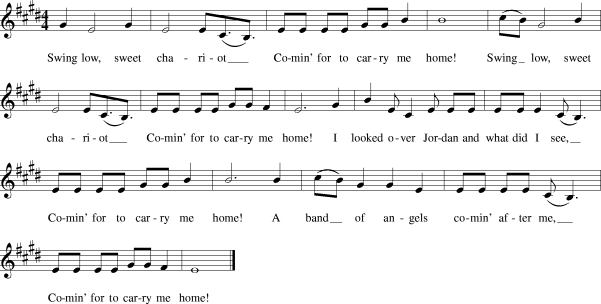
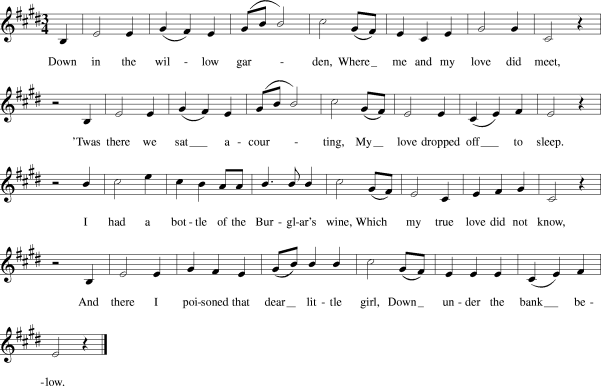
There are actually a couple of A's in Willow Garden, but that doesn't negate the pentatonic-ness of the tune; if you were looking at a 5x7" canvas that was completely covered in red paint, spare a miniscule drop of blue paint on the edge of the composition, I think you would understand when somebody asks "Did you see the red painting?". Besides, I think that Willow Garden picked up a couple of extra notes when it was imported from Scotland or Ireland or wherever - the original is purely pentatonic, as far as I remember. At any rate, this music is completely happy without chords. You can hum these melodies, and they sound cool and self-contained. Music that uses these modal scales, by necessity, is much more concerned with melodic motion than it is about harmonic construction.
Of course, one can harmonize the melody with a harmonic system (in other words, add chords to it) - all you have to do is look at the melody, decide what chord progression the melody implies (For example, the last two notes of both of those songs, F# & E, represent the V7 [B D# F# A] and I chord [E G# B] respectively; alternatively, anytime there is a C#, you're probably going for vi or IV. Between those, you get D# and A - neither of which is in E major pentatonic.), and it's only a matter of sticking something underneath. But when you try to melodize a harmony ('melodize' isn't a real word for a reason), you're putting the cart before the horse. It can be done, but it's not a very good compositional model. By far, when I'm writing, I write the melody and all the while have a strong sense of harmonic progression while I am writing said melody.
===================
All in all, don't worry that the pentatonic scale doesn't represent the IV chord; it's not meant to. Harmony and melody are separate entities in this case. Learn chord tones (the bass is largely a harmonic role, after all), leave the melodic stuff to the melody writers. "Forest for the trees" and all that.