• TalkBass has been independent since 1998. Add your voice.
    Create a free account to reply to discussions, view embedded media, and browse with fewer display ads.
    Join freeLog in
    Want zero display ads or expanded classifieds tools? Compare plans.

The John East preamp club

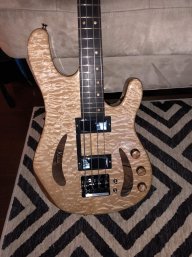
Hi all. I am the proud owner of a new-to-me 2002 American Deluxe Jazz Bass V with what I think is a J-Retro Deluxe with passive tone (4 knob with Vol/Blend/Bass-Treble stack/MidSweep-Mid stack/Tone. 1-piece ash body, pao ferro, 22 frets, bartolini pickup upgrade - it's easily my new favorite bass. Everything about this bass is luscious and goodness. Except, I find the pre EQ contour is a bit much with large amps and full volume (sounds awesome with small amps). Especially with boost-only bass EQ. Is there a way to defeat the pre EQ contour?

Otherwise I am loving the overall sound, including the passive tone in active mode, and the passive mode sounds great as well. I just have other options for boosting the bass and don't need to be locked in to that sound.

Thanks!
 
  • Like
Reactions: Zoot H Rollo
Hi all. I am the proud owner of a new-to-me 2002 American Deluxe Jazz Bass V with what I think is a J-Retro Deluxe with passive tone (4 knob with Vol/Blend/Bass-Treble stack/MidSweep-Mid stack/Tone. 1-piece ash body, pao ferro, 22 frets, bartolini pickup upgrade - it's easily my new favorite bass. Everything about this bass is luscious and goodness. Except, I find the pre EQ contour is a bit much with large amps and full volume (sounds awesome with small amps). Especially with boost-only bass EQ. Is there a way to defeat the pre EQ contour?

Otherwise I am loving the overall sound, including the passive tone in active mode, and the passive mode sounds great as well. I just have other options for boosting the bass and don't need to be locked in to that sound.

Thanks!
I have a uni-pre, so it may be different. But this model has two things (I don't know if they're called relays or what) that you can remove from the board to get an eq contour. If you want to defeat it, simply put them back in. I'd take a look on the website to see if what you have is a j retro, then just read the directions ...if I'm right, you may be able to order the two things directly.
 
  • Like
Reactions: Chris Wilke
I have a uni-pre, so it may be different. But this model has two things (I don't know if they're called relays or what) that you can remove from the board to get an eq contour. If you want to defeat it, simply put them back in. I'd take a look on the website to see if what you have is a j retro, then just read the directions ...if I'm right, you may be able to order the two things directly.

Thanks~ I will study the manuals for both the Uni and J Retro to see if this is something that is common between them
 
Hi all. I am the proud owner of a new-to-me 2002 American Deluxe Jazz Bass V with what I think is a J-Retro Deluxe with passive tone (4 knob with Vol/Blend/Bass-Treble stack/MidSweep-Mid stack/Tone. 1-piece ash body, pao ferro, 22 frets, bartolini pickup upgrade - it's easily my new favorite bass. Everything about this bass is luscious and goodness. Except, I find the pre EQ contour is a bit much with large amps and full volume (sounds awesome with small amps). Especially with boost-only bass EQ. Is there a way to defeat the pre EQ contour?

Otherwise I am loving the overall sound, including the passive tone in active mode, and the passive mode sounds great as well. I just have other options for boosting the bass and don't need to be locked in to that sound.

Thanks!
Yes, as mentioned John offers a “flat-response” version. He also has some preamps that allow you to bypass the low or high pre curves.
 
Hey all, I have my custom J bass with a 5 knob Uni Pre

Any tips on where to get started dialing in tone?
My take:
  • Choose flat vs preshape contour.
  • Set the balance between pickups.
  • Then figure out how high you want your treble control. I like it low, like 2-3k. Remember you still have the 10k boost by pulling the treble knob.
  • Then how low and wide do you want your bass control. This is the hard one for me, but high-ish and relatively narrow was where I ended up.
 
Hey all! I'm having a bit of an issue with my preamp.

Spector Euro 5
Rautia Multicoils (old way)
Uni-pre 3-knob

I wired everything as it should be, but the pickups seems to be distorting the preamp in a really bad way, but only when I play full volume, sounds great when I play soft, but that won't do with what I want to use it for. It seems I've found the limit to these preamps fairly quickly. there's also a LOT of hiss from the high end when I turn it up a little. Think it's faulty? Send thoughts (and prayers if that's your thing!)
 
Hey all! I'm having a bit of an issue with my preamp.

Spector Euro 5
Rautia Multicoils (old way)
Uni-pre 3-knob

I wired everything as it should be, but the pickups seems to be distorting the preamp in a really bad way, but only when I play full volume, sounds great when I play soft, but that won't do with what I want to use it for. It seems I've found the limit to these preamps fairly quickly. there's also a LOT of hiss from the high end when I turn it up a little. Think it's faulty? Send thoughts (and prayers if that's your thing!)
Make sure you have the pickup gain trimpots at minimum (fully CCW). They look like 2 large blue blocks where you can use a crosshead screwdriver. See this post for a picture : https://www.talkbass.com/threads/the-john-east-preamp-club.984491/page-44#post-27719831
 
I’m sure the answer is in here somewhere. But how can you tell if the preamp is “flat response” or “ standard curve”? I bought a bass with what looks to be the first version J Retro layout with two switches and no passive tone control. Thanks in advance!
 
All: I’m a little confused at the overlap in the low lows and high lows frequencies. For example, you can set the low lows to 80hz and the high lows to 40hz? I must be missing something.
If your talking about setting the range of the bass response, they're not bands. They're cut-off frequencies. You need to set the low cut-off lower than the high cut-off for the cut or boost to have any effect. The overlap means you can set a response entirely below 40hz or entirely above 80hz

Apologies if I'm missing your point and you're talking about something else.
 
Last edited:
All: I’m a little confused at the overlap in the low lows and high lows frequencies. For example, you can set the low lows to 80hz and the high lows to 40hz? I must be missing something.
I think this goes towards "infinite flexibility." My Mesa head as parametric EQs for Lo Mids and High Mids, and the bands have quite a bit of overlap, so you can boost and cut the same frequency with Lo and High mids. Not that you would ever do that, but it does give some flexibility if you want to cut a frequency they both cover, and boost a frequency only one covers.

With this type of flexibility, you can definitely configure it in a way that doesn't make sense. Just like a swiss army knife, while a powerful tool with many uses, you can definitely cut yourself.
 
If your talking about setting the range of the bass response, they're not bands. They're cut-off frequencies. You need to set the low cut-off lower than the high cut-off for the cut or boost to have any effect. The overlap means you can set a response entirely below 40hz or entirely above 80hz

Apologies if I'm missing your point and you're talking about something else.

You got it. I was wondering what would happen if you set the high lows dial lower than the low lows dial. Sounds like bad things would happen.

It makes sense to think of the internal low lows dial as the floor and the high lows dial as the ceiling of what would be adjusted by the bass boost/cut dial on the front of the bass.

John East sent me this as approximate locations of frequencies for each.

upload_2024-1-26_12-56-41.png


upload_2024-1-26_12-57-0.png


My intuition says that the low lows at around 32hz and the high lows at around 60hz would be nice.
And then treble around 5khz would be nice for more sizzle up top and less overlap with high mids.

But maybe not? Maybe it is better to have more overlap?

I'm curious how you all have your internal trim dials set on your Unipre?