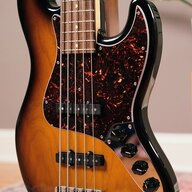
Exactly. And this kind of "automatic" rolling off of some highs, and a kind of compression I think, contribute to the sound.
I'm skeptical that an "active/passive" bass enables all these effects via a true bypass.
Yes. One reason is how the signal gets to the amp. All instrument cables reduce the signal, affecting some frequencies and loudnesses differently than others. It's called impedance here, because it's an alternating current. (Resistance is DC.)
So: a passive bass signal, going through the tone controls and then a cable, before going through gain stages in the amp, undergoes changes.
These changes don't happen in active basses, whose signal can power through (so to speak) the tone section and guitar cable.
Thank you! That was extremely interesting. Do you know of any "passive / active" switchable basses that offer a "true bypass" for passive mode and so would get cable impedance effects, etc.? Do most manufacturers do this?
I'm wondering about the Fender American Ultra II basses.
Yes, most basses with an active/passive switch that I've seen are true bypass, with one of the goals of them working without a battery. It's a common fear of the battery dying and/or circuit failing mid-gig, so that offers you a plan B. Or, of course, there are other uses for it, like setting up two very different sounds available at a flick of a switch, etc...
That suggests to me it's not a "true passive" with a true bypass. (?)
Because in a true passive-only bass, e.g., the instrument cable will attenuate the sound and it'll have a slower attack.
I think that another effect of a pure-passive bass is a different ADSR envelope, for example a slower attack. I believe the tone changes over the decay where with active basses, I don't really hear much change at all. (?) I think this is key to the sound and is audible in the YouTube video I posted.
Passive isn't merely a "tone" that can be simulated with active electronics, IMO.
You brought up compression a couple times, and I think that is one of the things people often mention with active electronics (not passive). I can see two things happening here (tho I may be wrong) - one is true compression, leading to a quicker attack. The other may be, and I think someone already mentioned that above, simply an artefact of our hearing - if active electronics better preserve the highs, and we hear those faster than lower frequencies (I believe this is true), this gives us the impression of a faster attack. I think the compression thing is an issue (it matches my experience with some actives), but a consequence of design. If I'm not mistaken, 18V circuits help in that regard. The treble response thing, on the other hand, can be "simulated" with active electronics, by inserting capacitors before the active electronics (to simulate cable loading) or using a filter-based preamp. How well these tricks work may be a matter of preference and perception (more on that below).
There's another limiting factor of active on-board electronics (vs. those in an outboard preamp or amp/head), which is related to their on-board installation - they have to be designed for small cavities on a bass. This can lead to suboptimal components, including 9 or 18V power. I recall that some think that's still not enough, and that only a proper preamp can cleanly EQ the sound (e.g., I believe the late great Anthony Jackson said that in an interview). While this gets a bit into the "golden ears" territory, it does remind me of tonewood debates, 60s vs 70s J spacing debates, P bass vs solo P in a PJ debate, etc... For many of these, we have theories that explain the differences, but some people hear differences, and some don't. And from those who can hear the differences, some care and some don't.
And finally, this also reminds me that sometimes we perceive things that we struggle to describe, or have no known theory to explain it. Basically the Polanyi Paradox (we know more than we can tell), but sometimes a true blindspot of our (theoretical) knowledge. I'm probably getting some of this wrong, but I recall reading that folks in/around the Grateful Dead heard some artefact in the amplified sound, but it did not corresponded to any engineering principle or theory known at the time. But over time, based on their observations, a new theory/model was developed to account for what they were hearing. We see similar things in other areas of knowledge/science too - what may be consider BS in a previous era can become science once our theories and methods catch up.