• TalkBass has been independent since 1998. Add your voice.
    Create a free account to reply to discussions, view embedded media, and browse with fewer display ads.
    Join freeLog in
    Want zero display ads or expanded classifieds tools? Compare plans.

The 'magic' of passive electronics?

Magic?

I bought a Fernandes Gravity Four back in the 90's.
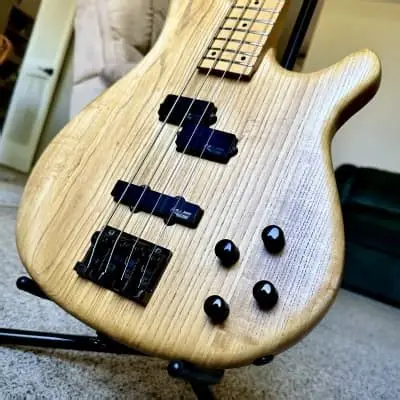
1769621817367.png


And the factory pickups weren't all that, really let this down.

So I bought an EMG PJ set and a BTS control network to replace the OEM parts, Plug and play once the old stuff was out.

This axe had ZERO shielding in it. No paint, no foil, nothing.

Went back with the EMG assembly, didn't even connect the bridge ground wire as it wasn't needed. Installed no shielding anywhere.

Once back together, I test drove it, and for as long as I had it, it sounded great and was as quiet as a tomb.

THAT was magic for me.
 
Regarding the number passive vs active threads. Sure there’s plenty. There are other duplicate threads on other subjects as well. Some are as ancient as the pyramids. Yeah, you could pose a question there. The poor inquirer then gets snarked for reviving a zombie thread. Who knows? A new tidbit of info may come out of this new one.

Just to throw another twist in.

Strings can factor into this too. Early on in my ignorance I neglected to deal that variable.
Just an example on flats. A Labella Lo-Tension isn’t going to sound as bright or punchy as a set of Chromes or TI Jazz Flats. I’m assuming all tests were done with the same kind of strings.

@Gervais Cote
Your buddy playing his MIM P with flats definitely knows that’s the best tool outside of an upright for big band. I believe the P was originally created to replace the upright due to volume.
Another friend of mine has a 1962 Fender p bass with a rosewood slab board and some La Bella Deep Talking flats and when I play it past the 7th frets, it sounds like an upright. It’s REALLY jaw dropping !
 
Here we go again.

I have a hard time knowing what organic tastes like, much less sounds like.
I can help: it sounds like an unamplified upright bass. Everything else is fluff, but IMO inorganic magical fluff can be a fine thing to discuss. But to eat, maybe not so much. :atoz:
 
Interesting... Would you explain (please) what is meant by using loading capacitors?
The way I use the term is to refer to capacitors wired in parallel with the pickup(s) to shift the resonant peak. If you look up examples of how Tonestyler works, you'll get a sense of what it does. I find it really musical, but use it mostly for fine tuning the sound (using smaller value caps, in the 100s and 1000s of pF)... It works different from tone controls, which are mostly the effect of resistance (pot), and the capacitor only kicks in at the very end.. And tone control caps have larger capacitance, .033-.1 uF...
 
  • Like
Reactions: robert_stuart
Yep.

What's left to discuss? Probably a lot less than most people think. Mostly what is left is to have new conversations about stuff that has already been covered. Without these types of threads, we would rarely discuss anything at all...just review what has already been written. Most people would rather participate in a conversation rather than wading through the typical thread.
Yep. People wonder why forums in general are dead, because they are filled with grumpy geriatrics that just want to complain when somebody makes a thread that's been done before. Everything has been done before. In the bass guitar world especially, there is only so much to talk about. There is a reason most young people don't bother with Talkbass and just go to the bass subreddit or elsewhere instead.
 
I think there's a bit of an Apples and Oranges thing going on, comparing wildly different basses.

If anything, you could try to see if there is a tonal shift on a bass with a passive/active switch. My Dingwall NG3 has one of those, and I hear absolutely nothing in terms of changes in tone.
Yep, depends on the bass and its electronics. I'm a long-time mostly passive bass guy but my number one these days is a Sadowsky PJ5. When I switch between passive and active (with no eq boost) it sounds identical.
 
Yep. People wonder why forums in general are dead, because they are filled with grumpy geriatrics
The term that doctors use geriatric pregnancy actually starts at 35 . It should also be applied to men however immature they are

We do need these topics. I am sure even among your in real life friends, you rehash the same things over and over and you still hang out. If you want new topics you should go back to school , where hopefully they do not repeat the same thing discussed last week,

BTW @Wasnex is one of the patient ones who does not mind repeating stuff to explain a lot of technical things, with equations and graphs and lecture ready write ups. Great resource here on TB.
 
Yep. People wonder why forums in general are dead, because they are filled with grumpy geriatrics that just want to complain when somebody makes a thread that's been done before. Everything has been done before. In the bass guitar world especially, there is only so much to talk about. There is a reason most young people don't bother with Talkbass and just go to the bass subreddit or elsewhere instead.
Tanner, Wasnex….you two go stand in opposite corners. You’re both in a “Time OUT”…
 
  • Like
Reactions: Tanner5382
I envision a different metaphor when describing active vs passive. A vintage Stereo receiver’s “loudness” button. Takes the already clean signal, and puts some “loudness”, for lack of a better word into it. Its not a cure all, and there are plenty of awful preamps that sound better removed than in the signal chain. But I often times will install a quality preamp ( Sadowsky, John east, and the late Audere) in lots of OEM passive designed instruments. These particular pre’s don’t step, crush or “unwarm” the original passive sound, heck, they even offer the ability to bypass the pre. They simply enhance, by a small or larger amount, the original signal. I also prefer Pre’s that include a traditional tone control, which works in both active & passive mode. I find this duplicates a passive sound far better than a single freq treble cut, mimicing the passive sound far better than boost/cut controls alone.

I can understand the OP’s position. Especially when you’re comparing a Crispy active Stingray pre, or a twangy Tobias Growler pre, to a pillowy soft passive circuit.

But when I put this John East J-Tone into this formerly passive Sire V5-24, it never changed the wonderful warm tone the bass provides. it just gave me some “loudness”…
IMG_2257.jpeg
 
Last edited:
Could be why the 2-band Stingray preamp is so much preferred among Music Man connaisseurs? There's both active accuracy and a bit of passive organicity, and I like to think of it as a Jazz Bass that stands tall and proud in the front row.
The Alembic also achieves it, but probably through a different design. The filters give a frequency response of a passive pickup (2-pole resonant low pass), but there's still the reliability of active buffers.

Or that the original 2 band had a tendency to saturate a little bit when all controls maxed. It wasn't a particularly clean design all the way through the boost controls. It also has very wide curves for the bottom and top.
 
  • Like
Reactions: Iristone
I envision a different metaphor when describing active vs passive. A vintage Stereo receiver’s “loudness” button. Takes the already clean signal, and puts some “loudness”, for lack of a better word into it.
The loudness button added a bass boost at lower volume levels, to compensate for the Fletcher-Munson effect. This was achieved via a tap on the volume pot.
 
The loudness button added a bass boost at lower volume levels, to compensate for the Fletcher-Munson effect. This was achieved via a tap on the volume pot.
Good to know. ….I thought the feltcher Munson thing was when somebody didn't know how much they didn't know. But, now i know something i didn't know,…… ya know?
 
  • Like
Reactions: fdeck
I prefer passive voice especially on 4 string P, J and PJ bass. That's the reason I mod my charvel pro mod PJ to fully passive with volume/blend control only.

The only reason go active are 5 string bass. 34 scale Sterling Ray 5 and Ray35 has nice B string voice, but both D and G sound slightly thin to me. Currently I am happy with Ibanez SRMS725 multiscale bass along with unique voice fishman active pickup and preamp,

The bass tone are clear and polish on Voice 2 (flat mid) , G string has fuller voice, overall tone slightly rounder than EMG . Voice 1 are mimic passive bass sound, but sound on dry site , less raw , woody and organic compare to all my passive P, J and PJ.

On passive bass , she possible sound different but with their own character with all different kind of bass string.

But the fishman active electronic quite picky on string choice. I been trying DR hi beam, Pure blue, GHS custom flatwound set, Chrome super long , even stock EXL -SL, all sound as worst as my previous cheapo Cort Action DLX V.(Onboard Mark bass preamp inside )
Until I drop a NYXL Multi scale set, speak well and perfect match to my ear.
 
You're comparing a hi-fi digital recording to a record player. Some people like the sound of vinyl and that's cool.
Sure! but when you start applying a purity test to vinyl and claiming it's "more pure" that's where things fall apart. I'm sure there's a few of us here who could list off the vast amount of restraint and sonic sacrifice that is required to cut a vinyl record. It's probably the least sonically "pure" format around.
 
The batteries in my Lull MV4 started to go during band rehearsal, so I switched to passive and thought it sounded better. I could hear myself clearly without volume wars. I don’t think I would have reached the same conclusion alone in my bedroom. Have not changed batteries since, it’s been over a decade. I acknowledge this could have been a skill issue with my ability to dial in an active sound.

Since then I have come to believe that an awful lot of signal we bassists pursue in our endless quest for my tone is stuff that very quickly becomes irrelevant once guitars, keys, drums, horns and vocals enter the mix. Without those noises present it is hard to judge the usefulness of a particular bass tone.

TLDR in my experience solo tone is meaningless and passive sits better in the mix. For me the “magic” is useful tone with less fiddling.
ha! funny, that's pretty much how my Lull M4V became a passive bass too. Batteries died and I just never replaced them .... and I found I liked the sound better. My other primary player is a Roscoe Beck IV, which is also passive, but with the Bill Lawrence pickups that are quite high output .. particularly in series mode.