• TalkBass has been independent since 1998. Add your voice.
    Create a free account to reply to discussions, view embedded media, and browse with fewer display ads.
    Join freeLog in
    Want zero display ads or expanded classifieds tools? Compare plans.

The Mediocre Builders Club

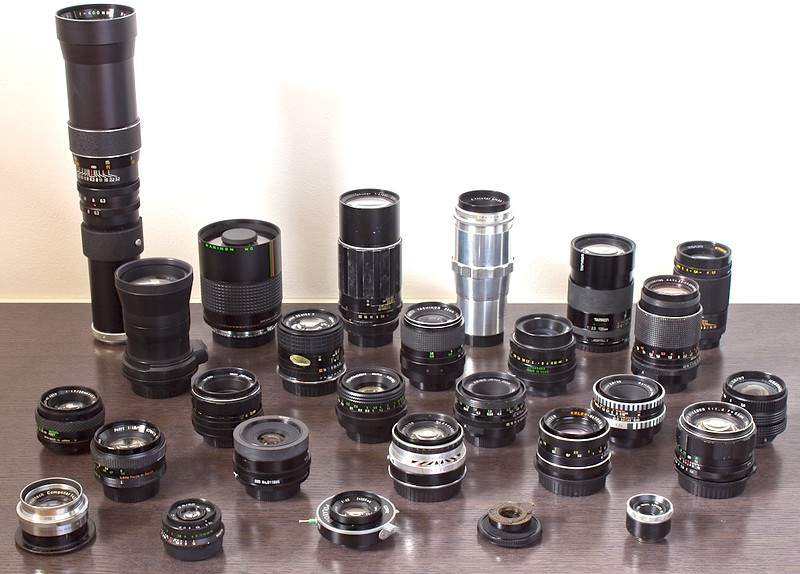
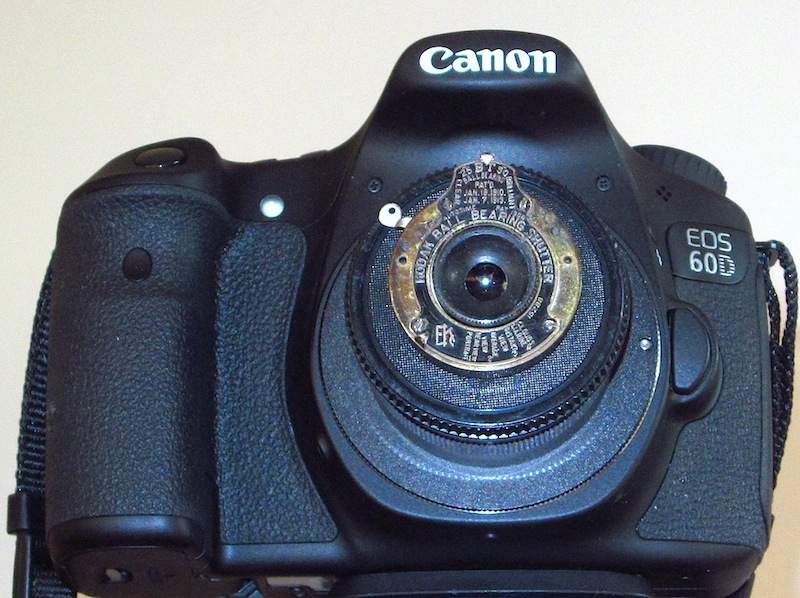
I have too a relatively small collection of old lenses (a subset is in the picture), nothing really expensive except a Leica Summicron. I like them for their beauty, however almost all can and have been adapted to work on my Canon 60D (e.g., the 100y old Kodak Vest Pocket lens) or on my Sony Nex6.
It turns out that there is a category of people that absolutely needs to have some way for loosing time (and money too, but this is secondary) :)
7434987870_e5f8b8ec51_c.jpg


7675310660_9e6938d4af_c.jpg
 
As for other hoarding disorders I also have a rather extensive collection of SLR cameras, film ones that is. I have a pile of some 20 cases each containing between 5 to 8, so about 120, not counting duplicates, all mayor brands, some very rare and expensive nowadays, mayor brand being Olympus of which I also have nearly all lenses. I also have some digitals but those are minor. This collection is easy to move as they are in cases already.

Wow I'm impressed.
back about 30 years, give or take a few, My wife and i used to do wedding photography on the side. she ran the darkroom and set up the shots and i was the camera man. We used all Olympus equipment. the FTL, OM-1,OM-2, etc Gave it all away over the years, except we still have a SLR digital. and about 3 lenses for it. been so long since i used it i don't even remember the model.
 
  • Like
Reactions: MirandM
I'm a builder who loves to design things... at one point, my project was to build a telescope using an olympus body for the eyepiece. that way i could photograph everything. I had a 6" lens (i don't remember the focal length)
and started to fabricate the tube, but i never got the precision good enough to be a useful telescope.

A few years later they started selling lenses long enough to use your camera as a telescope, and i lost interest.
 
Last edited:
Wow I'm impressed.
back about 30 years, give or take a few, My wife and i used to do wedding photography on the side. she ran the darkroom and set up the shots and i was the camera man. We used all Olympus equipment. the FTL, OM-1,OM-2, etc Gave it all away over the years, except we still have a SLR digital. and about 3 lenses for it. been so long since i used it i don't even remember the model.
That's my speciality, FTL, M1, OM's you name them I usually got one even the infamous OM3-Ti. I do repairs too, including lenses.
Now whenever you see any views on the news about a pharmaceutical laboratory, fix your eyes on the microscopes they use, 90% of those are still using Olympus. I've got a telescope, one of those that has motors and I've got the relevant converters to use my OM cameras on it. Never got enough time to make it work, but who knows?
 
I have too a relatively small collection of old lenses (a subset is in the picture), nothing really expensive except a Leica Summicron. I like them for their beauty, however almost all can and have been adapted to work on my Canon 60D (e.g., the 100y old Kodak Vest Pocket lens) or on my Sony Nex6.
It turns out that there is a category of people that absolutely needs to have some way for loosing time (and money too, but this is secondary) :)
View attachment 4462248

View attachment 4462249
I guess I belong to that group sort of... I have adapters for all mayor brand lenses to be use on my olympus cameras.
In 2002 I was forced to sell my late brother's OM2 and swore to recuperate it when I had the chance again. I did just that and a little more so it got a bit out of hand. Today I still keep an eye on the market but hardly ever buy something. Prices have gone up considerably and since I've got nearly everything...
 
So I just played a bit on my latest fakenbacker, That one has been standing here to see if the neck got a little more relief. It was dead straight and the strings were buzzing. I hadn't given it much attention the last few months. Now since I only have three basses here I picked it up. No good, still buzzing.
Released the truss rod tension completely, no dice. So what do you do with that?
Well one thing is get more tension on the strings. In my case not that easy since I play DGCF, so that is a lower tension on normal strings as it is... unless... you get a higher gauge! The strings on this bass were still standard, probably 45-100 or so. Went through my string box and found a nice pack of d'Addarios EXL160BT. 50-120, great for my purpose. So I mounted them... and guess what... gone buzz, yep, that was the solution. Have to wait several days to see how the neck adjusts, but they feel good.
 
I'm glad to say I had the right idea. After 24 hours the neck has indeed some relief, very close to what I want as I usually have a low action setup and at this point the bridge is just a bit too high for my liking.
It does play much better though. Will need a little more time to settle, but it's going the right way.
Sometimes it pays off to leave a problem as it is just to let time pass until you get a different angle on it and bamm you nail it.
 
I'm glad to say I had the right idea. After 24 hours the neck has indeed some relief, very close to what I want as I usually have a low action setup and at this point the bridge is just a bit too high for my liking.
It does play much better though. Will need a little more time to settle, but it's going the right way.
Sometimes it pays off to leave a problem as it is just to let time pass until you get a different angle on it and bamm you nail it.
Yeah, I usually give a neck 24 hours after loosening the TR. Check again, then wait a week before doing the setup.
 
  • Like
Reactions: RodRy and MirandM
Yeah, I'm at 11 and holding. Just have not had the GAS like I did for a few years. Still, if a nice 8 string Zon shows up...
:woot:
... and you happen to have a Zon wallet...

At this time my wallet looks like a flat E...
All basses are at my new home except for the Ric, two fakenbackers (my workhorse and the wait-for-relief one) and the no-fretbacker (which is still not terminated). Oh, and I think I saw a semi-acoustic 5 string the living room and the neck and body of the "el weirdo" project.
Need to move all other equipment, cabs, drums, 20.000 kms of cabling, the lot... That's gonna fun because I will need to mark all cables before removing them otherwise my whole setup will go haywire, not a good plan.
 
... and you happen to have a Zon wallet...

At this time my wallet looks like a flat E...
All basses are at my new home except for the Ric, two fakenbackers (my workhorse and the wait-for-relief one) and the no-fretbacker (which is still not terminated). Oh, and I think I saw a semi-acoustic 5 string the living room and the neck and body of the "el weirdo" project.
Need to move all other equipment, cabs, drums, 20.000 kms of cabling, the lot... That's gonna fun because I will need to mark all cables before removing them otherwise my whole setup will go haywire, not a good plan.
Yeah, at the moment, I could pay a fair price for a Zon Sonus 8 if one comes up. But not an unfair price...:eek:
 
Yeah, at the moment, I could pay a fair price for a Zon Sonus 8 if one comes up. But not an unfair price...:eek:
Problem with most of these remarkable instruments is that the price after several years goes sky rocketing.
Some 10 years back it went for around 1200-1500$ now I see price tags from 3000-3700$, ouch!
Which is kind alike my T-40, which goes a double the price I payed for it.
This is also why I don't sell any of my collection basses (not the ones I made). Back in 2002 I needed to sell nearly all I had then, with the exception of the T-20FL (thank god!) and I learned my lesson from that exercise, took me 6 years to get hold on a decent version of my Westone Rail Bass, which btw now goes at 3-4 times what I payed for it.
The Sonus 8 seems a very interesting bass, I'd love to try one, in DGCF of course, looks like you hand play a part of a piano... :woot:
Electronics are impressive as is the total build.
 
Last edited:
  • Like
Reactions: RodRy
Problem with most of these remarkable instruments is that the price after several years goes sky rocketing.
Some 10 years back it went for around 1200-1500$ now I see price tags from 3000-3700$, ouch!
Which is kind alike my T-40, which goes a double the price I payed for it.
This is also why I don't sell any of my collection basses (not the ones I made). Back in 2002 I needed to sell nearly all I had then, with the exception of the T-20FL (thank god!) and I learned my lesson from that exercise, took me 6 years to get hold on a decent version of my Westone Rail Bass, which btw now goes at 3-4 times what I payed for it.
The Sonus 8 seems a very interesting bass, I'd love to try one, in DGCF of course, looks like you hand play a part of a piano... :woot:
Electronics are impressive as is the total build.
Yes, I guess I still see $2k-$3K as reasonable prices for these. I have just about that much on hand in case one comes up. I do like the idea of tuning it lower to take real advantage of it being a bass, but I'm a little concerned what that would do to the playability with a carbon fiber neck.

Ah well, still dreaming at the moment...
:laugh:
 
  • Like
Reactions: MirandM
... I do like the idea of tuning it lower to take real advantage of it being a bass, but I'm a little concerned what that would do to the playability with a carbon fiber neck.
...
In what sense? Don't see any reason why this would change as long as you get the tension right. I can even see this as an advantage, a stiffer neck should go better with lower resonation.
Back when I was building speaker cabs, the rule was: the ticker the wood (and thus stiffer) the lower the resonation frequency, which meant a better low end (for closed cabs that is).
 
Last edited:
  • Like
Reactions: markwrob and RodRy
It is about what gives the best combination of sound and beauty. I have been working with several oils lately. They work best on darker woods, I have some Mahogany which i plan to finish with oil, and nothing but oil. I am thinking tongue oil for it. My specific question is about when using woods which have great sounds but not beautiful grain, What opaque finish would give the best look of classy, without looking mundane. I have ebony opaque stain, but is there something that would really look great, with a top of natural cherry or oak?

well i found an answer to my own question.

I have been practicing doing sunburst finishes, and i think i have the tobacco burst finish down to where it is what I can be proud of. Beautiful.
First time working with laquer finishes. but it is hard to match the beautiful gloss of it.

I also have been working on techniques for installing binding. but i will use it on different instruments.
currently my favorite use is .... no binding on the body, Binding all around the top.(including cutting the neck pocket oversized on the top and binding around the neck.) I am torn between binding the pickguard or leaving it natural.
BTW the best glue for binding is to liquify some of the binding material in acetone until it is pasty, then use it as a glue. I also have bee practicing binding tight corners by using separate pieces which just meet up, then brushing acetone on this joint till it disappears. need to be careful though too much acetone and it is ruined. otherwise use CA glue.
 
  • Like
Reactions: RodRy and MirandM
That's my speciality, FTL, M1, OM's you name them I usually got one even the infamous OM3-Ti. I do repairs too, including lenses.
Now whenever you see any views on the news about a pharmaceutical laboratory, fix your eyes on the microscopes they use, 90% of those are still using Olympus. I've got a telescope, one of those that has motors and I've got the relevant converters to use my OM cameras on it. Never got enough time to make it work, but who knows?

you never cease to make me jealous.:thumbsup:
 
  • Like
Reactions: RodRy and MirandM
So I just played a bit on my latest fakenbacker, That one has been standing here to see if the neck got a little more relief. It was dead straight and the strings were buzzing. I hadn't given it much attention the last few months. Now since I only have three basses here I picked it up. No good, still buzzing.
Released the truss rod tension completely, no dice. So what do you do with that?
Well one thing is get more tension on the strings. In my case not that easy since I play DGCF, so that is a lower tension on normal strings as it is... unless... you get a higher gauge! The strings on this bass were still standard, probably 45-100 or so. Went through my string box and found a nice pack of d'Addarios EXL160BT. 50-120, great for my purpose. So I mounted them... and guess what... gone buzz, yep, that was the solution. Have to wait several days to see how the neck adjusts, but they feel good.

I'm glad you finally found a solution. Next time you run into a similar situation try this...

If a guitar or bass buzzes everywhere with one set of strings and not with another the answer is the nut.
Buzzing all along the fretboard is a symptom of having the action too low at the nut. usually because the grooves are cut too deep.
different gauges of strings will fit differently into the nut grooves depending on how they were cut. a typical nut file makes grooves which are slightly narrow for some bass strings. one gauge string might lodge in the nut without bottoming completely, while another might be just small enough to fully bottom in the groove. When i file the nut grooves i use a depth gauge to make sure that the bottom of the groove is just a couple thousandths higher than the frets. and never cut them in a "v" shape! always make sure thee bottom shape is a "u".
Yes i know that they use "V" grooves at the bridge, but the bridge groove is not as critical to the action.
 
  • Like
Reactions: RodRy and MirandM
I'm glad you finally found a solution. Next time you run into a similar situation try this...

If a guitar or bass buzzes everywhere with one set of strings and not with another the answer is the nut.
Buzzing all along the fretboard is a symptom of having the action too low at the nut. usually because the grooves are cut too deep.
different gauges of strings will fit differently into the nut grooves depending on how they were cut. a typical nut file makes grooves which are slightly narrow for some bass strings. one gauge string might lodge in the nut without bottoming completely, while another might be just small enough to fully bottom in the groove. When i file the nut grooves i use a depth gauge to make sure that the bottom of the groove is just a couple thousandths higher than the frets. and never cut them in a "v" shape! always make sure thee bottom shape is a "u".
Yes i know that they use "V" grooves at the bridge, but the bridge groove is not as critical to the action.
You are partially correct. The situation you describe is assuming the neck relief is perfect (that is for low action a very slight relief), then you are correct. But if the neck is dead straight with a nut cut too deep it would give buzzing on the first 5 or 6 frets, and rather heavy. If the relief was to big, it wouldn't matter if the nut was a bit too deep as the neck would be overcurved. If it had a back bow, then forget about being able to play at all with a nut too deep, the strings would be laying on the first frets anyway like zero-frets.
Before doing any work on the nut, I always check the relief. And as a general rule I don't touch the nut unless I change gauges (you know me at DGCF using a bit higher gauge) or there's a clear too high action that is due to the nut not being deep enough. I had this case on one or two basses. Then there's also the difference between fretted and fretless where the nut can be deeper.

Your U technique is ok, but there's something about the V technique that does count. It avoids nut buzz. If you have a string like let's say a .100 guage and you put it into the U slot of a .120 gauge string you will end up with nut buzz as the string doesn't get fix between the two walls of the nut. With a V technique this is never possible. What I use is an intermediate, A slight V shaped slot but with around U like bottom. I've had one bass with nut buzz and it's terrible, you can't do a thing about it but change the nut.
 
Last edited:
  • Like
Reactions: RodRy
I've had one bass with nut buzz and it's terrible, you can't do a thing about it but change the nut.

me too. That's how I learned the problems with nut buzz. I am learning more about your abilities each time we have one of these discussions. And i learn a lot that i hadn't thought of from reading your postings. We may soon have to kick you out of your own club for being far beyond mediocre.
And yes, if filing nut groves into a U rather than a V you definitely need to be mindful of the string size. too big is indeed worse than too small. I filing into a "v" i would say make it a wide shallow "V" rather than a deep narrow one. Also the grooves in the nut and the heights of the bridge slots need to match the curve of the fretboard. It is common for new builders or even players who set up their own instruments to have the heights at the bridge and nut the same for all strings.

I now make all my own nuts. Even when i buy a neck rather than fabricate it, the nut is almost always plastic. so first thing always i do is remove the nut, and cut my own out of natural bone. then i go over every fret with a fret scale and straightedge to make sure the frets are perfectly consistent. I even check the binding. In just the last year, I started to inspect every part of a neck as carefully as if i built it. one brand new neck didn't seem quite right to me, so i removed the fretboard and added two carbon stiffing rods, one on either side of the truss rod (each in their own slot cut to be a tight fit). then reattached the fret board.
Why pay such close attention? because when i started to learn to do inlays, i had to remove the frets so that i could sand the contours properly, then install new frets. In taking one apart i found all sorts of problems that could exist and never be found until they manifested a problem, maybe years later. A year ago this wouldn't matter to me because the necks I bought were better than I could make anyway, not true anymore. Although i did make a lot of firewood in the shape of bass necks in getting there.