• TalkBass has been independent since 1998. Add your voice.
    Create a free account to reply to discussions, view embedded media, and browse with fewer display ads.
    Join freeLog in
    Want zero display ads or expanded classifieds tools? Compare plans.

The Mediocre Builders Club

me too. That's how I learned the problems with nut buzz. I am learning more about your abilities each time we have one of these discussions. And i learn a lot that i hadn't thought of from reading your postings. We may soon have to kick you out of your own club for being far beyond mediocre.
And yes, if filing nut groves into a U rather than a V you definitely need to be mindful of the string size. too big is indeed worse than too small. I filing into a "v" i would say make it a wide shallow "V" rather than a deep narrow one. Also the grooves in the nut and the heights of the bridge slots need to match the curve of the fretboard. It is common for new builders or even players who set up their own instruments to have the heights at the bridge and nut the same for all strings.

I now make all my own nuts. Even when i buy a neck rather than fabricate it, the nut is almost always plastic. so first thing always i do is remove the nut, and cut my own out of natural bone. then i go over every fret with a fret scale and straightedge to make sure the frets are perfectly consistent. I even check the binding. In just the last year, I started to inspect every part of a neck as carefully as if i built it. one brand new neck didn't seem quite right to me, so i removed the fretboard and added two carbon stiffing rods, one on either side of the truss rod (each in their own slot cut to be a tight fit). then reattached the fret board.
Why pay such close attention? because when i started to learn to do inlays, i had to remove the frets so that i could sand the contours properly, then install new frets. In taking one apart i found all sorts of problems that could exist and never be found until they manifested a problem, maybe years later. A year ago this wouldn't matter to me because the necks I bought were better than I could make anyway, not true anymore. Although i did make a lot of firewood in the shape of bass necks in getting there.
Don't worry, your knowledge of necks is far beyond mine, so maybe we should kick you out? JK.
I know my fair part of setting things up, many years of experience and making basses myself is obviously an advantage. Also the fact that I play DGCF always, plays its part in changing certain parts of the bass to have it correctly setup. It still is a biblical study though.
 
  • Like
Reactions: RodRy
I just found the most beautiful wood i have ever seen.
I was looking for a substitute for mahogany and found an African rainforest wood called sapele.
I thought it looked good so i ordered some in 6/4 size center cut lumber.
That was months ago. It just arrived today. O M G.
The pictures on the lumber sites don't do it justice. the interlocking grain patterns are not only beautiful.
they have an iridescent quality to them i have never seen in raw lumber before.
I am going to try to capture it in a picture or two, but it might not show the effect.
I picture making a body from two 6"boards of sapele with a super clear natural white oak between.

Oh, and i got a 16"scroll saw for Christmas.... It is going to save me a lot of guitar-shaped firewood. even the delicate scroll work to make wooden pick guards is no longer a challenge.

time to see if my pictures can do justice to the Sapele lumber.

sapele 2 (1).JPG

sapele 2 (2).JPG


You can see a touch of the iridescence in the bottom right of the second picture, but it is much more beautiful to look at live.:)
I think this will make some beautiful guitar bodies. :bassist:But there is one drawback...
Sapele is notoriously hard to work because the different grain stripes are of different densities.
that can lead to severe "Tear out" when working it.
Ut oh, I am making myself nervous now.:laugh:
 

Attachments

  • 20210102_134937.jpg
    20210102_134937.jpg
    1,002 KB · Views: 30
I just found the most beautiful wood i have ever seen.
I was looking for a substitute for mahogany and found an African rainforest wood called sapele.
I thought it looked good so i ordered some in 6/4 size center cut lumber.
That was months ago. It just arrived today. O M G.
The pictures on the lumber sites don't do it justice. the interlocking grain patterns are not only beautiful.
they have an iridescent quality to them i have never seen in raw lumber before.
I am going to try to capture it in a picture or two, but it might not show the effect.
I picture making a body from two 6"boards of sapele with a super clear natural white oak between.

Oh, and i got a 16"scroll saw for Christmas.... It is going to save me a lot of guitar-shaped firewood. even the delicate scroll work to make wooden pick guards is no longer a challenge.

time to see if my pictures can do justice to the Sapele lumber.

View attachment 4519042
View attachment 4519043

You can see a touch of the iridescence in the bottom right of the second picture, but it is much more beautiful to look at live.:)
I think this will make some beautiful guitar bodies. :bassist:But there is one drawback...
Sapele is notoriously hard to work because the different grain stripes are of different densities.
that can lead to severe "Tear out" when working it.
Ut oh, I am making myself nervous now.:laugh:

That is some lovely timber which will polish up beautifully!

If you would appreciate a bit of obvious advice from a former cabinetmaker (that you likely already know), for timbers that suffer tear out a lot, make sure all your tools are literally razor sharp, and work slowly. This will minimise the tearing.
 
question:
I started to build a bass body out of the sapele i just got and some white oak.
I tried a single coat of tung oil on the scrap area while waiting for the glue to dry completely.
If i were to finish the guitar this way i would use probably 6 coats of tung oil. but the first coat gives an idea of how it will affect the wood.
The question is whether to finish with the oil or go with a polyurethane finish.
What do you think?
sapele with oak.JPG
 
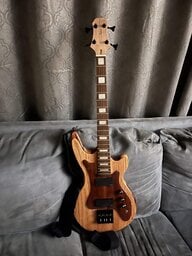
A water-based poly would be super clear and wouldn't change the color, if that is what you want. On this body, I threw in just a touch of tanstint honey amber

View attachment 4521263

That is a beautiful Rick inspired piece.
Please tell me you are going to make the covers for the pots, battery and through bridge out of wood.
At the custom shop i work with, everything is wood, no plastic covers are used anywhere. (unless requested by customers) That is why I had to master making wooden pick guards out of 1/8" thick hardwoods. (No plywood).

I even go to the extreme of using external power supplies for active pickups, so that there is no battery cavity.
check out the EMG ES-918. (under parts on the EMG pickup website) it uses a stereo cable to connect to the bass, with a standard mono cable to the pedals and amp. the second circuit on the stereo cable carries the power from batteries inside the ES-918 to the bass electronics.

I am looking for custom strap plugs and a holster (leather?) of some kind to hang the power supplies from a bass. Until then...
 
Last edited:
question:
I started to build a bass body out of the sapele i just got and some white oak.
I tried a single coat of tung oil on the scrap area while waiting for the glue to dry completely.
If i were to finish the guitar this way i would use probably 6 coats of tung oil. but the first coat gives an idea of how it will affect the wood.
The question is whether to finish with the oil or go with a polyurethane finish.
What do you think?
View attachment 4521254
go with the tung oil. Why? one simple reason: damages to pu finish are very much more visible and harder to fix. Damages to tung oil are hardly visible, and easy to fix, just apply the oil to the damaged area.
My T-20FL has an oiled finish, any dent is hardly visible and easily fixable, you can even file or sand down the wood a bit and apply new oil, nobody will notice, try doing that with a pu finish. And just for the record, I'm a big fan of pu finish, but tung-oil with the right wood is just a combination you can't beat.
 
Last edited:
First the Tung oil issue, I used it on my kit bass. It turned the crappy piece of Basswood into something quite nice. I used 4-5 coats and used 0000 steel wool in between coats.To the guy that has that lovely Sapele, be careful, i have heard that that wood can be quite toxic when worked.
Not the wood, it's the dust when sanding that can be toxic. Use good ventilation and wear a mask.
I tend to sand first thing in the morning outside my house because of the higher humidity. The humidity avoids the dust going higher in the air (up to your nose). It's also a great moment for doing any spray paint job, for exactly the same reason, dust keeping low will not ruin the paint job.
 
  • Like
Reactions: RodRy
thanks for the heads up. I treat all wood dust as toxic, so i wear a mask most of the time. It seems this wood may require a little extra care. i bought it finished 4 sides to minimize the sanding requirements. what I am most worried about is the shavings from routing.

Good plan. I did my cabinetmaking apprenticeship with my Dad, and they didn't have quite so much Oc Health & Safety (or the Dept. of Cotton Wool, as tradies whinge about it) for much of his career, and his lungs are shot from the dust. Even the non-toxic dusts still don't belong in the lungs.
 
...Even the non-toxic dusts still don't belong in the lungs.
My father was the managing director of a pastry factory. He got an allergy from the flour dust. Seen him sneeze continuously for more then 45 minutes, and not just some light sneeze, nope sounded more like thunder.... No fun I tell you.
He had to be treated with calcium injections in Switzerland to lower the sensitivity. Glad today we know more about prevention.
 
Last edited: