TB management, please make this a sticky!
The attachment is Sting in this month's (well, Apr 2017 arrived today) Bass Player mag. While it is "only" Sting and only Rock and Roll rather than a conservatory professor, it's importance should not be neglected. This is not a shot at theory or education, I am eyeballs deep in each. Also, I daresay that even if educated classical musicians supposedly can't improvise (a sentiment I've read here over and over), I'd bet my left nut that almost all of the ones getting paid have great ears in addition to superior mechanical and dot-reading skills.
As someone who was not informed of the importance of "having/developing an ear" and who consequently paid the price in: 1) spending excessive time learning songs mechanically (even though using only my ear to learn songs); 2) forgetting songs and; 3) not readily able to recognize that there are many similarities in so many songs. A good ear fixes all of that. Yes, learn theory and merchanics, too, but an ear wins.
Think about this daunting illustration of the difference in learning and remembering songs- It's easier to just be able to hear 12 pitches in your head than it is to remember 18,900 mechanical movements. What's 18,900? That's simply quarter notes at 120 for 45 songs (3, 1 hrs sets (with a little break each hour)). That's a lot of stuff to remember, let alone learn and memorize! But wait, now say that you want to play some music with 8th notes and 16th notes... it gets ugly real fast. Even if you're grooving and leaving space, it's huge numbers!
Yes, my math WAY over-dramatizes the difference between ear and mechanical and it excludes the time it takes to develop one's ear but say I'm off by a whopping factor of 10. You're still looking at 12 vs 1,890. That's just for one gig of boring quarter notes, though.
How long will you remember the order of those mechanical movements (hint: not long unless you keep playing the same songs over and over- real fun). How well will you associate any bunch of those mechanical movements between one song and any number of others? Poorly at best.
If you want to be simply a bar band bassist playing classic rock with your buddies, disregard this. Certainly don't bother knocking it if you're one of the grouch squad in said bar bands! I'm talking to the younger guys/girls who want to maximize their potential.
If you want to be in demand and learn stuff fast enough to be in demand, ear is where it's at unless you are just looking for reading gigs (but, I bet those guys have good ears, too). There will be people here who deny my assertions but disregard them. They are either limited and don't care to acknowledge that which they don't understand OR they actually have a better ear than they realize. Many guys can play well but not explain why. It's called an ear. Best of luck and hard work to you!
Okay, on with Sting:
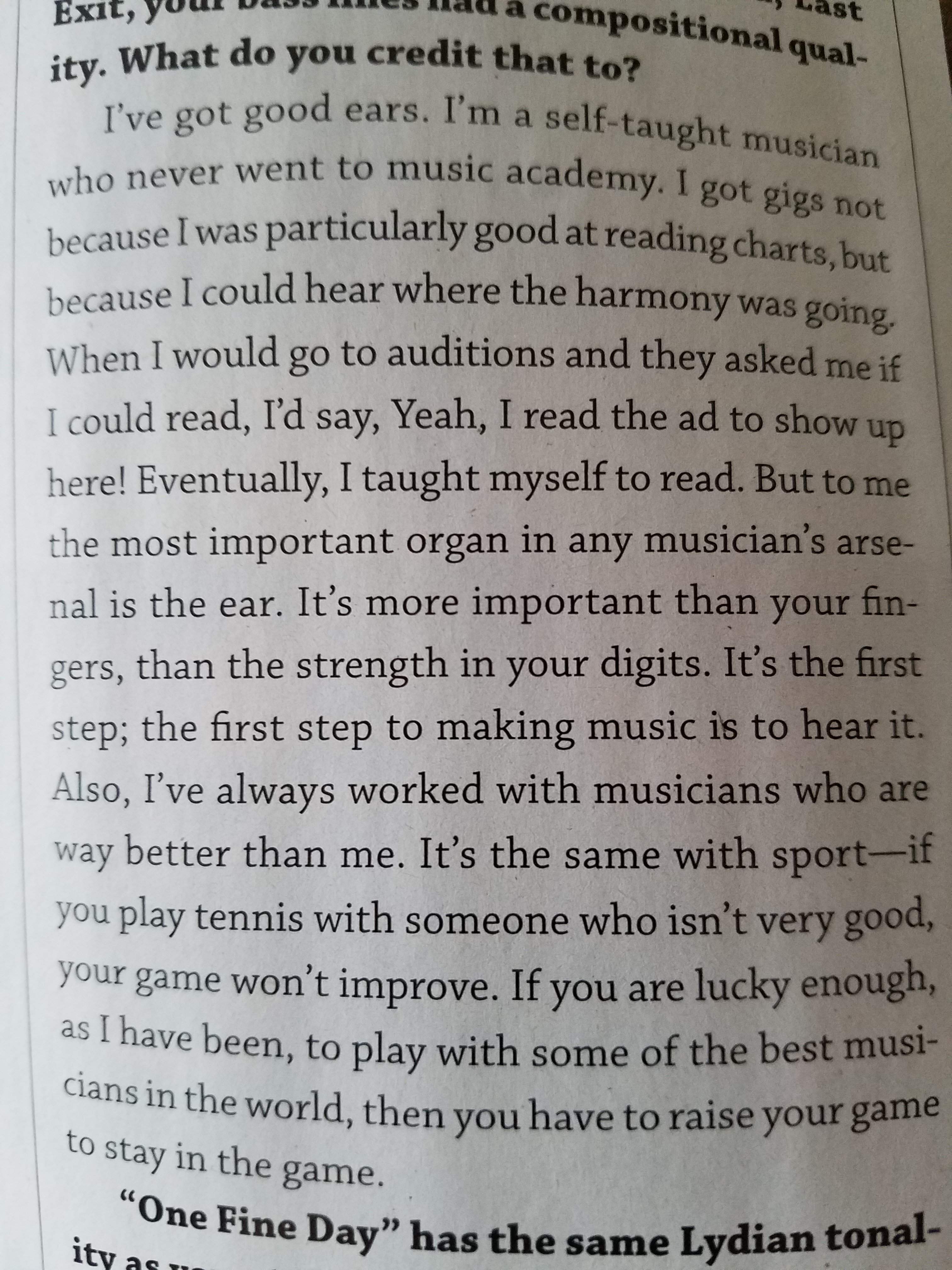
The attachment is Sting in this month's (well, Apr 2017 arrived today) Bass Player mag. While it is "only" Sting and only Rock and Roll rather than a conservatory professor, it's importance should not be neglected. This is not a shot at theory or education, I am eyeballs deep in each. Also, I daresay that even if educated classical musicians supposedly can't improvise (a sentiment I've read here over and over), I'd bet my left nut that almost all of the ones getting paid have great ears in addition to superior mechanical and dot-reading skills.
As someone who was not informed of the importance of "having/developing an ear" and who consequently paid the price in: 1) spending excessive time learning songs mechanically (even though using only my ear to learn songs); 2) forgetting songs and; 3) not readily able to recognize that there are many similarities in so many songs. A good ear fixes all of that. Yes, learn theory and merchanics, too, but an ear wins.
Think about this daunting illustration of the difference in learning and remembering songs- It's easier to just be able to hear 12 pitches in your head than it is to remember 18,900 mechanical movements. What's 18,900? That's simply quarter notes at 120 for 45 songs (3, 1 hrs sets (with a little break each hour)). That's a lot of stuff to remember, let alone learn and memorize! But wait, now say that you want to play some music with 8th notes and 16th notes... it gets ugly real fast. Even if you're grooving and leaving space, it's huge numbers!
Yes, my math WAY over-dramatizes the difference between ear and mechanical and it excludes the time it takes to develop one's ear but say I'm off by a whopping factor of 10. You're still looking at 12 vs 1,890. That's just for one gig of boring quarter notes, though.
How long will you remember the order of those mechanical movements (hint: not long unless you keep playing the same songs over and over- real fun). How well will you associate any bunch of those mechanical movements between one song and any number of others? Poorly at best.
If you want to be simply a bar band bassist playing classic rock with your buddies, disregard this. Certainly don't bother knocking it if you're one of the grouch squad in said bar bands! I'm talking to the younger guys/girls who want to maximize their potential.
If you want to be in demand and learn stuff fast enough to be in demand, ear is where it's at unless you are just looking for reading gigs (but, I bet those guys have good ears, too). There will be people here who deny my assertions but disregard them. They are either limited and don't care to acknowledge that which they don't understand OR they actually have a better ear than they realize. Many guys can play well but not explain why. It's called an ear. Best of luck and hard work to you!
Okay, on with Sting: