
The guys in my party band are all getting older, including me. The lead vocalist occasionally wants to take a song down a step or so. My 5-er is indispensable to retaining the character and linear integrity of the bass lines on those songs.

Enjoy the benefits of a premium membership!
Upgrade Account
-
TalkBass has been independent since 1998. Add your voice.
Create a free account to reply to discussions, view embedded media, and browse with fewer display ads.
Join free Log in
Want zero display ads or expanded classifieds tools? Compare plans.
You are using an out of date browser. It may not display this or other websites correctly.
You should upgrade or use an alternative browser.
You should upgrade or use an alternative browser.
The occasional low note vs. gathering dust on an extra string
- Thread starter g-dude
- Start date
- Status
- Not open for further replies.
More options
Who Replied?

I love the classic sound of 4 string basses.To my ear having more wood on the neck on fivers creates a richer more complex sound that is very nice,but to me it feels hard to dial back in case i want to hear a more classic type of sound.
I also prefer the sound of my E string tuned down to a D or even a C, than the sound of those notes on a B string.
I guess the reason why,must be because when you play a D on the B string you are getting a lower note on a much thicker string but with actually shorter vibrating length. And even though that is the nature of the instrument,as to how it's tuned, at that point my ear starts to hear a huge gap in texture and timber between the B all the way up to the G string. It kind of feels like the balance is off...
Yeah, you're going to have a different set of harmonics either way, so for sure it would sound different. Whether that difference is perceptible through a board or a PA is irrelevant if *you* can hear it, and you dig it one way and not the other.

10 years ago i bought a 5 to learn it, my issue was the narrow string spacing at the nut. After 25 years on a wider spaced 4, my LH muscle memory was not adjusting, so when I had my custom Torzal built, we used 4 string spacing, and just added another string.
That said, my band plays a lot of songs in Dm or G, and that is where the 5 string comes in handy, it opens the lower side of the Dm scale up for me, and allows me to "come up" to the G or A on songs in those keys
That said, my band plays a lot of songs in Dm or G, and that is where the 5 string comes in handy, it opens the lower side of the Dm scale up for me, and allows me to "come up" to the G or A on songs in those keys

When I played a 5, I spent a lot of time in position with my middle or ring finger on the fifth fret as "home-base" - so your core technique is kind of just playing a short-scale 5-string in D. I never really liked 5 strings as opposed to 4, even after playing one for over a decade - so now I have a short-scale 4-string tuned in fifths CGDA, and that kind of feels perfect to me right now.
A few low notes doesn't really matter in the grand scheme of things, your preference and comfort while playing matters leagues more. Even a fair number of metal and R&B guys play 4 strings, they might just have a second bass low strung for when they need it.
A few low notes doesn't really matter in the grand scheme of things, your preference and comfort while playing matters leagues more. Even a fair number of metal and R&B guys play 4 strings, they might just have a second bass low strung for when they need it.

The guys in my party band are all getting older, including me. The lead vocalist occasionally wants to take a song down a step or so. My 5-er is indispensable to retaining the character and linear integrity of the bass lines on those songs.
Lol - I know what you mean.
There are some songs where I’ll put the bassline up a full minor 7th (i.e. move the Bassline from the lowest two strings to the highest two) to more easily deal with a whole step key change. One song, they wanted to drop two whole steps, and I had to jump in and tell them that we might as well drop it downward a full fourth.
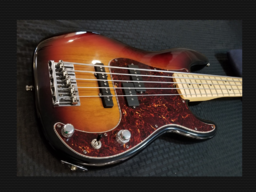
Late to the game; didn't read all the posts. I don't understand the need for justification. Play what you want, and make it work for you.
You could as well say, "Why play the bass, when you could be playing harmonica?" Play what you want to play.
You could as well say, "Why play the bass, when you could be playing harmonica?" Play what you want to play.

- Dec 21, 2007
- 15,222
- 45,014
- Disclosures
- Lark in the Morning Instructional Videos; Audix Microphones
3 reminders from your friendly neighborhood Moderator.
1. If someone is being generally rude, the "Ignore" button is your friend.
2. If someone is being particularly rude or trolling, you may report them. We don't read every thread so we may not notice otherwise.
3. There's really no reason to be rude. If you're about to post something rude - don't.
1. If someone is being generally rude, the "Ignore" button is your friend.
2. If someone is being particularly rude or trolling, you may report them. We don't read every thread so we may not notice otherwise.
3. There's really no reason to be rude. If you're about to post something rude - don't.

We have fancy dishes in the cabinet, but we don't always use them. They're nice to have when the occasion presents itself.
Lol - I know what you mean.
There are some songs where I’ll put the bassline up a full minor 7th (i.e. move the Bassline from the lowest two strings to the highest two) to more easily deal with a whole step key change. One song, they wanted to drop two whole steps, and I had to jump in and tell them that we might as well drop it downward a full fourth.
And if you're like me, waiting on everybody else to learn the transposed chords, you get so frustrated by the end the rehearsal, you're ready to drop a full fifth!

There are overtones present in an upright that acoustically give fullness bassiness like the low B.Here’s the ironic part - I’ve only really bothered to read bass clef for the bass guitar since starting playing the upright.
It’s actually sort of funny how much more profound a bowed E sounds on an upright bass compared to the E or even a B on an electric bass guitar. Maybe it’s because of the anticipation of the F, followed by E, and repeated over and over again at an increasing tempo until you get bored of playing the theme from Jaws.

I assumed that every bass player comes to avoid their use as they progress on the instrument.
Oh, the opposite.
The longer I've played bass, the more I've noticed the importance of playing open strings whenever it does not compromise fretting-hand efficiency.
I find this especially true the more I play along with recordings where the bassists play simple-sounding parts with sophistication.
I daresay that playing open-string notes whenever it does not compromise fretting-hand efficiency indicates advancement as a bassist.
Try it and see what it does for your playing.

No one... not one single one of us, knows what is right for you. Follow your heart and make music your way, the music is the validation, not the string count.
Same goes for "x" - piece drummers...
Same goes for "x" - piece drummers...

In these "Is a five necessary?" posts I always feel like something very important is missing from the mix in favor of fives. >>> Anyone else here play gigs that require reading off a written part? I mention this only for young players who aspire to these types of gigs. The rest of you play whatever the heck ya love if it isn't critical what you are playing but.... for those who are looking to play as freelancers:
Fivers are pretty much the de-facto standard in most of those reading type situations. They are increasingly being written for in Theater, Gospel, Star singers who travel without a band and carry a drummer and a conductor such as Bernadette peters and so on. There are plenty of entertainers who have books and hire the local talent to play their tunes and those parts may include notes below an E. Since a gig like that has the expectation that you play the part as written >> When ya need one, ya need one. Usually those low notes are used very intentionally to thicken the mix or provide strong "Stinger" at the end of the tune but they also show up elsewhere.
Those of you who do these gigs know this already. It is the young players I mention this for whenever it comes up. Can anyone else back me up on this?
Fivers are pretty much the de-facto standard in most of those reading type situations. They are increasingly being written for in Theater, Gospel, Star singers who travel without a band and carry a drummer and a conductor such as Bernadette peters and so on. There are plenty of entertainers who have books and hire the local talent to play their tunes and those parts may include notes below an E. Since a gig like that has the expectation that you play the part as written >> When ya need one, ya need one. Usually those low notes are used very intentionally to thicken the mix or provide strong "Stinger" at the end of the tune but they also show up elsewhere.
Those of you who do these gigs know this already. It is the young players I mention this for whenever it comes up. Can anyone else back me up on this?
Last edited:

Why do many buy a 5 or 6 string bass when they have no current or future use for the extended range?
Why do some make decisions with no purpose?
Do you drive a car with no destination?
Why do some make decisions with no purpose?
Do you drive a car with no destination?
Last edited:

My experience with a 5 string is that unless your amp/PA can faithfully reproduce those 5 extra low notes below E, it's a waste .... and I love my 5 string. My 2 cents ...
I don't disagree with that. There are far more great five strings around than there are great amps that can faithfully reproduce the true tone of the lowest notes on the B string. However, if you get a rig that can do that, the effect can be tremendous (and it may just be a case of turning up the volume, as I've found some amps that give an unimpressive low B sound at low volume perk up when you turn them up, for obvious reasons).
I often find that a really useful technique is to use the notes on the B string to support a note an octave above. Sometimes when ending a phrase, where appropriate, I'll pluck a note on the B string and the octave above to really put a stamp on it as the fundamental of the B string mixes with the upper harmonic content of the higher note. On the other hand, sometimes just hitting an unadorned note on the B string can sound utterly fantastic and totally trouser flapping. I do this when I play 'Coyote' by Joni Mitchell and in doing so, I put a little bit of a spin on the song in the way that Jaco couldn't, or didn't! What I do on occasion is, when the chord progression comes back to the Cb, I play the last note in the phrase on the Cb on the B string. In the relatively sparse, dry sounding mix of that song it sounds absolutely huge, like a grand piano!
My answer would be that IF you think of it as a 'bass with an extra string', you've answered the question already.
It's a five string bass and that's how you think of it and how you play it. Otherwise it's a total waste of money to shell out for a five-string to 'pick up the occasional below-E note and an extra string', and you'll be sorry you strayed out of your comfort zone on a four. If that's what works for you, stay with it.
It's a five string bass and that's how you think of it and how you play it. Otherwise it's a total waste of money to shell out for a five-string to 'pick up the occasional below-E note and an extra string', and you'll be sorry you strayed out of your comfort zone on a four. If that's what works for you, stay with it.

i get your question (i'd go for the "95%") but in practice = making 4 strings work 100% of the time is easy enough to make that a 'no-brainer' for a lot of players.But here’s the real question: if you’re dropping some serious coin on a higher end bass, do you go ahead and spend the extra $100 for an extra string that you might occasionally use, or do you stick with what will work for 95% of what you play
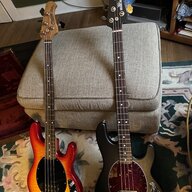
Got question about set of 5 strings,thinking I could use just the EADG strings,I bought them because I like the Dean Markley Blue Steels,but finding out the felt on the strings,are located in the nut,so shouldn't be able to use them? Thanks!The problem quite a few five players have, is that even if they are not using it, they still have to mute it. That, and the fact that it's in the way at the same time.

I love the classic sound of 4 string basses.
This is often overlooked...
To me, many fiver versions of the exact 4 bangers do not sound the same if played as a 4 string with a long thumb rest.
Plus a low E just sounds so much beefier on the B. More metal.
I dunno... 35" open E's sound very different to me than 34", even if not dropping to the fifth fret B. Sometimes it's better, sometimes not.
- Status
- Not open for further replies.


