• TalkBass has been independent since 1998. Add your voice.
    Create a free account to reply to discussions, view embedded media, and browse with fewer display ads.
    Join freeLog in
    Want zero display ads or expanded classifieds tools? Compare plans.

The Official MTD USA Thread

Just curious what is considered the ultimate specs for an mtd to cover a wide genre of music (rock, r&b, gospel, jazz). The only drawback of my spec is it's hard to mellow out all that grind for smother types of needs. Are the different specs more similar than different? Weight really have that big of tonal impact? If so what is difference?
 
Just curious what is considered the ultimate specs for an mtd to cover a wide genre of music (rock, r&b, gospel, jazz). The only drawback of my spec is it's hard to mellow out all that grind for smother types of needs. Are the different specs more similar than different? Weight really have that big of tonal impact? If so what is difference?

Each 535 (even basses with the same wood combo) is going to sound a little different. I've owned six in total (which pales by comparison to some of the folks who contribute to this thread!) and have gigged them all in various settings. My first 535 was an ash/maple/wenge/wenge combo and, while it does have that typical wenge compressed punch/slightly darker "tint" to the speaking voice of the instrument, it is remarkably versatile. My favourite in the versatility department, however has been my alder/maple/maple/rosewood 535. It is more "open" sounding than the wenge/wenge and doesn't have as much grind in the upper mids and treble but it is just as punchy and slaps like a dream. I owned an ash/walnut/ash/maple 535 for a while and, while it sounded great in certain contexts, I found that it didn't sit where I wanted it to in a band context. I had Mike switch out the ash neck thinking that might have been the issue but I had the same "problem" with the maple/maple replacement neck. I've since come to the conclusion that I'm much less a "maple fretboard guy" than I am a darker fingerboard wood guy.

As for weight having a big tonal impact, I think it's difficult to say. I've certainly not witnessed any correlation between weight and tone but that doesn't mean there isn't any.

Edit: sorry, just noticed your question about the specs and whether they are more similar than different. I think there is a basic "MTD sound" that each of Mike's basses will have. That means a very full range spectrum with a lot of clarity. But there are certain 535s that didn't work for me sonically, whereas the alder bass I mentioned above suits me to a T. If I'd judged MTDs solely based on my experiences with the maple fretboarded 535s mentioned above then I'd be missing out on a lot. I think each MTD is special, but you still have to find the one (or ones) that works best for you.
 
Knowing how much nature abhors a vacuum, my recent selling of two basses left an opening on my bass rack. This time I figured it was time for a modern sounding four string. Thinking back on past ownership, two of my favorite sounding basses were a 535 and a 635. The problem is they are neither four stings or have 34" scale. The only way to fix this problem was to order up a 434-24. A (long) call to Glenn at ABT and my problem was solved.

My favorite gigging bass has been a Lull P4 so I wanted something to complement it. Sonically, in order of priority: 1. Articulate - when I play a chord, I want each note to stand out. 2. Tight low end - no big, deep bottom; the ONLY time I touch eq on an amp is to turn down the low end. 3. Slight bump in the upper mids - when I push the bass, I want this to help it stand out.

Glenn and Mike's recipe for this tone was: makore body, sapele or maple top, maple neck and maple fretboard.

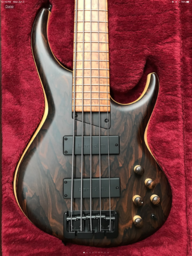
I took the (three and a half hour each way) drive to spend an hour looking at tops. My personal preference is for flame and quilt as opposed to burl and spalt. We looked at quilted sapele, quilted makore, flame/spalted ash and about ten quilted maple. In the end it came down to two of the maples with one of them having almost perfect bookmatching. The top I chose is in the pic below (and the pic really doesn't do the top justice; the color and quilt is even across the entire top).

The only other thing up in the air is the fingerboard. Mike is getting some more pistachio in. It'll be between that, ebony or maple. And also whether to keep it natural or have it tinted/burst.

If everything goes according to plan, I'll be making the drive again in December/January.


MTDTop.gif
 
I've been a huge fan of Mr. Tobias' work for about 20+ years but I'd be scared to death to drop that kind of $$$ to find out that my wood combination isn't what I had imagined...is there a process for narrowing down your choices?

You're always taking a chance when you order a bass "from scratch" - just as you're taking a chance buying any bass without having played it first. Honestly, I enjoy the entire ordering/waiting/contact with the builder experience so, even if I end up selling the bass down the line at a loss I don't feel too bad about it. But I can definitely understand those who would see things from a different perspective. So for such people buying used is probably the better option. Having said that there is a process for narrowing down your choices. The main thing is to talk to people who know the basses: MTD players, MTD dealers and Mike Tobias himself.

Or you could just go with the crowd who believes that wood has no discernible impact on tone... :p
 
Have you ever played on for an extended period of time? Mine is around 9.5lbs or so as well. With a good strap, i've never had any shoulder issues. Even on a long gig. They balance very well. I was a little concerned at first. But, it really works

Well, I find that under 8 is just too light, let alone the neck-dive issue. North 9 1/2, I get pretty irritated by the bass. So I'd say that 8 to 9 1/2 is where I like things best. a 10-lb bass would be a waste of money for me because it would never get played.
 
I've been a huge fan of Mr. Tobias' work for about 20+ years but I'd be scared to death to drop that kind of $$$ to find out that my wood combination isn't what I had imagined...is there a process for narrowing down your choices?

Buy used basses and try each wood combo you think you might like. What works for my ears may not work for your ears. It may take buying and selling 20 different basses to decide what wood you like. I own 4 of Mikes creations now, but have owned many more that just weren't "it" for me.
 
Knowing how much nature abhors a vacuum, my recent selling of two basses left an opening on my bass rack. This time I figured it was time for a modern sounding four string. Thinking back on past ownership, two of my favorite sounding basses were a 535 and a 635. The problem is they are neither four stings or have 34" scale. The only way to fix this problem was to order up a 434-24. A (long) call to Glenn at ABT and my problem was solved.

My favorite gigging bass has been a Lull P4 so I wanted something to complement it. Sonically, in order of priority: 1. Articulate - when I play a chord, I want each note to stand out. 2. Tight low end - no big, deep bottom; the ONLY time I touch eq on an amp is to turn down the low end. 3. Slight bump in the upper mids - when I push the bass, I want this to help it stand out.

Glenn and Mike's recipe for this tone was: makore body, sapele or maple top, maple neck and maple fretboard.

I took the (three and a half hour each way) drive to spend an hour looking at tops. My personal preference is for flame and quilt as opposed to burl and spalt. We looked at quilted sapele, quilted makore, flame/spalted ash and about ten quilted maple. In the end it came down to two of the maples with one of them having almost perfect bookmatching. The top I chose is in the pic below (and the pic really doesn't do the top justice; the color and quilt is even across the entire top).

The only other thing up in the air is the fingerboard. Mike is getting some more pistachio in. It'll be between that, ebony or maple. And also whether to keep it natural or have it tinted/burst.

If everything goes according to plan, I'll be making the drive again in December/January.


MTDTop.gif


I would leave it natural .........and ask Mike about Pau Ferro for the fingerboard
 
Thanks for the replies...I guess my biggest concern is being distracted by the beauty of the woods...there seem to be so many choices...and my lack of knowledge regarding the tone characteristics of each...

I owned a pre Gibson Tobias Classic 6 string in the mid 90's that was a quilted maple top over mahogany with a rosewood fretboard but sold it because I just couldn't get used to that high "C"

But there are some FINE examples of his basses on this site that I'd buy on looks alone and I guess that's my biggest concern :-)
 
But there are some FINE examples of his basses on this site that I'd buy on looks alone and I guess that's my biggest concern :-)
Well, the good news is that, no matter what kind of wood you choose, chances are good that Mike has some great looking specimens. Obviously, some wood types are more "stunning" than others but Mike has impeccable taste when it comes to selecting wood so you're dealing with the best of the best here (okay, one of the best of the best). ;) But if you have any questions about these basses fire away. Lots of experienced folks here...
 
or with a Van Dyke brown stain (if you decide on a dark fretboard).

I really like the color of your bass but I thought it was a trans black. And trans black (with maybe a little burst) is one of my color choices.

How does Van Dyke brown differ from trans black? Is it very close?

I disagree on using it only with a dark fretboard. I think it'd look great with a light maple board too.
 
I really like the color of your bass but I thought it was a trans black. And trans black (with maybe a little burst) is one of my color choices.

How does Van Dyke brown differ from trans black? Is it very close?

I disagree on using it only with a dark fretboard. I think it'd look great with a light maple board too.

I've had two MTDs with Van Dyke brown stains. The first was a more "chocolatey" brown while the more recent one is, indeed, darker. I think the colour of the brown depends partially on the tone of the wood itself, but it could also be a matter of colour concentration in the stain (you'd have to ask Mike about that). Anyway, you can compare them both here:

IMG_1310_2.gif


IMG_2215_2.gif
 
They had an amazing piece of quilted makore but I went with the maple. I wanted it different than the body.

Sorry, it just clicked that you're the one who posted the picture of the quilted maple top. My mistake. :rolleyes: The darker of the two 535s I posted photos of was originally supposed to be natural and I sometimes wonder whether I should have stuck with my original plan. Then again, I kind of like the all dark look, what with the wenge neck and fretboard...
 
Heard Mike is behind by 2-3 months! Business is good.... :)

Hope he can still finish my orders on time, I'll be having one coming this week. A customer of mine's Alder-Redwood, Maple-Honduran Rosewood. Mike said it's a 'wonderful bass', delivery schedule is on time too... One down, Four to go :D

Thanks...when the time comes, I'm sure that I'll be doing LOADS of research and questioning here...

The only thing I'm sure about at the moment is 24 frets and a 35" scale

Maybe I can help a little, since I've owned a few, and just last month I encountered the same question from a customer, a church that I played for. They like my MTD's sound and they want to buy one, I contacted Mike to ask for his advice, as this is going to be a property of a Church, not just someone's personal Bass, so the Bass must be versatile and it MUST be liked by various Players that will play with it (including myself), and price wise, it cannot be too expensive (as least option possible)

After a few emails, I decided to go with Alder-Poplar Burl Top, Maple-Indian Rosewood board, Mike said that the Bass will be very 'round', warm, punchy,has 'traditional' vibe, while having the MTD clarity and frequency response. The spec is pretty basic, additional charge is only for the Poplar top.

Anyways, the other alternatives Mike gave me was:
1. Ash body, with or without top, Maple neck-Indian Rosewood, this will have more hi-mids compared to the option I took.

2. Makore Body-exotic top, Maple Neck-Indian Rosewood, this is also round and punchy, but less 'traditional' sounding than Alder.

3. Black Limba Body, no top, with Wenge-Wenge neck, this will give the naturally compressed tone, but still very punchy and versatile.

4. The 'Norm Stockton' spec; Tulipwood-Myrtle, wenge-wenge neck, just hear Norm, and that's the sound.

5. The most expensive one, but you can't go wrong with this one, just plain right, the Andrew Gouche Signature.

So if you're planning to buy/make a new one, and afraid that you might ended up with one that doesn't suit you or too different sounding form your 'average' bass sound, those ideas works best, Mike always have the strongest confident to say that those combos will sound good, compared to other combos that he refers as the 'Customer's option'